


Coulomb
Members+
-
Joined
-
Last visited
Everything posted by Coulomb
-
No. The Axperts are all "off-grid" (in Voltronic Power terminology), basically a stand-alone inverter, solar charger, and changeover switch in one box. I'm not a fan of paralleling inverters like this, but if you try, my understanding is that the stand alone inverter should be larger (in real power), preferably twice as big (but some would argue that just a little bigger is ok). Even then, you need some luck, because it depends in detail how the grid tie inverter checks for the presence of the mains, and it has to get the answer wrong for the paralleling to work.
-
Ah. On those sorts of inverters, the neutral is the centre tap, not one of the lives. [ Edit: and you want one of the "lives" to become a neutral for normal 240 V usage. ] Strange that they don't leave the centre tap isolated from the battery negative. That's what I was missing, then. Thanks.
-
That's the second time I've heard that today. How on earth 🤮 does connecting earth to neutral out blow them up?
-
The time the fan is running is mainly determined by the firmware (edit: the external heat-sinks have little to do with it). They've changed the fan control a lot over the years. Quite early ones were terrible: running to jet speed at the slightest loads. About the quietest one was I believe 72.70. 73.00 now runs the fans at a minimum of 30% (barely audible, but in a lounge room you might not like it), and they run more aggressively during the day. What firmware are you running now?
-
This service manual is pretty good, even though almost 6 years old now. https://powerforum.co.za/files/file/30-axpert-mks-1-3kva-service-manual-20130611pdf/ With your experience, you may well be able to fix this one.
-
Sorry to say, but that label doesn't look genuine: Should be 14 digit serial number, starting with 9293 for a 5 kVA model, and as @Chris Louw says above, the date code should be YYMM (yours appears to be YYYYMM) Use of the ¢ (cent symbol) instead of the ϕ (Greek letter phi symbol) Label is too close to the mounting screw, and there is no small date sticker over the nearest cover screw. The screws should be black, not silver. None of this is totally conclusive, but it doesn't look good.
-
When I wrote that, I assumed that the estimation happened in the inverter's firmware. But in fact, the inverter doesn't report its AC input power at all, so this inferring must be happening in ICC. I think that your clone may be acting differently to what ICC expects. Typically, AC input power would be calculated as AC output power (which is measured and reported), plus estimated charging power, if the inverter appears to be charging from utility. The inverter reports total charging output current (DC amps) and PV output charging current (DC amps), so AC charging output current can be inferred as (total_current - PV_current). Maybe the total current is reporting as zero, or too low, allowing a negative result. You could cycle through the measurements on your LC Display with the buttons, and perhaps figure out what is going wrong. I wonder if they patched the patched firmware 🤔, or the hardware doesn't work quite the same.
-
Since 51.8 V is the voltage where balancing starts, you might want a smidge more than 51.8 V (say 52.0 V) for the absorb voltage. Just so your're sure that balancing happens most days. On a totally cloudless day, an Axpert could exit the absorb stage a few tents of a volt under the setting. Even though most days it will overshoot, you can't rely on that 🙃
-
Those are the latest factory firmware versions for 5 kW (PF1) machines without the 64 V capability. Unfortunately, there is no patched firmware for these, to fix the problems that @Padwan has mentioned. If you happened to buy a 64 V model instead, it would have come with firmware version 72.20, for which patched firmware is available.
-
I'm not sure, but I think that Axperts work the same way, so it's inexplicable (except maybe they didn't think of a need for it). But perhaps they sync to their own AC inputs instead of ±120° from R phase (L1).
-
And in an electric vehicle, a single 3.2 V cell that goes high resistance can end up with about -360 V, depending on the situation. That sort of voltage can do bad things, to the cell and its Battery Management Unit. 💀
-
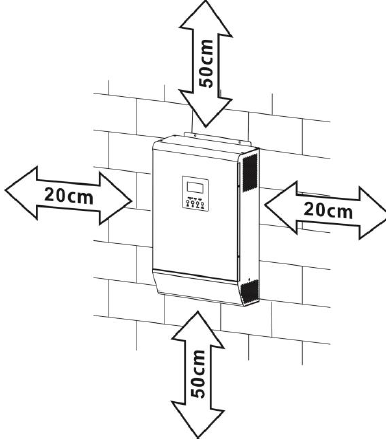
Definitely. Inverters of any kind need a decent flow of air, and they are supposed to have some 200 mm of clearance around them.
-
I have a theory that firmware version 72.90 only comes with clones. Could you post a picture of the sticker on the side of the inverter, or follow the steps in this post (just the one above the first photo [ edit: you should now use Do I Own a Clone? ] ). Your mention of "other funny stuff" only strengthens my theory. Edit: however, this post (in Italian) seems to disprove my theory. Sigh. If you have a genuine machine, you could update to patched firmware version 73.00e (or later, if that ever happens). It's unclear whether you will run into error 90 after 6 months if you update to factory firmware version 73.00. If you do, you should still be able to downgrade to factory firmware 72.70, or update to patched factory firmware 73.00e. If you have a clone, you might be able to update to 73.00e; some clones don't seem to have a bootstrap loader. If you need to parallel with 5 kW machines that come with firmware version 74.XX, then you can't run 73.XX, factory or patched. See also: Can I update my firmware, and if so, to what?
-
Kudos to Victron for that.
-
The Axperts can't do it. In order for utility charging to happen, they have to be in bypass mode. The inverter runs in reverse to charge the battery. As far as I know, you can't have one in bypass and the other two in battery mode. I can't immediately think of a reason why that would be impossible, but I'd say they won't do it, especially after you tried exactly what I would have and it didn't work. Edit : I assume that you gave utility power to the one that is designated as R phase, i.e. its output mode setting is 3P1. Maybe it also should be the master, so turn it on first. Edit 2: no need for a complete new inverter just to charge the battery, any stand alone battery charger would do. Though it might be more convenient to control it if it is another Axpert. But it would need separate control I would think, as it can't be paralleled with the others.
-
Yes. [ Edit: assuming it will update at all, of course. ]
-
My guess is that it coulomb counts, but there is a little drift in the current measurement, plus all the difficulties of guessing SOC, with temperature affecting it, hysteresis, internal resistance, and so on. At a certain voltage, it resets the coulomb counter to zero, and hence the SOC to 100%. So to answer your question, it was 99% but didn't know it yet 🤔. Edit: or it really was closer to 94%, and it expects you to keep it at a higher voltage until the current reduces to a low value, so that the battery really is full and the 100% SOC it reports is justified.
-
Grid (AC input) power is inferred, not measured. The inferring involves some estimations, particularly losses of the inverter (I forget the details now). It won't be pushing power into Eskom, so don't worry about that. I thought if its calculated power ended up negative, it would report zero. This is the big unknown. From the few photos I've seen, they seem to attempt to copy the circuit and even the PCB layout quite closely, but they may have screwed up, either to cut costs, or through not understanding how the machine actually works in detail.
-
I should have mentioned earlier: you should go for the LFP version of 73.00e; I guess that's not so obvious these days with all the different firmware versions.
-
Definitely give it a go. As far as I know, when the clones fail to update, the Reflash Tool simply fails to progress. Cycle the battery power on the inverter to restore normal operation. While unlikely, it's even possible that the clones that don't update are due to operator error, or incompatible USB to RS232 adaptors.
-
Pretty much. Except that you are also (usually) powering loads while floating the battery; the float voltage is the one for the charging system to aim for while loads come and go. The battery was full at the end of the absorb stage, and in the float stage it stays close to full while there is still solar power available. Suppose the load exceeds available solar power for a while. When the sun comes back or the load drops off, the charging system keeps charging the battery until the battery voltage reaches the float voltage setting. That's when it knows that it's replaced the deficit, without letting the battery voltage get too high for too long. Keeping the battery voltage too high for hours on end is not good for battery life, and there are only a few percent more SOC at the higher voltage anyway. I favour a decent gap between absorb (bulk) and float voltages; I use 55.2 and 53.7 V for my 16S LFP battery. The equivalents for 15S (PylonTech and some others) are 51.8 and 50.3 V. So the usual 53.2 and 53.0 are both quite high. 53.2 and 52.2 as above at least have a bit more of a gap between absorb and float voltage settings.
-
Your bulk and float settings are way too high for PylonTech batteries. They should be 53.2 and 53.0 V respectively. If you can reflash with the LFP version of 73.00e, the KettleKomp™ feature should prevent too-frequent switching to bypass (line) mode. Also, using the LFP version of the patched firmware should fix the problem of the far-too-sensitive low battery warning, so you should be able to change setting 29 back to a higher voltage, probably the PylonTech recommended one.
-
Exactly. If your inverter came with patched firmware, then it's a clone. I hope that you are able to re-flash it; some clones can be re-flashed; others don't seem to be able to.
-
No, on the output you appear to have just a double-pole isolator and a surge protector. If you want to prevent that, make the battery low voltage cutoff higher, say 46 V. (This is setting 29). This will cost you a few minutes in long-blackout runtime. Being a lithium battery, running low doesn't matter as much as with lead acid, but it's probably worth doing, perhaps when everything is sorted out. I say 46 V rather than 48 V because otherwise it will affect settings 12 and 13. If you decide to use the patched firmware (you would use the LFP version), then this consideration effectively goes away. I forgot to mention this consideration in an earlier post; corrected now. Today's picture was just 56 kB, so I don't think you're hitting the 3 MB limit. I expect that after you've had a certain number of posts, that limit will be more generous. You're at 11 posts now; maybe you can already post it (thanks to the post where you tell us you can't post it putting you over the threshold 🙂 ).
-
Usual story: apart from a handful of cases, you can only get the appropriate firmware update file from the manufacturer, via your reseller, sending them the serial number. As far as I know, your case isn't one of the handful where they are available elsewhere.


