JayMardern
Members
-
Joined
Everything posted by JayMardern
-
Agreed. There's also no way of them ever knowing that you're using it since it communicates with the inverter, not directly to the batteries. I do kind-of understand apprehension of connecting equipment directly to the batteries themselves, but Soalrman is absolutely not that. It's worth noting that the guys doing remote firmware updates (in my experience) aren't high-level support, so I'd take what they say with a grain of salt... As an aside, the changes to SOC are sorted under new firmware by the master averaging the output. So if one battery is at 50% and the other is at 60%, the master now reports 55%.
-
The Winter Solstice (in the southern hemisphere) was yesterday, so we're at the lowest-PV-production point in the year. My own arrays are producing around 67% of maximum rating; so you're not too far off. Wait for spring and you'll be more impressed; my daily kWh production is much higher in late spring/early-summer than it is now. Because they can't communicate with each other (eg: different protocols) and hence can't report to your inverter via BMS. Some people do still run same-voltage+same-chemistry+same-cell-count+same-C-Rating batteries from different manufacturers in parallel but you'd have to forgo battery communications to the inverter (and run in Voltage mode) to do so. This can work - but if the BMS does a good job, it's arguably the preferred option. I've been really happy with BMS-inverter communications performance (after a firmware upgrade!) on my pair of Hubble AM-5's. Expensive electronics don't really work the same as consumables (and these are rather specialized electronics, too), but do keep an eye out for specials, they absolutely happen. I picked up my second Hubble AM-5 (as well as a second inverter and another 10 panels), all for a boatload cheaper than current pricing; late last year when demand dropped due to load shedding being reduced. Black Friday also had some amazing deals last year, leave a few store tabs open and monitor and the deals will find you.
-
On my 5kW Sunsynk model with recent firnware, it appears that "Export Power Limiter" under System Mode --> System2 should do the trick, if you want to be on the safe side (or if you ever add more panels in future). Older firmware called this setting "Max Sell Power." This may be helpful for real-world feedback from members that've tried this: https://powerforum.co.za/topic/17270-sunsynk-5kva-push-back-to-non-essential-load/page/2/
-
Deye calls this 'Zero Export Power', it's on the System Work Mode screen, The manual describes it as follows:
-
Don't be so sure: we're flying awfully close to the sun today with tonight estimated to be truly borderline at around 6PM: That prize of yours may very well still be on the way...

-
It sounds like you could be describing the AM-5-in-parallel firmware quirk (when SOC percentages amongst the batteries are not perfectly matched, which is common) that we discussed here: If so, I can confirm the latest AM-5 firmware resolves it. A before-and-after example of a graph displaying the original issue as well as a graph post-firmware-fix: https://powerforum.co.za/topic/29642-spikes-in-soc/?do=findComment&comment=204205
-
It gets put into the 'Investment return rate' section at the bottom of the Overview tab of the mobile-phone app. It doesn't seem to appear on the web portal, however.
-
It'll depend on the model, but real-world draw on a family-size heat pump tends to approach 2kW range, which is equal to the size of a small geyser element. Measurements done here: In that case, even adding an additional 4 panels (to target a larger 3kW regular geyser) is going to work out cheaper if I'm not mistaken, and that extra power can then go elsewhere (eg batteries) when you're done heating.
-
Didn't affect me but the app has been down for days at a time over the last week. Love the inverter, app and portal - but man, Sunsynk really needs to work on cloud-platform reliability.
-
Just a data point: we heat 350L of water per day for 6 people, entirely from a regular Solar Inverter system. This is done across two regular geysers (a 150L 3kW and a 200L 4kW). We run a 20 x 455W panel array ie (9100W peak) but 15 panels (6825W peak) would do the job fine if the rest of our household demand were a bit lower. Rain obviously spoils the fun but that's not likely to be an issue in OP's location. Spare capacity then goes to running the rest of the house, and when the water is hot, the balance of the power goes to charging the 10kWh batteries for night-time use. Heat pumps still require the same peak power as a regular geyser but they run for far shorter. This makes sense when running on the grid, but less so in the context of a solar PV system. My logic: if you have solar capacity to run a 2kW-3kW Heat Pump then really, that same capacity can go to powering a 2kW-3kW Geyser or two; with the benefit being that regular geysers require no maintenance, are cheaper to install (and are the cheapest option to purchase by far) and when your geysers die of old age, Insurance replaces them quickly at no cost and no fuss. You can also drive up the thermostat of a geyser to store additional heat if you need more hot water; I've done so with one of our two geysers with pleasing results. The exception would be if you don't get enough sunshine hours in the day or if you can't sustain the required PV peaks: in which case it still might make sense to add panels and go with normal geyser heating. If I didn't have solar, I'd go for a heat pump for the far shorter run-times (since even with the greater initial outlay and installation costs, a heat pump will pay for itself with reduced grid usage). But with a solar system in place I'd go the opposite way: regular Geysers + Solar Inverter have worked incredibly well for my family - we only pay for water heating when it rains.
-
This icon is for when the Aux port is energised, that's the relay you're hearing as well.
-
This might be due to what @TaliaB describes above where the battery is hitting it's absorption percentage (as approaches full-charge) and throttles back at the end of the charge cycle (eg at that stage it'll only absorb 0.5C instead of 1C)
-
Demand is exceeding supply. Your house load, plus geyser, is going a little above what the panels are producing, so you're dipping into battery since without grid, there's no alternative way of keeping those loads powered. Adding a few panels would probably sort you out; although if you're still finishing the day with a near-full battery (which seems to be the case from this graph), does it even matter if you dip into the battery a bit when the geyser runs?
-
An inverter without an external CT clamp won't be able to zero-export. They'll still be able to combine power from grid/solar/battery/etc; and there're even some non-external-CT-clamp inverters that can still do Smart Load-type functionality. They just can't export excess power to your non-essentials.
-
Exactly Yes: think of Smart Load as an extension of your Essentials, separated by a relay (which, as you mention above, does need a separate set of breakers). When the conditions are appropriate (eg, battery level is high enough), the relay is active and Smart Load gets power. When the required conditions are not met, that relay switches off. And yes indeed, the main purpose of Smart Load is to allow you to put high-power items on Smart Load (i.e., to let them run when the grid is not present - sort-of like essentials) without risk of emptying your battery when there's insufficient PV/battery power to sustain those loads. In my case, Smart Load is set to get power whenever there's grid; and if there's no grid (which means I run the risk of dipping into battery if it's night-time or if the sun isn't shining), it then gets power whenever the battery is above 50%.
-
Primary benefit is to do what's commonly known as zero-export-to-CT. If you put the CT clamp on the mains breaker, you can set the inverter to do local-export where instead of feeding back to the grid, you feed back just to your own non-essential loads (ie, the loads that are not backed up by the inverter) - treating your house as a local grid, so to speak. A geyser or stove is an example of a high-power item that might not be on the UPS/backed-up circuit (so if the power fails, the geyser/stove won't be run from the inverter), but while the grid is available, the inverter can feed-back excess solar (or even battery) so that these expensive-to-run loads can benefit from excess solar. Let's assume you have 5kW coming in from your solar array, and your essentials/backup-up loads are consuming 2kW. The balance (3kW) can now go to your non-essentials; essentially the Grid input gets treated as both an Input and an Output, but the Output is limited to your own home. So whilst those high-power loads can't go directly onto the backed-up portion of the inverter (because they'd potentially overload the inverter), they can still be powered by solar when available. There's a fortune of electricity to be saved by doing this. Correct, smart loads would have a separate breaker. The idea behind these is that they're backed-up loads ('semi-essentials' so to speak) that only run under certain conditions. In my house, my stove is on my Smart Load port, so we can cook when the power goes out (frequent occurrence in South Africa!), but it only runs if the battery is above 50% (to stop us from depleting the battery without realizing it, since stoves/ovens are high-power devices). If the battery dips below 50%, the remainder of the essentials (lights, wi-fi. etc) stay powered on, but the stove (which runs the risk of putting us in the dark) gets powered off.
-
Here's a direct link, this does reflect the lower price - for now! (this is actually not the same vendor as yours) https://thepowerstore.co.za/products/solis-energy-storage-6kw-hybrid-5g-inverter-with-dc-switch Extremely competitive... Pre-election pricing? 😀 Yup, similarly priced to the Must clone I purchased 8 years ago as well. Astonishing what can be had for reasonable $$$ these days..
-
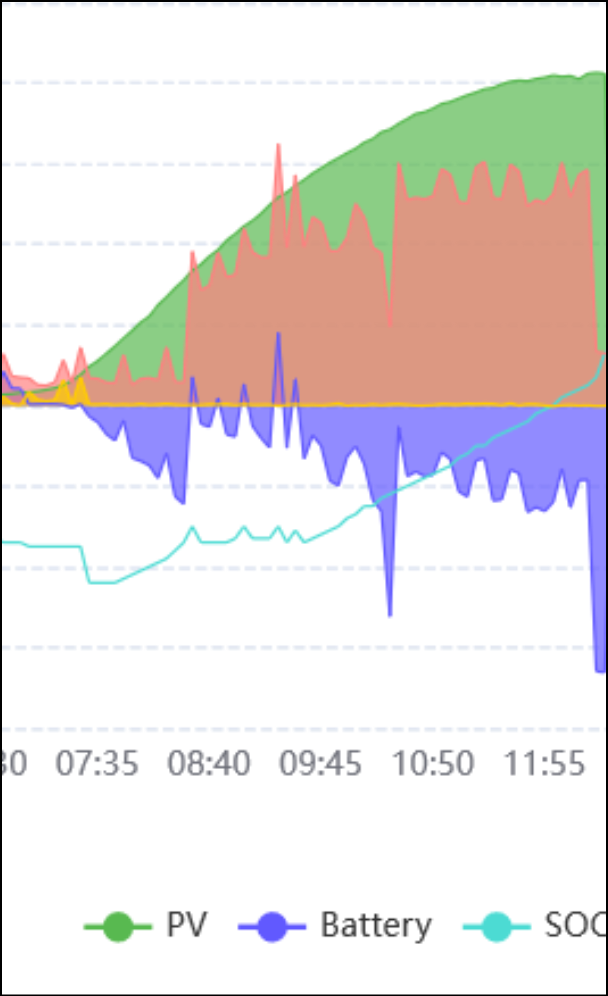
I agree - that was presumably their thought process. But it's pretty flawed in practice (which I imagine is why they changed it) - for a few reasons; but the most pressing issue was that it made it impossible to 'hold' a specific SOC. Take a look at what used to happen when I instructed my inverter to maintain a 30% SOC early in the morning (pre-sunrise): Here, one battery is at 30% and the other is at 25%. The reported value is initially 30% (the higher battery). The battery reports 30% for a little while but the 'trickle' to maintain that 30% puts the battery into charge mode, which now drops the SOC reported down to 25% - because that's what the lower battery is at. Now, the inverter needs to get it back to 30% - so it charges until it hits 30%. And then when it stops charging, the batteries go back into discharge mode - but now it's reporting 35%; because we've now overcharged the other battery (and we're seeing 35% from that battery now)! So it starts discharging again! So we end up with an endlessly repeated discharge/charge cycle loop (you can see in my graph it happens 3 times in the space of 2 hours). This is terrible for the longevity of the batteries (they're being repeatedly micro-cycled for no reason) and also causes the system to often hit the grid (with the full charging current) for no reason. It doesn't scale either, because this was just 2 batteries (with a small-ish SOC difference between them); but in a bank of 4 (like the OP's case), depending on age, etc, those SOC differences could be bigger - which is why OP sees jumps double the size of mine. Changing this to return an average may have other disadvantages, but nothing major that I've run into yet. And when one of the batteries in the bank depletes, the new firmware also correctly instructs the inverter about the revised discharge limit: so in a 2-battery setup, if one battery is at 10% and the other at 0%, it will give a 5% SOC to the inverter (which is perfect), but also a Max Discharge Limit of 100A (i.e., the limit of single battery), whilst keeping the Charge Limit at 200A (the limit for both combined); so that there's some visibility/control to account for the fact that we're running on one battery instead of 2. This is this morning (with the latest firmware) - it's perfect - we're now able to maintain 50% indefinitely until 2AM with no unwanted cycling (which is an average of the two batteries - each is at 47% and 53% respectively); and likewise there's no more jumping when swapping between discharge and charge mode after the sun comes up: In short: I was ready to throw my expensive batteries out the window after adding a second one - but now after updating their firmware, I couldn't be happier. I cycle down to < 20% daily now; the batteries will thus pay for themselves well before their 10-year cell-warranty expires.


-
Maybe OP can provide same but here's an example of when it was happening to me (prior to the firmware upgrade), In this example I'm running two AM-5's (same model as the OP) in parallel, with the master battery having an SOC of 45% and the slave having an SOC of 36%. Take a look at what happens when the sun rises: We can see the first jump (45% down to 36%) happened at 7:25. It happens every time the bank swaps between charge/discharge modes; we can see it happen a few times thereafter as well (when Load rises/falls beyond Production). We can see this same behavior in OP's graphs. Then Voltage at this same time stays constant despite the SOC jumping: So essentially as the Current swaps from negative to positive (i.e., battery bank goes from discharge to charge modes), the SOC jumps (without any changes to Voltage - and with only a tiny change to current). What's happening is a software bug: the master simply starts reporting the SOC of the lower battery (whereas during discharge, it reports the SOC of the higher battery). As a result we get these jumps all over the show without Voltage changing. AM-5 firmware version V15.55 and later solve this by simply reporting the average SOC of all batteries.


-
Funny I just posted about similarly-problematic SOC reporting on my batteries getting fixed via Firmware in another thread a little earlier today, Are you running multiple Hubble AM-5's in parallel by any chance? If so, the master battery reports the lowest battery's SOC in the bank when charging and the highest battery's SOC in the bank when discharging. It looks like that's what's happening here; this happened to me for a few months as well. So whilst there's nothing major wrong, the latest firmware does fix this (it now reports an average of all the SOC's instead, thus eliminating these jumps). Contact Hubble (or ask your installer) and they'll resolve this for you; you'll need a USB to RS232 cable for them to be able to update it for you.
-
Air fryers are fine but pay attention to the label: my old one was rated at 1.5kW; my newer (larger) one is 2.5kW. On a 3kW inverter you'd want to lean towards the lower-rated models to prevent tripping. Inductive loads can be killer: my (non-VSD) pool pump spikes at nearly triple it's current rating on startup!
-
Yeah my installer mentioned he has over 120 AM-2s installed with just a single reported sudden-low-SoC issue that Hubble fixed in only 2 days - and he continues to sell/install them happily. Threads like these might concern buyers - but in my case I went for the AM-5 because I'm a fan of LFP; otherwise I'd have picked up an AM-2 without much hesitation.
-
AM-5 are listed as "LFP Prismatic cells". I'm not aware of major issues with this model (in contrast to the older AM-2 which had some capacity-related issues resolved in firmware - part of the reason why I leaned towards the AM-5 myself early last year) but I did need to upgrade firmware on the AM-5 to improve SOC reporting when I added a second one in parallel; so the AM-5 wasn't flawless either. Hubble also imposed an 80A limit on charging [despite the 100A rating!] that was sorted with the latest firmware as well. (Hubble send an executable to do so which requires a USB to RS232 cable; or they can do it via Anydesk; but the newer battery was already up-to-date in my case so it was only the older one that needed upgrading). My older AM-5 has been worked pretty hard and has performed well in my use-case.
-
This will depend on the inverter and how you have it set up, but with appropriate hardware - yes. 1000W generation against a 500W load takes me off the grid during that time, with the balance (500W) going into the batteries if they're not already fully charged. Again it'll depend on setup, but yes. In my own case I even allow the balance to come from my batteries (as long as they're above a certain percentage during the day). So in this example, assuming batteries are above that percentage, then 1000W would come from PV generation, 300W would come from batteries, and 0W would come from grid. If the batteries are already at/below the minimum percentage then they stay unused and it becomes: 1000W from PV generation, 0W from batteries, and 300W would come from grid.
-
Fixed that in my edited post, it's this link: https://sunsynk.freshdesk.com/support/solutions/articles/103000242742-how-to-add-multiple-inverters-to-a-plant