


JayMardern
Members
-
Joined
Everything posted by JayMardern
-
The most efficient way to heat water electrically is via a heat pump. However if the solar system you're installing can cover the current geyser then you can leave it as is. As you say, the benefit of downgrading to a smaller element is that it consumes less power whilst running; which means that even if the geyser takes longer to heat (thus consuming the same total energy), you may find that solar can cover its consumption better at that lower peak, for that longer duration. In contrast if it, say, consumes 4kw and your system is only able to generate 2kw, the balance would have to come from grid/battery. Different size geyser elements are typically similar in efficiency; with the difference only being how long they need to heat for. Get the system installed and then review whether or not you're able to cover the existing unit as-is. If not, downgrading to a smaller element is simple and inexpensive.
-
Can confirm this; having recently paralleled a second Sunsynk 5kW (manufactured 4 months apart from the first), the new one has a different-sounding fan: it's lower in pitch compared to the first one. (Neither is particularly loud: but I absolutely prefer the sound of the first one!) It's on under high load during the day when PV production is high but remains off at night unless I run really high loads during load shedding.
-
Yeah; been running a 4kW element for a little under a year; no problem.
-
The Astute's form part of the Tuya/SmartLife ecosystem - so any compatible devices can be added. I use my CBI's through SmartLife and have been extremely satisfied.
-
Another vote for the CBI Astute. They're rated for 30A so no need for contactors unless you plan on exceeding that rating. Datasheet: https://cbi-lowvoltage.co.za/system/files_force/download/CBI ASC_DAT_4PAGES_1.85MB.pdf?download=1 They can also form part of easy-to-create SmartLife app automations - including triggering events on when they power up, draw current, etc - which makes them incredibly useful for this kind of purpose.
-
Agreed; even just 4 hours of load shedding can be a bit stressful on 5kWh; doubling up also gives the opportunity to do some kitchen appliances without stressing about SoC Another thread with settings to do more-or-less what @jdido87 is after:
-
Would also be inclined to lean towards Luxpower in this case due to your low consumption (some of my family members have them - and are all happy.) If everything’s on essential then the ability to zero-export-to-CT simply isn’t necessary. As long as you can manage your loads to keep them under 5kW of course; but this applies to both of your options. (Ovens can use 2kW depending on temperature; and check your pool pump’s rating.) Also with defeating load shedding being a primary objective, you definitely want another battery if you’re subjected to 4-hour stints (I’m saying that as someone who added a second 5kWh yesterday!) The panels will aid your other objective in dropping your utility bill. Go for it…
-
It just… kinda does it’s thing: two different screens let me set different battery thresholds for grid up and grid down. Power stored in the battery as well as PV can be used to feed both essentials and non-essentials to both battery SoC limits and output-power limits that can change depending on time-of-day to keep spare capacity for load shedding (the ‘System Mode’ screen is confusing but incredibly flexible in this regard). Graphs/charts/status displayed on the screen are helpful/informative. My first one chopped my utility bill in half so I had a second one paralleled today to go after the other half. Their mediocre service is a symptom of popularity - hence, since Deye does all the same (minus the Sunsynk app/portal which I enjoy but others might not care about), I’d possibly lean towards the Deye equivalents if nervous about support. Same hardware; same functionality but superior support. That said, minus the screen, the Solis could very well be just as capable; don’t have experience to say one way or the other though!
-
Now this I can relate to 😀 Whisper quiet under load. During the day at high PV production there’s a soft internal fan that kicks in, but you need to be up close to hear it. The 5kW is really pleasantly quiet (at least both of mine are.)
-
No external fans on the 5kW Sunsynk so it’s almost silent; so that’s an option for the noise-averse. But if their extraordinarily mediocre support is giving you pause, you could skip them and go directly to the OEM and buy a Deye.
-
Yeah my installer just added a second AM-5 to my install today. He mentioned he had his first Hubble return (in over 120 of them installed); an AM-2 that was repaired under warranty in 3 days; with the only inconvenience being the shipping to/from CT. He's never upgraded the firmware on any of them; stock factory-issued firmware across the board. Considering they're an almost de facto default in rentals from Versofy/GoSolr (of which there must be thousands upon thousands of installs) they can't possibly be that unreliable; otherwise they'd have switched brands long ago.
-
Correct, if ‘Grid’ is ticked it’ll be on regardless when there’s grid. When no grid, the parameters you specify here will apply. Also note that the PV Power value on this screen is currently-in-use solar power (as opposed to total available power); so this value would be your household’s base load to trigger the port when there’s PV. You can’t specify the power rating of your geyser in this field unfortunately. Otherwise, this should do what you’re after.
-
It’s most definitely not good news: if PV production is at an all-time high and they’re still resorting to Stage 6 in moderate-temperature weather even in the daytime on low-demand-weekend days, can you imagine what this winter is going to look like…
-
How many showers do you need to achieve? How short are you falling at present? I’m running a 3kW 150l and 4kW 200l, both running via non-essentials (like you, powered by solar through Zero-CT Export), with 4 showers (one of which is early-morning) on the 200l and a further 2 showers on the 150l. I cranked up the thermostat of the busier 200l geyser (from 60 to 75) to solve the same problem you’re having. Both geysers run sequentially/one-at-time from 9AM until 4PM (heating is normally finished by 3PM) and both are then powered off by timeswitch. They don’t turn on again until morning. In summer there’s now been excess hot water (including for the one morning shower); but the thermostat increase was vital: it caused the geyser to heat for longer in the daytime sun, allowing the water to stay hotter at night. We were always one or two showers short before. In winter I suspect I might need to run one of those geysers for an hour at night; or perhaps crank up the second geyser’s thermostat as well, but we’ll see!
-
Eskom went on record a few days ago indicating that rooftop solar had significantly reduced daytime load shedding - its an interesting read (especially how the load profile has changed - it follows the sun more closely now): https://mybroadband.co.za/news/energy/524156-south-africas-rooftop-solar-surge-making-a-big-dent-in-load-shedding.html But the bulk of ZA’s energy still comes from Eskom - and if they can’t deliver, all bets are off.
-
Your demand is low! With north-facing panels you'd likely get away with just 8 x 550w's; even in winter. Unfortunately other members will need to chime in on how swapping north for east/west impacts production, though; as I only have experience with north-facers. Would sticking to 12 to compensate for orientation be necessary, I wonder?
-
If you can't do north-facing then depending on demand, it may be an even stronger argument to over-panel and go for the 12 (with 6 per string). Can you share a graph of your daily load (pick a busy-ish day) from the Sunsynk app?
-
Exact same model my side. Mine clips DC-to-AC at a hair under 5000W; so assuming ~90% efficiency from the 10 panels you're looking at, (10 * 550)*0.9 =4950W from those 10 panels; hence those 10 panels won't ever clip. 12 panels at 90% efficiency would give you around 5940W; so a bit of clipping at mid-day in summer (assuming north-facing panels) to the tune of a maximum of around 900W lost. And if the battery is below 100%, that balance of PV (up to 6500W, so 1500W max) would go there. So not a train-smash to go 12 panels either. As mentioned above, over-paneling can make sense to improve production before/after the middle of the day, as well as during winter, and in lousy weather. You know what would take a bit of guess-work out of making recommendations: share a picture of your daily consumption from the Sunsynk app! Pick a busy-ish day and post here. That'll make it easier to make sure supply has a demand to match!
-
Your AC voltage to the fan is probably changing. When there's grid, even if running off battery, the inverter matches grid voltage and frequency. When there's no grid, the inverter will output the 'Inverter Output' voltage specified in the settings instead; usually this will be set to 230V in SA. If you check your stats, you'll probably find that grid voltage is significantly different (probably lower) than the 230V the inverter supplies when running without grid. At my house, the supposed CoJ supply (which should always be around 230V) often drops all the way down to 195V (!). Check yours and you'll probably see something similar (although hopefully not as extreme as my case!) At differing voltages, your fan (and some other electronics: my dimmable lights change brightness, for example) will behave a bit differently.
-
Yeah you were tripping the inverter (as the battery is rated for 1C max); the second one in parallel (and the pair of batteries to match) should sort you out. Don't have any solarman experience, unfortunately.
-
As someone with 10 (lower-capacity 455W) panels, with the same Sunsynk inverter, what you've been quoted is a perfect start from my experience. 10 x 550w (I assume you meant 'w' rather than 'kw') panels will produce a peak of 5.5kW, which is a perfect match to the maximum the inverter can invert from DC to AC. Anything above that will either go to the battery (if it's not already full, to a maximum of a further 1kW or so); or will get completely lost. Beyond this, overpanelling beyond this number only makes sense if you don't mind taking losses during mid-day (through clipping) and instead want to push up production earlier in the morning or later in the evening; or if you're looking to cater for days with cloudy weather. I adjusted my geysers (both are fed solar through the non-essentials) to come on to follow the arc of my daily PV production (smaller geyser from 9:30AM, larger geyser from closer to midday) to follow the rise and fall of PV production over the course of the day. It's been incredible; production averages 25kwh to 30kwh per day in the summer here in JHB; my CoJ electricity bill has been slashed by more than half. I'm adding another inverter (and another 10 panels to match) to go after the remaining half of my bill. Those running more than 10 panels on this inverter are mostly dealing with lower-capacity panels (say, 390w panels). For the 550w panels you describe, 10 is a perfect match to it's DC-AC inverting capabilities. Just ensure that your installers split the strings such that you stay in the correct voltage range for the MPPTs according to the specs of those panels. You won't look back.
-
Either the inverter could trip (if you exceed 5kW) or the battery could trip (if you exceed it's rating). What battery are you using?
-
Yes, and the higher typical PV production of an 8kW install vs a 5kW install would probably help to justify this. And we know the idea has legs already because one of the reasons for the mass success of long-term PV rentals in SA (despite their questionable long-term financial prospects vs owning a system) is because these systems offset their own costs with PV production, which makes them a relatively easy sell. The tougher sell would be backup-power-only installs that lack PV.
-
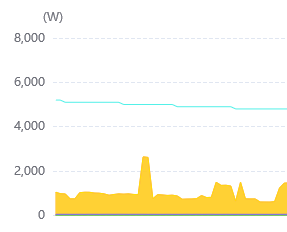
Yeah, 'Batt First' is selected in the first screenshot so we'd think that would be the case! Yup that's right - was hoping we'd get lucky and that would sort you out: here's my system running with Grid unticked and a battery SOC (indicated in blue) being allowed to drop (with a zero power value) - we can see it slowly diminishing despite not outputting power to any loads (so self-consumption)? But alas, no such luck in your case. At a loss. Also strange that: It's only the primary that seems to be doing this It only started when swapping out the unit. What could've possibly changed!
-
Makes sense - in the event of a solar system being out of service, a lot of the time R1k per month will easily pay for itself in terms of the production that would be lost with an out-of-service system!

