


ChristoSnake
Members
-
Joined
-
Last visited
-
-
-
Nope, no clamp meter of any sorts. I base my statement only on the EmonCMS monitoring graphs that show numerous little ridges at night that disappear during the day. They look a lot like fans running for a short period of time, which corroborates your theory of internal powering losses.

-
-
-
-
I concur with the problematic DP at the top right - it will block the hot air coming from the fan exhaust finding a natural way upwards out of the cabinet. That hot air will find it's way around the front & bottom of the inverter and get sucked into the inlets on the left of the inverter. Once you feed hotter air into the inverter, you'll get hotter air at the exit, etc. etc. You may get around a lot of that by making use of passive ducting to channel hot air away and keep it from interfering with cold air that should be drawn into the inverter. I have two suggestions: Cut a large circular or square hole (depending on available tools) at the left bottom of the cabinet to allow cool air into the cabinet when the door's closed. Make a duct out of whatever you have lying around - carton, polycarbonate sheet, a (probably illegal) corrugated carton sign on a street pole, etc. Use this to channel air upwards out of a similar hole you drilled at the top of the cabinet. I used the second part of my advice to you to redirect air upwards towards a ceiling fan right above my inverter, instead of blowing it indiscriminately into a small scullery. The duct is closed at the bottom, flush against the electrical trunking on the right, and open at the top.

-
Anton, it was always running in grid-tie mode, but without any additional hardware involved. We're connected to the grid via an old school ratcheted mechanical meter, so I could not feed back into the grid. Instead we went big on batteries to go 99% off-grid. Weirdly enough it trickled about 90 W from the grid at night (despite sufficient battery SoC and adjustment of the unit itself) which went down to 0 W during the day when the MPPTs woke up. I attributed this to a sight calibration issue with my specific unit's internals. Reading about the split design in many areas it might be due to slight component differences affecting balances somewhere?
-
-
I "only" have 24 panels, so it never went over 500 V per 12 panel string. But 500 V DC is enough to cause a lot of trouble if it finds a path with a lower resistance, as @Coulomb often mentions. The strings are now wired differently to cater for the 8 kW Sunsynk's lower voltage MPPTs.
-
-
-
-
-
 ChristoSnake reacted to a post in a topic:
Charging inverters during peak could push up demand by one stage of loadshedding: Eskom
ChristoSnake reacted to a post in a topic:
Charging inverters during peak could push up demand by one stage of loadshedding: Eskom
-
A quick look at my inverter's battery stats shows that I lose about 10% during a charge/discharge cycle. By using the grid to recharge batteries we're adding an 10% additional overhead to the grid. I have no idea how many households are in that situation, but that could also add a stage if there are enough such installations around. I suspect that also explains the reasoning behind government's plan to only incentivise PV. Doing anything else adds to their problem. Not pointing fingers, just stating the facts...
-
WannabeSolarSparky reacted to a post in a topic:
How much has your electricity bill decreased since getting solar?
-
Antonio de Sa reacted to a post in a topic:
How much has your electricity bill decreased since getting solar?
-
zsde reacted to a post in a topic:
How much has your electricity bill decreased since getting solar?
-
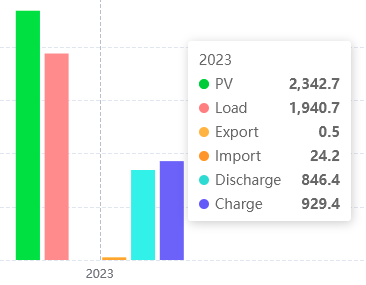
We are mostly off the grid. Used to consume around 800-850 grid kWh/month, now we're down to <10 kWh/month.
-
-
Could it be related to this model's 900V PV limit? I ran it with two strings of 12S panels each, somewhere around 500V on each of the MPPTs most of the time...
-
You're welcome to take your time to get acquainted with that beast of an inverter... It may also be worthwhile to reach out to @Youda. He has a <insert appropriate collective noun> of InfiniSolar 5kW inverters and seems to know their workings inside & out. PS: I'll bring a smaller vehicle next time 😉
-
-
Yes please!
-
I have a spare Victron cable if anybody's interested in one. Still sealed and unopened in its bag.
-
-
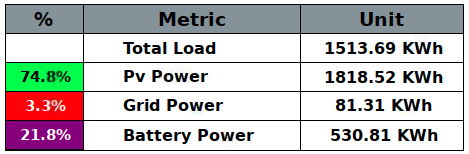
We're on the Mooikloof substation and we had 11 days without electricity when the stupid thing burned down in December 2021. We're running in grid-tied mode and our stats show that we've used 3.3% of grid power for the year to date. But more importantly, we made it through that extended outage last year without ever being in the dark, having cold bath water, not being able to use the washing machine or dishwasher, eating cold food, not running pool filtration & borehole pump, etc. We pretty much went about our daily lives as if nothing had happened, except for the racket of everybody's generators making it tough to sleep at night 😃 I've also considered getting rid of that last 3.3%, but much of that grid usage is due to way grid-tied inverters work when the grid is available. Once the grid disappears they go into off-grid mode, and there's nowhere to leak power from (except PV or batteries) while they keep up with load changes. I think that I've made my peace with remaining "mostly off grid"...
-
A colleague of mine's car battery exploded on the way to work many years ago (a Ford XR3, to date the story). All that remained were some bits of plastic clamped to the end of the battery leads. Also a lot of battery acid all over the engine and underneath the bonnet. He had a new battery fitted and all was fine, so it must have been a short circuit inside the battery itself.
-
I have a stack of them too... No hassles at all, except for one of them (the missing number 5) that had it comms board blown by a lightning strike. But its BMS still works, so I've left it connected and it now lives in its own (hopefully happy) world. I should take it in for a board replacement, but I haven't been too bothered because it still pulls its weight. The oldest one has 641 cycles and reports 95% SoH. The pause in charging at 89% is not a bug, but occurs while the BMS equalises the individual cells in each battery. I monitor the individual cell voltages (see above), and during the time the BMS reports the SoC as 89% the highest cell voltage goes up to almost 3.60 V. Once all the cells have been pushed that high, they highest voltage decreases to 3.50V (in my case, because I use 52.5V as a charging voltage and there are 15 cells per battery) and the SoC goes up to 100%. I'd buy them again without thinking twice.

-
Battery Brand/Model: 5x Pylontech US3000B Installation Date: 2019-02, 2019-07, 2019-09 & 2020-02 Cycles: 618, 526, 479 & 363 Performance: SOH is 96% according to ICC. I think that's the value for the oldest battery, not an average. Discharge limit is set to 25% SOC. They typically discharge to 60% SOC (summer nights) and 45% SOC (winter nights). Average temperature over the 3 years is 25.7°C (min 16°C & max 32°C). Very happy with their performance. May buy another one if La Nina returns. There's a 5th US3000B with broken comms (@#$% lightning!) that does not report it's SOC/SOH/etc. Because its BMS still works, I have connected it up to assist the other batteries. It's flying dark, but still pulls its weight.
-
Some practical examples may help... I run 2 strings with 12 panels each and the strings *just* breach 500V on a partly cloudy day (String 2 had a 510V peak on Sunday). Voc on my panels are 45.6V (for a 547.2V theoretical max) and my roof has a 17.2 degree angle. PS: My inverter is capable of 900V per string, so I'm actually thinking of adding more panels 😁


