


PeterP
Members
-
Joined
-
Last visited
Everything posted by PeterP
-
Apologies - spoke to soon. I was notified today that Sunsynk have disabled the MI Zero export function so the inverter will only control the MI in off-grid mode. In on-grid mode the MI will continue to export unless the MI itself has a zero export functionality built in.
-
We AC coupled 2.76kWp of panels on an old 2kW grid-tie inverter via the Gen port on a 8kW Sunsynk yesterday. It is working perfectly. it switches the grid-tie inverter with frequency shifting so you can set at what battery SOC% you want it to switch off and back on. You can also restrict grid-feedback without adding another CT clamp. The grid-tie inverter continues working during loadshedding as the inverter frequency makes it believe it's still has grid. Very neat solution. Cheapest way to do it is if you have an old un-used grid-tie inverter floating around. If you don't have a cheap grid-tie lying around i would recommend just adding another 8K Sunsynk in parallel - or you could use the 5K Sunsynk AC-coupled but the benefits of having another 8K in parallel probably outweighs the price difference

-
The new Sunsynk logger does have Ethernet port - it's inside the antenna.
-
I have from reliable source that Sunsynk Dongle will indeed offer real-time monitoring.
-
Agreed, real time data and System Mode settings so you can fast charge battery prior to loadshedding are the two main nice to haves.
-
As most might know by now, Sunsynk will be launching their own monitoring dongle, which gives access to all settings. We have one in beta testing and so far it's looking pretty good. Not sure when they will be broadly available, though. I'd imagine they'd want people to use their proprietary solution over Solarman's - and that would answer your question.
-
AUX is Smart Load (output) or Generator/turbine (input) or Microinverter (input) depending on what you chose to use it for. UPS is your Load output (essential loads) = Loads that will operate when grid is down.The House is your non-essential loads (ie loads that will not function when grid is down). The cup with a straw through it indicates you have a CT clamp connected to prevent feed-in. The Pylon Tower is the Grid. Your installer should have given you a manual or a rundown of the basics.
-
You can increase the SOC % set in System Mode - then the grid will supplement once it has discharged to that SOC %.
-
The Solar MD 3.7kWh is a little more than your budget, but it has 100A fuse so it virtually matches the 5K Sunsynk as it can do 1.3C. It does require the Solar MD Logger as well though.
-
From Sunsynk: In time of use set power= essential load, so at night only that much power it will discharge from battery and remaining from Grid , At day time solar will provide both essential and non essential, You need to to Click on zero export only not Zero export to load, Else solar won't provide supply to non essential If solar is less then battery will provide supply to non essential till it will reach SOC, you can control this by Setting % in time of use , suppose you have set 95% then battery will discharge only 100-95% at day time and if you set 20% for night then battery will discharge to 20% in night. So the Sunsynk will supply battery power to non-essentials.
-
If you limit the battery discharge power in System Mode surely this is supposed to limit battery discharge to essential loads only? As I understand it, non-essential loads are not supposed to get power from anything but grid and excess PV, having said that we have one site doing just that (battery power to non-essential loads) and we've been told it will be fixed with a firmware upgrade. I sense there is a lot of confusion around this, and I, for one, am not sure how it is intended to work as we've seen both....
-
1) I don't see the reason to switch anything to gas unless that is your absolute favored way of cooking or you want to have redundancy solution in case your PV trips out. Heating anything, but especially water with gas is more expensive than solar or solar PV will ever be + it's polluting + potentially a fire/explosion hazard + you have to replace cylinders when they run out + gas will go up in price over life of your PV system. Rather get a little more PV and storage and some energy efficient appliances. 2) Parasitic loads can make up a large portion of our night time loads eating away at the battery capacity. Switch off and unplug everything that is not absolutely essential and you'll be astounded how much you can save. Even 300W over 10 hours x 30 days adds up to 90kWh over a month. I have wired TV, amplifier etc etc so that I can switch it off on the wall when we go to bed - just get rid of all those little red standby lights and you will save 100-300W easy. 3) Water heating - get a bigger tank and low-flo shower heads and use your PV to heat it up. Some days there won't be enough sun, that's when Eskom will have to step in.
-
Tariq, wouldn't it be simpler to just leave geyser on non-essential, then you wouldn't have to manage cloudy days and the only downside would be that geyser would not be powered during loadshedding? If loadshedding frequency increases then I can see merit with the Smart Load functionality (for geyser) but if it's one or max two outings a day then geyser should still work.
-
Ditto - we will only ask for final 30% once job is complete which includes COC and any registration docs. Trust goes both ways.
-
You are currently making good return and your system will have a very high IRR, but it seems you are exporting more than what the CoCT SSEG system allows for (ie you are not currently a net consumer). Net consumer is calculated on annual consumption and production so you might still be ok once winter is taken into consideration, but seeing your impressive tracker results, I'm not sure You are missing my point about having the option to add batteries, of course it will be more expensive and thus IRR will be potentially reduced but batteries are all about having power when Eskom can't supply - for most people (not you), eliminating loadshedding, is as important as the ROI. On a small residential system the Hybrid inverter may add R10K up-front, but then you are at least able to add batteries at a later point if the feed-in tariff is reduced (or eliminated) - or loadshedding ramps up even more. One of the main problems with CoCT SSEG feed-in system is that you are effectively entering into a 1 year contract with the City on your 20-25 year solar investment. The monthly SSEG connection fee, tariff and feed-in tariff are changed annually which means your system IRR is very vulnerable, especially if it is dependent on the feed-in, to achieve savings (eg. City may only offer R0.33/kWh feed-in next year or R0.10/kWh or none at all.....). The R0.25/kWh incentive is for first year only and may not even apply to systems added in future years. If CoCT would offer a feed-in deal fixed for 5 years then we'd be able to do our sums and make much more informed decisions. With a self-consumption battery system you will fix your R/kWh rate for life of system (currently R1 - R1.50/kWh) so it's a bit easier to work out the IRR as the Eskom kWh tariff historically has only ever gone up. Feed-in tariffs world-wide have mostly been coming down. Currently, hybrid battery system in Cape Town expected pay-back is 5-8 years, grid-tie SSEG can be as low as 3-4 years (but no grid - no worky).
-
The Hybrid will still require a battery to function during grid-outage - panels will give no power. The reason to start with Hybrid is to give you the option to add battery later instead of having to buy a new inverter once you decide to do so. The Hybrid will export and work while grid is up like Erastus system at a fractionally higher upfront cost but with the added benefit you can add battery at any time (which anyone with a grid-tie only system would ultimately love to have when there is loadshedding...)
-
Grid Tied Inverter - which has to switch off when grid is down. I like your example, but would recommend setting up with a Hybrid inverter if the feed-in is attractive in your area as this can be expanded to work when grid is down (only requires battery). Most people going solar, do so to be loadshedding proof - I offer the grid-tie version but once it's clear it has to switch off when grid is down it's mostly a non-starter
-
Current SA EV prices are ludicrous - we got ours 2nd hand for R193K with 35K on clock - so then it's ok. Future EV pricing will be in line with ICE in a few years. We had to replace the other car anyway, so for us it made sense.
-
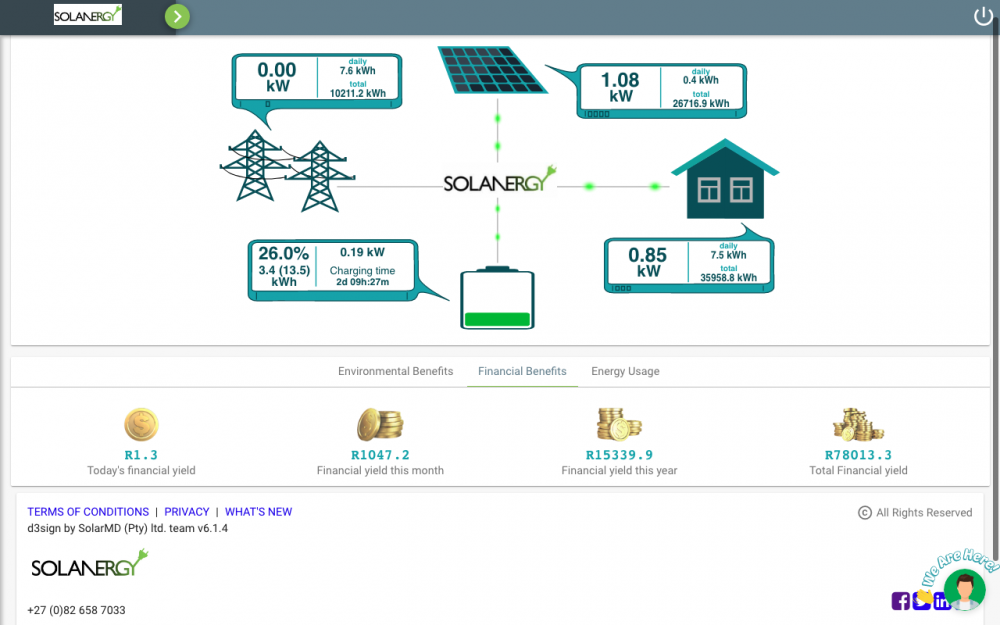
ROI is typically the single most important factor when considering going solar - even though being Loadshedding resilient and producing clean energy are close seconds and thirds. The screenshot gives our savings on a 5.6kWp (320W modules) - 10KVA (Axpert inverters) - 13.5kWh (Solar MD Li-Ion Battery) for the past 3.5 years. Cost of system R200K. Annual solar savings: R25K+ What it doesn't show, is that we have further estimated savings of R25,000-R30,000 per year in avoided petrol purchases and vehicle maintenance as the system is also powering our Nissan Leaf EV. We use the electric vehicle for school runs, daily shopping and the odd meetings/outings and are able to have it on the solar powered plug for 3-4hours per day. Standalone the solar system will pay for itself in 6-8 years but adding the car doubled the ROI of the solar system.
-
The CoCT Residential SSEG tariff shown is only for customers who feed-in - if you are not feeding in, you pay the same Energy Charge but a reduced Service charge of R171 VAT incl. pm. on Home User Tariff.
-
The 25% limit is about how much the grid has to pick up when it reconnects after a grid-outage. The grid is designed to handle a % of possible loads off your standard supply - now add feed-in, and if left unregulated, you could have feed-in off over 100% plus your loads exceeding capacity of grid very quickly when grid is restored and everyone's load and feed-back resumes simultaneously. If your embedded generator trips it not really a problem (no worse than switching on 2 geysers at the same time) as it's inconceivable that all other embedded generators (geysers on) trip at the same time - when a grid is restored after an outage, it all happens at the same time.
-
Don't forget Eskom future increases will increase savings thus making financing more viable. I have done the calcs for a couple of customers and in most cases savings will equal or exceed installments in year one - so provided Eskom continues with tariff increases it will be worthwhile.
-
We are running it in SNG output mode for the time being and this works in terms of negating the E60 Error - but then we lose part of our monitoring systems functionality which the clients paid for.....our monitoring system supplier thinks this can be overcome by changes to the software but it's not high on their priority list to fix
-
Still stuck with this one - there are no 3-phase loads on the 2 sites where I have this problem. Only response from Voltronics is that it must be a load. Any one have a suggestion as to how one would identify the load causing the feedback? Tried doing Utility to switch to SBU on the one site with a cranky fridge and voila - it displayed E60 error - tried to repeat the feat x3 with no E60 error......not sure what to do.
-
Let's do the maths on the above 3kW element example. With the heatpump you are saving 1.75kWh per hour of operation (3kW element minus 1.25kWh consumption). With the 3.7kWp extra PV you will be generating an ave. of 16.65kWh/day (North-facing in Cape Town) less the 3kWh to heat geyser for 1 hour = 13.65kWh/day which can be used for other loads or stored in battery. Heatpump saving: 1.75kWh/day PV saving: 13.65kWh/day Cost of PV is about double but life is 25 years vs 10 years for heat pump so that evens out. Running costs will be zero with the PV with an extra 13.65kWh in the bank daily vs 1.25kWh x tariff x 25 years (+ 1x replacement of heatpump) for the heat pump. I know this is over simplified as you won't always have sufficient sun + you may well need to use Eskom/battery to get morning showers hot + you might already have excess PV you could use to power heatpump. If you don't shower often in the evenings the PV will be more cost-effective over life of system. If you empty geyser every night it becomes more even. The EV tubes will use no power whatsoever in summer (provided you don't empty geyser completely at night) and reduce consumption in winter and grey days if over specced - but once the water is hot they stand idle, hence my preference of the PV solution. But as I stated when I started out - it depends. It depends on when you shower, how much you shower, available roof, available cash upfront, priority of low running costs over cost of system etc.


