


markus_m2
Members
-
Joined
-
Last visited
Everything posted by markus_m2
-
Something not right, BMS is not taking your 2 US2000s into account (maybe not communicating properly with them)... I had identical setup, 1 US3000 and 2 US2000s. BMS showed max charge/discharge as 87A (37+25+25). Did you update the battery firmwares before connecting up?
-
That is strange @Cef Not sure why your batteries are only charging at 48A (and apologies, I see now you have four and not three US3000s, nice! 😉 My Goodwe definitely charges at correct spec in Eco mode - did you maybe set, within eco mode, rated power to 50%? P.s. the 148A charge limit shown is the value read from the BMS. Correct, 37 *4. If you check in SEMS as opposed to PVMaster it correctly labels this reading "Charge Current Limit (BMS)". The inverter itself is obviously limited to 100A, but BMS saying its happy to accept anything up to 148A...
-
Hello @Cef, Interesting graphs...your hour graph does indeed show roughly 50A charge rate... You running in ECO mode? Or some other mode which allows charging from the grid? Correct? I'm no expert, but I suspect that, under your basic settings, you've set something other than 3 * US3000; while the battery BMS is saying "gimme more" your inverter has been setup presumably with 2*US2000s (or similar), hence the inverter itself (and not the BMS) is limiting to only 50A charge? If you login to SEMS, what value does it give you at "Charge current limit (BMS)" - when batteries are below 90% SOC this should show 111A (with 3*US3000s installed).
-
Correct, this is what I alluded to earlier....I'm sure different batteries / different BMS' do it differently, in the case of Pylontech it will charge at max 0.5C until 90% SOC, whereafter it drops significatly, until I think around 98%, at which point it drops again. Off the top of my head - Pylontech US3000: Max charge 37A. After reaching 90%, charge reduced to max 10A After reaching 98%, charge reduced to max 2A (my exact numbers may be off, but you get the point...) This is just what I picked up in the early days when I was addicted to watching my SEMS portal
-
@Cef not sure why you're only charging max 52amp? Are you sure this isn't a PV available restriction under normal mode? My setup, Goodwe with one US3000 and two US2000s. Max charge I've seen is around 82amps (under ECO mode, i dont have enough panels to get that high in normal mode). This works out close enough based on battery specs: US3000 - max 37A US2000 - max 25A each (*2) Totals max charge of 87A
-
BMS comms will limit the charge current once battery charges beyond 90%... I.o.w. you should have a uniform charge rate up to 90%, thereafter a (reduced) uniform charge rate up to 98% I think, at which point there's a further reduction up to 100%
-
How much per kWh at the charge stations?
-
Super interesting, ive been eyeing the Volvo for a few months but bank manager keeps diverting my attention 😉 Out of interest, what average kWh/100km were you getting from the i3? I thought one could work on average of around 15kWh/100 for most EVs, is the the highway driving that pushes it up that much?
-
Remember, "having to nurse it" is only during load shedding at night (or low PV production)... If you're anyway planning to add second battery in future, save some money and just be careful during night-time load shedding in the meantime.
-
Any specific reason you have it in economic mode? As @P1000says, General mode covers our normal scenrio here in SA (My Goodwe on general mode uses zero grid to recharge batteries)
-
I may have around 35 or 40m run to the CT Coil. From all I've researched this does seem too far. How would a smart meter overcome any issues with length? Is the smart meter able to "forward" the signal / CT Coil reading closer to the inverter?
-
Location?
-
Morning everyone, Do I understand this correctly? Deye/Sunsynk/Goodwe are full hybrid inverters. Growatt SP5000ES (and others) are off-grid inverters, right? To my understanding, the full hybrids can "export" PV (and battery) power to non-essential loads, whereas with the off-grid inverters PV and battery will only power the essential loads. So once batteries are full, the "excess" PV (after supplying essential loads) will be lost and won't power non-essentials (geyser for example). Is this true? And are there other big differences between the two? Cheers, Markus
-
Ive done a DIY job at home so no expert, but personally I'd do exactly as you've stated - 1. Decent inverter (Sunsynk) to see you through many years. Can parallel a 2nd inverter later if needs be. 2. Small (expandable) battery running pure essentials until you can afford bigger batteries (you'll need to split DB accordingly). 3. Whatever number of panels you can afford (plan properly for future panel expansion). You'll start saving from the get go. Every 2nd month, take the savings and buy an additional panel - planned properly it'll be pure plug n play onto your existing array. Start increasing battery banks once you have enough panels to produce for decent battery storage. At this point you can start adding some extra loads to the essentials bus. What the guys say about solar water heaters and heat pumps is very true! Should plan that into your system for sure. Whether you do that first or PV first- personal preferende 😉 Hey presto, a few years down the line you're saving 3.5k per month without an exhorbitant initial investment;-)
-
Hello everyone, My dad sleeps with a CPAP machine. Load shedding really messes with his sleep (not to talk of health effects when the machine switches off). Machine has 24V DC input, existing PSU rated at 90W. Thinking (need a cheap and (not too) nasty solution): 2 x 12V AGM batteries connected in series. 20AH, maybe slightly bigger (withstand good 2hrs loadshedding without draining the batteries beyond 60%). 24V 5A power supply. Wiring: input 240V. Output - parallel 24V to battery and CPAP machine. Will this work? Am I missing something? Will that PSU overcharge the batteries? Or can I just set it to a certain max voltage which will keep the batteries safe? Batteries will obviously need higher than 24V to charge correctly; should I install a regulator inline to the CPAP machine to keep its input at 24V? In my mind this should work nicely, but obviously don't want to blow the CPAP machine 😉
-
Hi Gerrie, I connect to the battery fine - I see the green battery icon and can see individual cell temps etc. However, newer versions of BatteryView seemingly show additional info over and above what V2 shows - and I'm specifically looking for event data not appearing in V2 which I'm hoping a newer version will show me. Anyone have a link to a newer version of BatteryView?
-
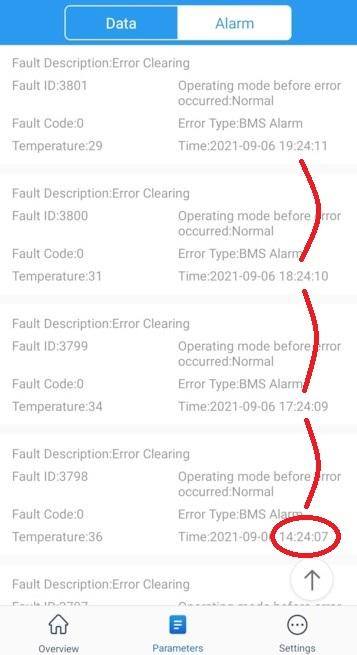
Hey guys, I finally got Batteryview running on our US3000A...some questions (@Youda, you seem to be the expert on this :-) I have Batteryview Version B2.0. Seems newer versions give more info, but I cannot find a newer version. Anyone got a link to a newer version of Batteryview? Main reason for connecting via Batteryview was to search the event history / event data, however it comes up empty. We did have the battery shut down once due to excessive power draw during loadshedding - granted, this was a few months ago now, but seeing as no events listed at all I'd have thought it would have stored this event even if old? Reason for wanting to view event history - on our Goodwe, via PVMaster, it shows a recurring Alarm: Error type: BMS Alarm Fault code: 0 Fault Description: Error Clearing (??? What error) Operating mode before error occurred: Normal What the heck does this mean? This fault repeats itself, mostly every hour, sometimes a few hours in between (but always 24minutes past the hour) - no pattern to this one hour vs many hour delay that I can recognize. I was hoping Batteryview's access to event history would tell me more, but as mentioned it comes up empty...Any ideas? Thanks as always... Markus
-
Hi guys, Weird "error" showing up in our Goodwe alarms. Setup: Goodwe ES with single US3000B (plus panels etc), setup works fine but keeps showing this "error": Fault code: 0 Error type: BMS Alarm Fault description: Error Clearing Always comes up at 13minutes past the hour, sometimes every hour sometimes a few hours in between (see screenshot below). Any ideas?

-
Interesting story - most of you already know this, but I was dumb struck by the magnitude of the effect... We had an array of 7 panels in series (360Wp each), running just over a year. Yesterday finally installed an 8th panel we'd provisioned for - expecting a 14% increase in yield. Monitoring the PV output this morning, seemingly it was producing extra but wasnt sure and waiting for midday peak - it started consistently dipping around 11am. "Weird, no clouds, what the ???" I thought. It dawned on me - the newly installed panel has a small chimney that may be casting a shadow on the new panel. But surely that can't be? The dip showed lower production than what the 7 panels on their own would produce!!! Surely with shadow on 8th panel I'd still produce 7 panels plus one additional "downgraded" panel??? Anyways, climbed on the roof, and there was indeed a small 8cm by 8cm shadow right at the bottom of the newly installed panel (total array size 8m x 2m, size of each panel 2m x 1m, so the small 8 x 8cm shadow really was comparatively tiny). Long story short, I cut the chimney - no more shadow, and the PV output immediately jumped by almost 25%!!!! (See image below) I understand any shadow will handicap the system somewhat, but didn't realize how much it would actually handicap the entire array! Wow, lesson learnt, if any part of your array gets shadow throughout the day then either get rid of that shadow, or split into 2 or more separate arrays to minimize the effect...

-
Interesting, thanks guys...why do you say Sunsynk is a better option? What makes it better (besides the price)?
-
Hi guys, Six months ago I installed a system with the 4.6kw Goodwe (based on the excellent advice I'd received on this forum)...very happy with it! Now a mate of mine wants to install, and I'm suggesting the Goodwe (fits his requirements well as a hybrid grid-tie). But, we all know technology moves at lightning speed...is there anything new on the market that you guys would recommend over the Goodwe? (apart from the previous Victron vs. Goodwe discussion). Cheers, Markus
-
Had our internet go down for a few hours once, and data obviously wasn't logging. Internet back, and a few hours later the data was uploaded, so yes it does seem to store and send later - a few hours worth at least. But better someone really in the know answers this in more detail...
-
Yes, I am very happy with the Goodwe (now three months running), but do wish one had more configuration options....ce la vie, answers to another post of mine here had warned me about this lack of Goodwe customisation; although very happy I do find myself dreaming of a blue upgrade p.s. when I have some time I will try set the battery to "other" and manually see what parameters I can set - SOC shouldn't be too difficult to limit with a reduced voltage (please anyone if I'm being an idiot with this comment / assumption do let me know). Will revert back with my findings...
-
Is there really no way to limit with the Goodwe? What about setting the battery as "Other" (not specifying its a Pylon) and setting custom parameters? Or is it rather recommended to stick to setting specifically Pylontech (maybe one needs to set this for correct communications with the BMS?) Ultimately I really would like to set the battery to charge only to +- 80% (with on grid discharge to 40% DOD). This will keep the battery at between 60% to 80% while connected to the grid. Furthermore, I'd like to limit the charge / discharge during grid connect to only 15A or so. Worth doing to increase battery longevity? Or rather stick with Pylontech battery settings (which cannot be changed)?
-
Back to original question - Is it better to cycle (exercise) a Pylon, or keep it charged? (For this question please disregard Eskom savings, this is purely a question of battery longevity). They say better not keep it at 100%. No problem to keep it at 50% - 60% for extended periods... To phrase it differently - what degrades a Pylon more, keeping at high charge or cycling up and down to say 60% daily?


