markus_m2
Members
-
Joined
-
Last visited
Everything posted by markus_m2
-
Still on the lookout for 2nd hand panels - preferably Canadian 360 - 380W, but will consider anything with IMP between 9.2A - 10A 😉
-
Installed the Goodwe about 3 years ago ... loving it. Upgraded over the years with additional battery capacity... BUT, now in winter I realize (again) I really could do with some extra PV panels (does one ever reach a point of total contentment? 😉 Currently: one string of 8 * Canadian Solars, 360W each (IMP: 9.1A). Model: CS3U-360P I have margin to fit another 2 of these to the same string and stay within the MPPT limits. Issue: Not only are these panels long out of production, all current panels I find have a much higher IMP (generally starting at around 11A). I've been scouting for 2nd hand panels (even similar IMP panels from other manufacturers), no luck... Question 1: Would installing a new 11A panel be detrimental to the system (other than pulling down the power output of only the 11A panel itself)? Could I expect to benefit roughly 1/8th per addition over and above my current 8 panels? (roughly, obviously dependent on voltages of new panel). Or would the newer panel technology and specs really mess with my inverter's MPPT trying to find the sweet spot? In case I'm not able to add as per question 1 - I'd have to look at a new separate string. I really want to avoid this route - additional cables, breakers, etc. And most importantly the min startup voltage issue has me adding more panels than I actually want to budget for. ce la vie... Googling the datasheet for the GW5048D-ES, I get different specs (listed here only the differences / important points): Question 2: Did these differences come in with a subsequent "upgrade" in hardware, or was it Firmware that miraculously changed these figures? (surely not?) I have also put this question to Goodwe, but hope someone here knows the answer while I wait for a reply... IF I need to go the route of adding an additional string: Newer specs would definitely help, as I could fit 3 "high power" panels with a higher IMP, making most provision for potential future expansion (having now learnt about technologies moving on). Older specs I'd have to find lower IMP panels (not many sub-11A panels around anymore), AND I'd have to install 4 of them to fit in the min start-up voltage... Any other thoughts and suggestions on my predicament would be highly appreciated

-
Ain't that the truth! 🤣
-
Disclaimer: I don't have much experience with aux (yet, by next week my father in law's geyser will be on aux)... I would do as you're suggesting- all non-essentials on aux, wire and program correctly, but include a change-over switch to Eskom. That way, you manually manage your loads while on aux (and correct setup will disconnect aux below certain battery level), but you still have option to connect direct Eskom in case you need to run beyond pass-through limitations (seldom, but best to future proof from the start)... Best of both worlds 😉
-
Moderate system: roughly 5kW inverter, 2kWp and UP5000 or similar - looking for a reliable installer around Pretoria East (specifically Meyerspark close to Silverton)... Any recommendations on installers in this area?
-
Does the geyserwise itself switch the element off at 55deg? Or does the geyserwise show as still heating, but it doesn't get hotter, in which case I'd say your mechanical thermostat (at the geyser itself) is set to cutout at 55deg...
-
Intermittent temperature reading issues below a certain temp; i know theres some very clever okes here might know what causes this 😉 Connected a Sonoff TH20 Elite temperature sensor to my geyser. This uses 1-wire comms between probe and Sonoff device. Direct connection all works well (30cm probe wire length). I then extended the probe cable using UTP CAT6 cable, roughly 5m length. Comms and ground to one twisted pair (orange & orange/white), and power to a single strand of another twisted pair. (Green). "Extended" using two sets of CAT6 crimps and extender adapters. Important: the one extender adapter sits in a "housing" on the side of the geyser which gets pretty warm... ISSUE: intermittent temperature readings! As soon as the geyser temp drops below roughly 43deg, the temperature is no longer shown, until heated up beyond roughly 43deg again (between 42.5 and 43.3 seems to be the "cut-off" point). What the heck could be causing this???? I've done some basic troubleshooting, with more troubleshooting ideas, but access to the geyser is a mission hence hoping someone has an idea off-hand how to resolve this... Troubleshooting thus far: 1. Originally the individual probe and UTP cables were just twisted together with some heatshrink (inside the warm box on side of geyser). Replaced this with UTP connectors and extender adapter. Problem persists. 2. Ran a separate temporary 5m UTP cable extension, away from all potential electromagnetic interference, problem persists. 3. Got another temp probe, crimped with UTP, and connected directly to the "close to sensor" UTP extender (i.e. roughly 30cm between sensor and probe, with UTP extender in between but no UTP cable). Tested with a mug of luke-warm water and waited for temps to drop - worked perfectly all the way through 43deg down to ambient. 3. Connected same new probe at the geyser UTP extender. Funny thing, outside the geyser box it read the value (ambient about 20deg). I then placed this replacement probe (and UTP extender) inside the geyser box to let it run for a while and see performance over time. HomeAssistant shows very quick temp rise and within around 10secs, passing 30deg or so, readings stopped (by which time I'd already climbed down the ladder 😉 Water temp at the time was below the magic 43deg, as soon as I heated the water beyond 43deg this "replacement" probe started showing the temp again. i.e. Problem persists, it's not a probe issue... Further troubleshooting ideas (very much open to further suggestions here): 1. Place the UTP connector (extender) outside the geyser box. As mentioned, it gets quite warm in there, BUT the connector seems to happily work when warm above 43deg, which is counter-intuitive. (But seemingly also happy below roughly 30deg). This connection having previously been "hotwired" together though I don't think the problem lies here...Anyways, ill temporarily route the probe cable and extender outside the box and see what results this gets. 2. Would changing the UTP to STP (shielded cable) help? I suspect that won't make a difference, but worth a troubleshooting attempt? 3. Actually spend some time up by geyser (yay!) with lukewarm cup of water, running sensor from around 50deg down to ambient...alternating UTP connector inside and outside the geyser box, alternating between the two probes. For sure I'll get some answers from this experiment, but I'm trying to avoid having to spend extended periods of time up there, or having to go up at all, 😆 Any ideas / thoughts?
-
Just a tiny shadow on the edge of a single panel reduces performance of the entire array - check out
-
Still eternally hopeful 😉 Anyone got 2nd hand Canadian Solars for sale, CS3U between 360 - 375W?
-
I'd say you need to limit PV input to 12V max
-
That is indeed strange! Same inverter, my HA doesn't shows normal behaviour. I would log a ticket with Goodwe...
-
LOL, yes, I have a similar story - car broken down in the middle of Botswana, with my "physics doctorate" mate standing next to me gobsmacked (handing me the tools) while I hot-wired the failed immobilizer....He will NEVER live that story down 🤣
-
@Scorp007, Modina was kind enough to do exactly that on this thread:
-
I thought the exact same, coupled with the realisation that in my youth this stuff was completely uninteresting, but now I find it fascinating (especially now one can put it to such cool practical use) Thank you @Modina, really appreciate you taking the time to explain! Will go through your post in detail when I have time, and research more on my own, before embarking on this cool project...Will post results 😎
-
@frivanand @Modina, in another thread you mention using two capacitors in series to "derate" a geyser element... Could you please elaborate? This could be a GREAT solution ! My solar water heater element is around 3.5kw, and I've been considering replacing with a smaller element (to stay within the bounds of my PV production), but: 1. SWH doesn't take stock standard elements (Solahart). 2. We'd loose ability to heat up the water relatively quickly if needed. Idea: run parallel (seperated) circuits feeding the geyser. Controlled by wifi switches in a way that they're never connected at the same time. One circuit straight in (no funky electronic gizmos, straight supply), the other parallel circuit using capacitors as mentioned to "derate" the element. What would be needed and how would one wire this 2nd "derating" circuit?
-
The more I reas this forum the more I realize I don't know 🤣 Awesome stuff....
-
Awesome, thanks. Some mates installing soon so I'll definitely punt the Goodwe as an option 😉
-
I have the previous gen Goodwe, so very keen on this new one coming to market...who is supplying them?
-
-
-
Check here:
-
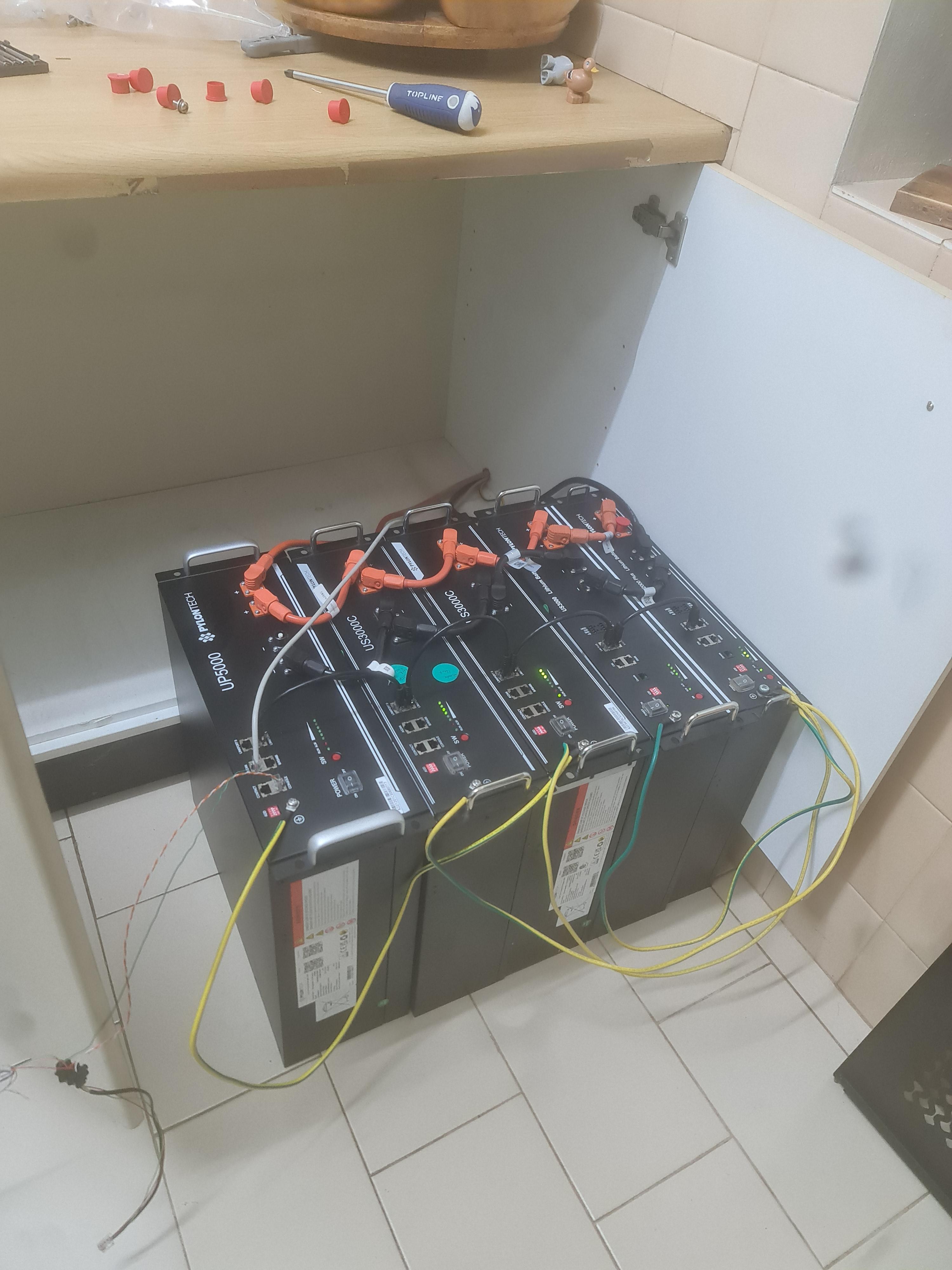
Not sure what you mean by upgrade - I did install latest firmware in all batteries, UP5000 as master, and off it went.... At the peak I was running (in this order): UP5000 master US3000C US3000C US3000 US2000Plus (Temp install for only a week, hence the "incorrect" single inverter power cable...two of the batteries have since gone to my parents;-)

-
My Goodwe runs my UP5000 mixed together with 3000 and 3000C and 2000Plus', basically a mix and match of Pylons collected over the years, NO PROBLEM! Telling the inverter what battery you have literally just sets an additional level of charge / discharge and DOD limits over and above BMS comms (at least I don't see any other advantage to setting the exact same battery type in Goodwe settings, maybe someone can correct me on this?). I.o.w. what @P1000 mentioned is correct, a single UP5000 has the same charge / discharge current limits as two US2000 (doesn't matter normal or C). If, for example, you have a UP5000 (50A max) mixed with a single US3000 (37A max) giving you a combined max 87A charge/discharge, set the Goodwe to 3x US2000, thereby setting max 75A; slighly lower but helps with the longevity of your batteries 😉
-
Offer R25k for both...
-
Barely used it because its been so fickle (only sporadically accepting changes)