


system32
Members
-
Joined
-
Last visited
Everything posted by system32
-
I would use the diagram in the user/installation manual: In the bottom-right (blue arrow) the E-N Link is driven by ATS240

-
I have 4 x Hubble AM2 batteries. These are 100A "1C" rated as can be seen from the LiBMS screen below. LiBMS indicates a charge/discharge limit = 400A (4 x 100A) from the battery bank. The SunSynk 8k is configured lower at 150A -> 7.2kW to 7.9kW depending on the voltage. On the below left, Solar-Assistant showing 7.793kW drawing from the battery bank whist grid was connected. On the right, 6.461kW drawing from the battery bank with no grid. Having multiple batteries in parallel (aka bank) allows for higher current / kW to be drawn from the battery bank.


-
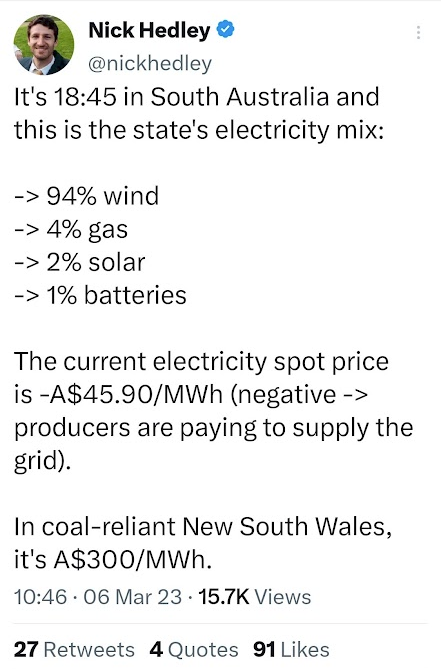
In a renewable economy, we going to have to over provision and distribute to deal with weather issues - sun don't shine, wind don't blow, etc. The end result will be plenty of periods with the marginal cost of energy being zero with plenty of excess when the wind blows and sun shines. Remember that the cost of solar and wind fuel is zero. Tony Seba - world famous futurist with excellent track record has a talk on "Super Power/Super Abundant" energy. https://www.youtube.com/watch?v=fsnkPLkf1ao The Tony Seba talk is a prediction of what will start happening in places like Australia, US, China, Spain that are aggressively adopting Solar & Wind in 10-20 years. Chamath Palihapitiya - well respected venture capitalist talks about "zero marginal cost of energy" in the All-In-Podcast at 1:32:48. https://youtu.be/FOuks3BM55o?t=5537 The discussion is in relation to on-shoring in US, where electricity is more expensive that China and that Solar & Wind will over supply will result in zero marginal cost of energy. ZA needs to plan accordingly as electricity is a major cost in a manufacturing economy. https://twitter.com/nickhedley/status/1632664003406077952
-
+1, I agree with your points. In most places, PV+Battery is to self consume what your panels generate. Lots of homes in sunny places like California and Australia are retrofitting batteries to panel only system to change from grid-tie to self-consumption. The feed in rates for electricity has dropped to near zero during midday in these places. It's cheaper to self-consume than round-tripping the grid and buying back at peak. In ZA, batteries are required to deal with load shedding with the added benefit of self consume. In ZA if you have PV+battery I would expect that in the event of load shedding you would self consume first. If you have excess, then by all means sell to the grid, be it at midday or 5pm peak.
-
Competition and regulation do help to ensure that customers are protected. We need to learn from mistakes in California and Texas with privatised energy generation. Eskom is not a private entity, it is a non-profit SOE designed to minimise electricty costs - well how's that going? California with Enron Scam and Texas with Regulator not mandating weather proofing of gas supplies pales in comparison to the utter destruction that Eskom load shedding has wrecked over the past 15 years.
-
The price of gas and and price of oil in Europe has everything do do with the Russia/Ukraine war and sanctions and very little to do with privatisation. The answer to high gas & oil prices is to not rely on gas & oil and to self generate electricity from other resources like solar and wind. My home of 5 has not had load shedding since Nov 2021 when I installed my system. My home of 5 has reduced Eskom bill by ~85% (pay Eskom 15% and 85% comes from Sun). Fortunately in ZA we blessed with excellent Solar and Wind, just need to make use of it. Back to the topic, PV incentives are a token. Many of my neighbors are installing Solar+Lithium Battery. Many businesses are installing Solar. Eskom will be left with the non-payers (Yes, I'm looking at you Soweto).
-
I have an issue with (3) their energy is more expensive. Yes it's more expensive if you do a straight Rand/Dollar conversion. You conveniently forgot to factor in local purchasing power and access to natural resources (coal, wind, solar). People earning € or US$ have a much higher purchasing power that ZA locals. ZA has access to local cheap coal and high quality solar and wind resources. IMHO, I think SARS/Government R15,000 for solar panels is narrow minded and does not address the load shedding issue aggressively enough. 1) Does not look at at the system as a whole, the R15,000 only applies to the panels - no mounting system. no cables, no fuses, no installation, no inverter, no battery. Sure people are going to claim for the panels and make it more affordable, but it's not enough of an incentive. 2) The R15,000/R60,000 limit is high for panels only. Most home installations don't install R60,000 of panels. Most people are not going to realise the R15,000 saving. The incentive should: 1) Be on the whole system 2) Be for grid feeding systems only 3) Require batteries to deal with peak 4) Be higher +50% of total system cost You may think 50% is a excessive - it's actually low. 50% is the cheapest electricity that SARS/Government can fund. SARS/Government is getting a 50% discount on every kWh added to the grid - much cheaper than any other hardware or kWh. With battery, you address the intermittency of solar. 50% incentive will directly reduces Eskom's income (and coal industry revenue) but having no load shedding is 1000% better for the country than worrying about Eskom revenue. Load shedding has cost the country trillions of rands over the last 15 years - Eskom had it's many chances and have failed to live up to their mandate.
-
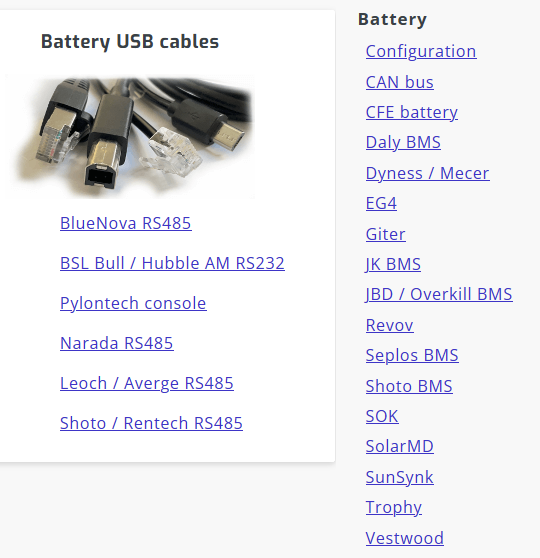
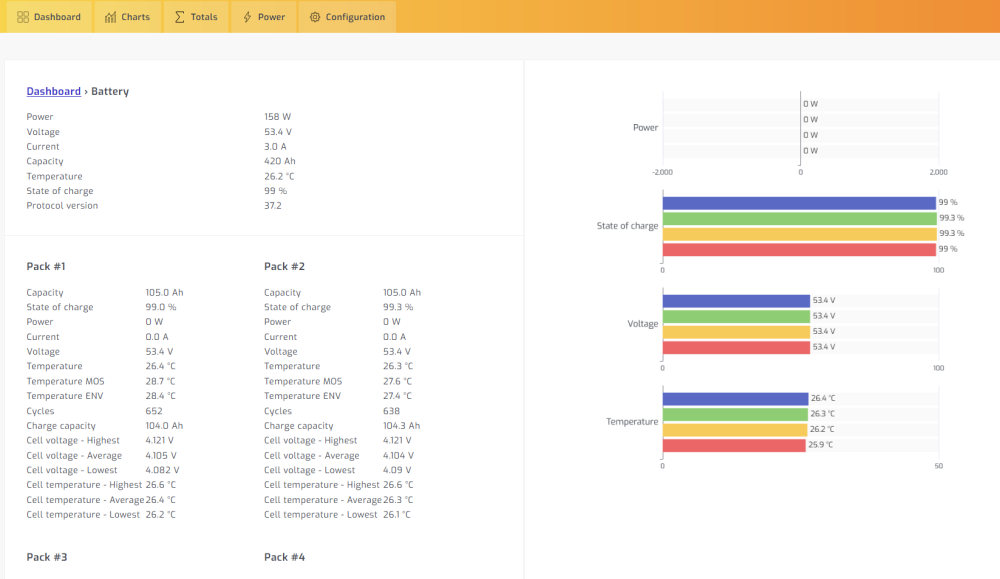
Do you have a cable connecting SA to your battery? You required a cable to connect so SA can read the detailed data from the battery. solar-assistant.io shop: Edit1: would be nice for SA to provide cell voltages Edit2: Not all information is available on all batteries.
-
In Jan 2023, SunSynk released some new firmware that allows the inverter to enter a "low power mode". This low power mode is designed for countries that have little sunlight in winter. When in low power mode the +/- 100W decreases to a few watts to save the batteries end enters a bypass (straight through) mode. The downside is that in the event of an outage (load shedding), it takes the inverter a few minutes to wake up. Not sure this new "low power mode" would be of any benefit with South African regular load shedding. Check the SunSynk youtube channel for details.
-
Correct. The first geyser has a 3kW element 300l Kwikot - it is connected to a Solar water heater (thermosyphon) , I boost it at 10:30 to 65C and let the sun heat it further during the day - this has a GeyserWise timer. The 2nd geyser has a 2kW element 100l Kwikot used in a cottage with 1 resident - this has a Sonoff Geyser timer. If it's overcast, the geyser will draw from the battery. According to the SunSynk 8kW manual, the inverter is able to pass through 50A (~11kW) when grid connected. 10kW UPS Load ~ 4.9kW from Solar PV + 3.5kW from battery + 2.0kW from Grid The numbers don't add up exactly as there is some lag, but close enough. The inverter is inverting ~8.4kW To date I've not yet had the inverter trip.

-
My whole house, including 2 geysers, dishwasher, washing machine, tumble dryer, all runs on the "backup/essential load" (UPS) side of the inverter. I have some timers that limit geysers to heat up (sequentially) between 10:30am and 17:00pm when the sun is usually shining.

-
Does not compute. SARS does not rebate some of the required equipment such as fittings, inverter, installation costs, CoC - ONLY rebates the PV Panels. But: The good part is that it's offset against your Income tax, so all those that have not registered to avoid tax will loose out.
-
In terms of Grid Charge Amps, you need to factor in your grid feed. My grid feed is an 60Ax230V = 13.8kW feed. Grid Charge Amps is at 48V, I found 40Ax48V = ~2kW to be plenty, leaves ~11.8kW for the rest of the house. In my setup, the 2kW Grid Charge is only used when the battery goes below 20% to bring it back to 20%. I have 20kWh of battery, so 20% is 4kWh, so worst case it takes 2 hours to go from 0% to 20%. My actual Low Battery cut off is about 7%. In my case I rarely go below 20% and mostly charge from Solar PV. EDIT: Not sure if pbmstools works with your battery - worth a try to check if cells are OK.
-
What's the settings on System Mode? Suggest something like this: Enable Grid Charge Below 20% - change to 50% (or a suitable value) Enable grid charge: Alternatively, try changing the battery to AGM/V and manually setting the voltages on the various screens. I did that for a while with Hubble AM-2 which also had broken firmware.


-
@MeepMoop wrote: >My batteries are now in a state where they refuse to charge, and 1 of them is flipping on and off on its own permanently. Try enabling "Activate" to revive a discharged battery.

-
If your battery is 0.5C rated, it will only allow 50% of the rating.
-
+1 If you installing Solar PV + Battery, then the recommend, most cost effective & simplest solution is to use excess PV electricity to heat your normal geyser. Use a timer (eg GeyserWise / Sonoff Geyser) to limit geyser to solar time - 10:00am to 16:00pm.
-
The relay has to be controlled by the inverter (see info about delay below). On my SunSynk 8k, there are 2 wires connected from the ATS240 points on the inverter to a relay in box that bonds N & E. The SunSynk will activate the relay box when in Island Mode (grid goes off). When grid returns, the SunSynk is programmed to delay ~60s (NRS requirement) before connecting to the grid and deactivating the relay.
-
+1 Presenter did not explicitly state if the Generator was included, so you probably correct that should be a bit more. Based on the fact that he owns a Tesla and some big excavators, C$130k does not seem to be an issue. In South Africa we fortunate that we have plenty sunny days, so could get by with a much smaller system to support similar loads. I've hear that Eskom charges $$$ to connect farms that are distant from grid. In these farm cases, R2.3m may be quite reasonable. In Australia, the grid provider is replacing long distance grid lines to farms with off-grid solar+battery systems as it's too costly to maintain the long distance power lines to farms in addition to the fire risks. The operator owns the system and bills the farm owner. See https://www.abc.net.au/news/2022-10-02/thousands-of-renewable-standalone-power-systems-to-be-rolled-out/101479136
-
1) Can you confirm that "Signal Island Mode" is enabled 2) Does the RED led lights up on the Neutral Earth Bond box when grid is off? 3) Whats the voltage on the Essential Side (when grid is off): L-N -> Expect 230V L-E -> Expect 230V N-E -> Expect 0V

-
Interesting video. Does not state if grid is an option in Southern British Columbia Canada - seems not. Pretty sure Eskom does not reach all the way to nowhere land - 🤣 Location: Southern British Columbia Canada Schneider Electric Inverters & Charge Controller 3x16x435W panels (20.88kWp) 96kWh of battery storage - enough for 4-5 days with no solar. 13kW diesel generator for when it snows for more than 5 days in a row (only in Dec/Jan) C$130k installed Tesla Car, Starlink Internet

-
>i use between 12 and 15 kWh a day according to my eskom meter. >20kWh of battery power (2x10kWh in series parallel) >Is the Atess 30kw inverter able to do this? >I also looked at the Deye 50kw 3 phase inverter (my system is 3 phase) I use ~26.2kWh per day - almost double your consumption. SunSynk 8kW singe phase 16 x 400W Panels 20kWh battery House of 5 I'm 85% self consumption (15% is due to rain/clouds) I don't current grid feed I'm on pre-paid For you, I would consider a smaller 8kW 3 phase inverter, 12-14 panels in two strings of 7. If possible switch to pre-paid,
-
>The unscrupulous installer still has access to my system via Solarman Business and I do not (I only have Solarman Smart so can't change any settings if needs be). How do I get control of it and remove their control? IIRC, the SolarMan WiFi dongle has a reset button for a fresh install.
-
Pity that there is no hide option. SunSynk needs to add a password to the logger screen - not good for security.
-
Thanks for the Power on & Shutdown Sequence (as per 6.1. Start-Up / Shutdown Procedure of the manual). I notice in the manual 5.23. Fault Codes, as solutions, a step in the recommend action is: F13/Reset the system F20/Reset the inverter F26/Fully reset the inverter F18/F23/Restart inverter F64/Turn off the inverter for 30 minutes and restart. For items (4) and (5) Restart inverter - I would follow the Shutdown & Power on sequence as per 6.1. Start-Up / Shutdown Procedure of the manual What are the procedures for: Reset the system - items (1) and (2) above? Fully reset the inverter - item (3) above - is this the same as in the manual 5.9 Factory Reset? Thanks in advance.


