system32
Members
-
Joined
-
Last visited
Everything posted by system32
-
See at about 279s "the inverter board from one of these it's like a computer power supply switching at high frequencies and these things always run well above audible frequencies because the Transformers on these things do emit a little bit of sound but if it's high enough frequency nobody can hear it so when it's way overloaded I guess some of that does come through it doesn't get filtered out" My Sunsynk 8k works fine with no noise that I can detect - then again my wife insists that I'm deaf, especially when being summoned.
-
Since your system does not have PV at this stage, I would use something like this: This means, maintain a 100% SoC, use Grid to Charge. Remember to tick "Use Timer". If there is a powerfail / load shedding use battery until shutdown at 12% SoC. Charge battery from grid at max of 60A*48V ~ 2.9kW - don't set this too high, as you need to allow other appliances to use Grid. EDIT1: If you have an "external N/E bond relay" you will need to enable "Signal Island Mode" Not sure if "external N/E bond relay" is still required with newer model inverters as they may have a relay built in. a) turn grid off b) use a voltmeter to check the voltage on the "UPS" circuit: Earth + Neutral = should be zero Earth + Live = should be ~230V Neutral + Live = should be ~230V EDIT2: You have 4x Ecco 5kWh LFP = 20kWh 12%(2.4kWh) to 100%(20kWh) = 17.6kWh 17.6kWh/2.9kWh ~ 6hours to charge EDIT3: TIP: If your whole home is on UPS, add automation to disable geyser, dishwasher, pool, stove, washing machine during load shedding.

-
Please post your Sunsynk: Battery Settings System Mode Settings See this post for my settings: https://powerforum.co.za/topic/10730-sunsynk-8k-hubble-am2-16x400w-pv/?do=findComment&comment=143325
-
LiBMS Check that LiBMS is working. BMS controls the charge/discharge based on SoC. Depending on SoC, the BMS allows different charge & discharge rates. The inverter will only allow a max of 150A (set above). 35% -> 400A/400A * 48V charge/discharge, <10% -> 400A/200A and 400A/0A >95% -> 0A/400A CT COIL:


-
SunSynk 8k Settings Version Battery-Setup Activate is used to recover a "dead" battery 4 x 10⁵Ah = 420Ah * 48V ~ 20kWh 150A * 48V ~ 7.2kW limit charge/discharge battery 50A * 48V ~ 2.4kW limit from grid - must be less than 25% of your "service connection circuit breaker" The 53.6V float are for Hubble AM2 (from their web site) Signal Island mode to activate N/E bond relay BMS_Err_Stop prevents the inverter working if there is an error. 10% SoC is where the inverter will start working again after a shutdown System Mode Setup Maintain a minimum of 20%/35% SoC during the time periods. If there is grid (ticked) use grid to get to 20%. Don't overlap the times and keep them in order and no gaps. If there is no grid, inverter can go down to the Shutdown SoC% If there is grid, stop using battery at 20% 20W trickle feed to prevent pre-paid meter trip - considering 0W Grid is on & SoC< 20%: use Solar & Grid to get to battery to 20% SoC Grid is on, SoC> 20%: use Solar, then battery to power UPS, excess PV goes to battery Grid is on, SoC> 20%, UPS load > 7.2kW: use Solar, then battery, then grid to power UPS Grid is off, use Solar, then battery to power UPS, at ~5% SoC shutdown. At Night, use battery until 20%, then switch to grid. System Flow Chart Note: the whole house is connected on the "UPS" side Useful video on setup of Deye https://www.youtube.com/watch?v=miOrLBp4t0Q


-
South Australia grid is 'collapsing' because Scott Morrison ate the big banana in South Australia.
-
Thanks for the feedback. The below is from a post I did in a another, but felt I would like to add it to this thread. Been considering grid feeding, here are my findings: CityPower / CoJ should get with the renewable program and encourage cheap renewable PV + Storage by: 1) Publishing guidelines, rules, application forms, costs for TOU meters, tariffs for grid-feed 2) Streamline the process 3) Use plain-speak suitable for residents and lay people: see https://www.joburg.org.za/Documents/2020 Notices/Bylaw Notices/Proposed Draft Electricty By Laws.pdf for an example of difficult to read legal speak (and the document refers to previous 2000 rules with no links) Q1. What is the feed-in rate for CityPower? Not listed in https://www.citypower.co.za/customers/Pages/Tariff-Info.aspx Q2. Is it still "net-metering" or can I sell all my excess to CityPower. According to https://www.sseg.org.za/wp-content/uploads/2019/04/City-Power-Experience-SSEG.pdf https://www.joburg.org.za/documents_/Documents/2022-23 Final Tariffs/ITEM 3C Consolidated2022-23FinalTariffsForApproval-19May 2022.pdf A1. ❖ Domestic Embedded Generator ✓ Customer should be on post-paid residential with Time of Use (ToU) tariff ✓ Residential Embedded Generator [Feed in rate] 70.70c/kWh flat rate [2022/23 rates] TOU single phase <=80A Service/Admin + Capacity charge: R886.98 (inc VAT) [2022/23 rates] I could not find 2022/23 TOU domestic rates, so these are from 2021/22 with a 14.49% increase: The domestic TOU rates are telescopic, this is just up to 500kWh per month: Peak Summer 226.54c/kWh, Winter 521.19c/kWh Standard Summer 190.98c/kWh, Winter 227.84c/kWh Off-Peak Summer 140.98c/kWh, Winter 150.66c/kWh [ when you charge your Tesla ] A2. Net Billing against consumption charges still applies So they pay you 70.7c/kWh with a net metering limit, but will charge you up to 521.19c/kWh. I could configure my system to ensure I only don't use grid during peak and only use battery. I use ~180kWh from CoJ. Using only Standard off Off-Peak, I would only be billed TOU R344 (summer) or R410 (winter) per month. Due to net-metering I could make a maximum of R344 (summer) or R410 (winter) per month. Does not sound like a good home business plan considering I would have to pay for a new meter and pay R886.98/pm in fees. CoJ should/must remove the net-metering to make it viable. CoJ can come and beg me when they remove the net-metering so I can give CoJ all the excess kWh. TIP: Pay me more to grid-feed during peak - I'll discharge my battery during peak to grid feed. Pay me like you pay Eskom. I can then offset grid-feed revenue against: Electricity consumption kWh Electricity Service/Admin Fee + Capacity charge Water consumption KL Sewer Fee PIKITUP Rates & taxes And if I exceed the total due, pay me cash. It's a win-win situation - my kWh are cleaner than Eskom's
-
See this thread https://powerforum.co.za/topic/11206-hubble-lithium-battery-am-2-55kwh/?do=findComment&comment=123435 Many people have done the firmware upgrade with either their own made cable / a Hubble Lithium supplied cable or the SA cable: You need a laptop.
-
A friend is Work-From-Home and his company supplied thousands of staff with these "trolly" UPS with 100Ah AGM battery. 100Ah * 12V ~ 1200Wh, at 50% DoD ~ 600Wh usable. The typical load is ~100-150W consisting of laptop/pc, special vpn router, wifi, ont, 21" screen. After 26 months most have had their batteries replaced once and are again unable to sustain the load for two hours. They seem to have exceeded the number of cycles 300-600 of AGM batteries or are damaged due to being discharged below 50% DoD caused by longer outages and misconfigured shutdown settings on the inverter and not enough time between load shedding to recharge. They now considering a lithium battery based solution.
-
60 minutes - seems normal for a 5 month old lead battery subject to current levels of load shedding and below 50% DoD. Seems you getting the expected life out of a lead battery based system. Did you change parameter 19 on your inverter to prevent over 50% DoD? For current levels of load shedding, lead batteries are not recommended. Lead batteries have a cycle life of approximately 300-600 cycles with 50% Depth of Discharge (DoD) - much less if you exceed 50%. After ~66 days of load shedding 3 time/day, your typical lead-acid battery will loose ~50% of its capacity if run flat during those 2 - 3 hours. Only viable option for daily use is Lithium based batteries, depending on composition, Lithium batteries have 3000-6000+ full cycles with 95% DoD & 80% capacity at the end. Also lead batteries are only 50% efficient and Lithium are +90% efficient.

-
BMS Firmware update fixed the discrepancy
-
Ingula has 21,000 MWh capacity and cost US$3.5 billion (R63 billion) Now if we could only find some high mountains near some water...
-
Thanks for the feedback. I wish CityPower / CoJ would encourage PV + Storage by: 1) Publishing guidelines, rules, application forms, costs for TOU meters, tariffs for grid-feed 2) Streamline the process 3) Use plain-speak suitable for residents see https://www.joburg.org.za/Documents/2020 Notices/Bylaw Notices/Proposed Draft Electricty By Laws.pdf for an example of difficult to read legal speak (and the document refers to previous 2000 rules with no links) 4) Get with the renewable program and encourage cheap renewables. Q1. What is the feed-in rate for CityPower? Not listed in https://www.citypower.co.za/customers/Pages/Tariff-Info.aspx Q2. Is it still "net-metering" or can I sell all my excess to CityPower. EDIT: According to https://www.sseg.org.za/wp-content/uploads/2019/04/City-Power-Experience-SSEG.pdf https://www.joburg.org.za/documents_/Documents/2022-23 Final Tariffs/ITEM 3C Consolidated2022-23FinalTariffsForApproval-19May 2022.pdf A1. ❖ Domestic Embedded Generator ✓ Customer should be on post-paid residential with Time of Use (ToU) tariff ✓ Residential Embedded Generator [Feed in rate] 70.70c/kWh flat rate [2022/23 rates] TOU single phase <=80A Service/Admin + Capacity charge: R886.98 (inc VAT) [2022/23 rates] I could not find 2022/23 TOU domestic rates, so these are from 2021/22 with a 14.49% increase: The domestic TOU rates are telescopic, this is just up to 500kWh per month: Peak Summer 226.54c/kWh, Winter 521.19c/kWh Standard Summer 190.98c/kWh, Winter 227.84c/kWh Off-Peak Summer 140.98c/kWh, Winter 150.66c/kWh [ when you charge your Tesla ] A2. Net Billing against consumption charges still applies So they pay you 70.70c/kWh with a net metering limit, but will charge you up to 521.19c/kWh. I could configure my system to ensure I only don't use grid during peak and only use battery. I use ~180kWh from CoJ. Using only Standard off Off-Peak, I would only be billed TOU R344 (summer) or R410 (winter) per month. Due to net-metering I could make a maximum of R344 (summer) or R410 (winter) per month. Does not sound like a good home business plan considering I would have to pay for a new meter, pay R886.98/pm fees. CoJ should/must remove the net-metering to make it viable. CoJ can come and beg me when they remove the net-metering so I can give CoJ all the excess kWh. TIP: Pay me more to grid-feed during peak - I'll discharge my battery during peak to grid feed. Pay me like you pay Eskom. I can then offset grid-feed revenue against: Electricity consumption kWh Electricity Service/Admin Fee + Capacity charge Water consumption KL Sewer Fee PIKITUP Rates & taxes And if I exceed the total due, pay me cash. It's a win-win situation - my kWh are cleaner than Eskom's
-
WARNING: avoid solarbay, hellosolar, sunsmart, heatsmart I lost R90,000 with solarbay - see solar-bay.co.za for public service announcement.
-
Sad and not really fair if your system is not capable of feeding in. My system is Hybrid, but not yet grid feeding. If CityPower do an audit and force me to a new smart meter and pay TOU rates, then I'll feed back and offset the new costs with revenue from sales. Or go off-grid by adding a battery or two more. Do you have a link to the new bylaws that were passed 22 Sept 2022?
-
I've been on CoJ pre-paid for over 10 years, and it surprises me that more people don't use CoJ pre-paid. WARNING: - Not all metro's tariffs are the same - YMMV eg EKURHULENI pre-paid is the same as postpaid. - some metro's charge a connection/network fee on pre-paid Tip 1: When installing Solar. ask you installer to add a plug on the feed side for the keypad [if your keypad is communicating over power lines]. Tip 2: Make sure you install an official metro meter - go direct There was a scam some years back where scammer would install a their pre-paid meter, and then transfer the Electricity statement to their account. You would have two meters - CoJ meter and scammer's pre-paid. Tip3: Load 45 days worth of units on install, and refill back every 30 days. before solar, I kept 2000 kWh in my meter and used ~900-1200kWh per month, I would refill back to 2000kWh. On Solar I now use 200-300kWh per month, so I'm reducing the buffer from 2000 to 600. Tip4: Buy from an official vendor - I use online banking / banking app. Tip 5: Once you have Solar, get a timers for your geyser and set the schedule to use Solar to heat water (use geyser as a battery) Mine is on 10:00am-6pm and 4am-6am Also timer for pool - only run 9am-3pm Tip 6: Measure Efergy /Sonoff POW/etc. @Bobster. My keypad has a 9V battery, and according to the manual is able to communicate even without any units (I've never run out of units)

-
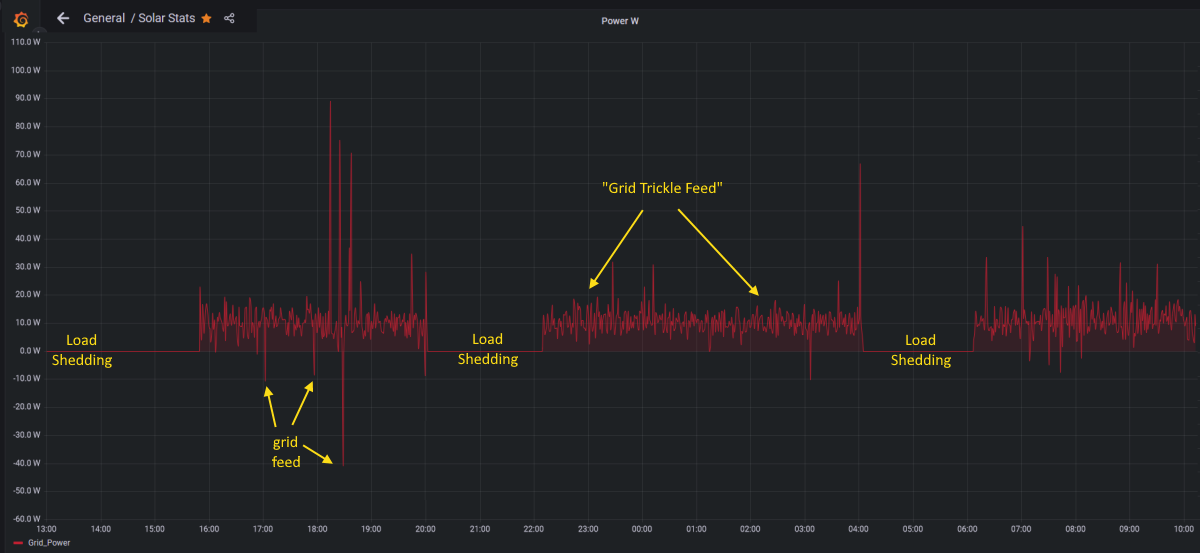
What is the SunSynk "Grid Trickle Feed" set to? This is to prevent some pre-paid meters from tripping. 0.8kWh/24h ~ 33W I reduced mine from 50W to 20W - YMMV before issues.

-
What kind/model of inverter do you have? Is the inverter configured to grid feed excess solar? Is it a "hybrid" inverter? The SynSynk/Deye have the option of "grid trickle feed" which maintains a minimum draw to stop some meters from tripping in a "Zero Export" mode. Even though "Zero Export" is selected, the inverter can be slow to react to big changes in load/supply feeding the grid and tripping the meter. The "Grid Trick Feed", raises the average to minimize grid feed. NOTE: The above chart is directly from the inverter sensors.


-
Anyone here on PowerForum in CoJ/CityPower grid feeding?
-
In my case my battery arrived at 110Ah, kept dropping Ah was reset to 100Ah via RIOT, kept dropping Ah, a firmware update reset it to 105Ah and stopped the dropping of capacity.
-
Try PBMStools to see what's going on - see above thread for details.
-
I'm not sure how to read SA - can you post it like this:
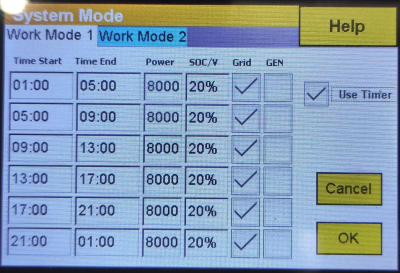
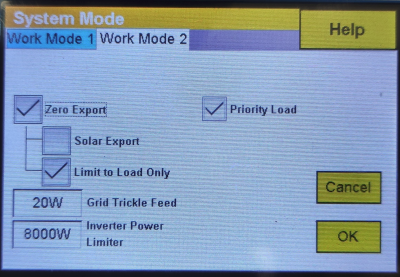
-
Probably a problem with the settings on RIOT. I much prefer Solar Assistant as it just works - pretty much gave up on RIOT.

-
Ethernet cable from CAN port on Battery to CAN port on Inverter works for me.
-
What I do not understand is how many KW’s can I safely draw from the battery when there is no PV power? Hubble AM-2 is a "1C" rated battery As @Steve87 said ~5kW - remember to set the Charge & Discharge Amps In my case I've set the limit to 150A x 48V ~7.2kW. My 4xAM2 can do 4x100Ax48V ~19.2kW The Sunsynk 8k can handle 8kW (or 8.8kW)