system32
Members
-
Joined
-
Last visited
Everything posted by system32
-
Use a volt / multi-meter meter to measure Live-to-Neuteral ~230V Live-to-Earth ~230V Neuteral-to-Earth ~0V Test when not load shedding (grid on), and when load shedding (grid off - island mode)
-
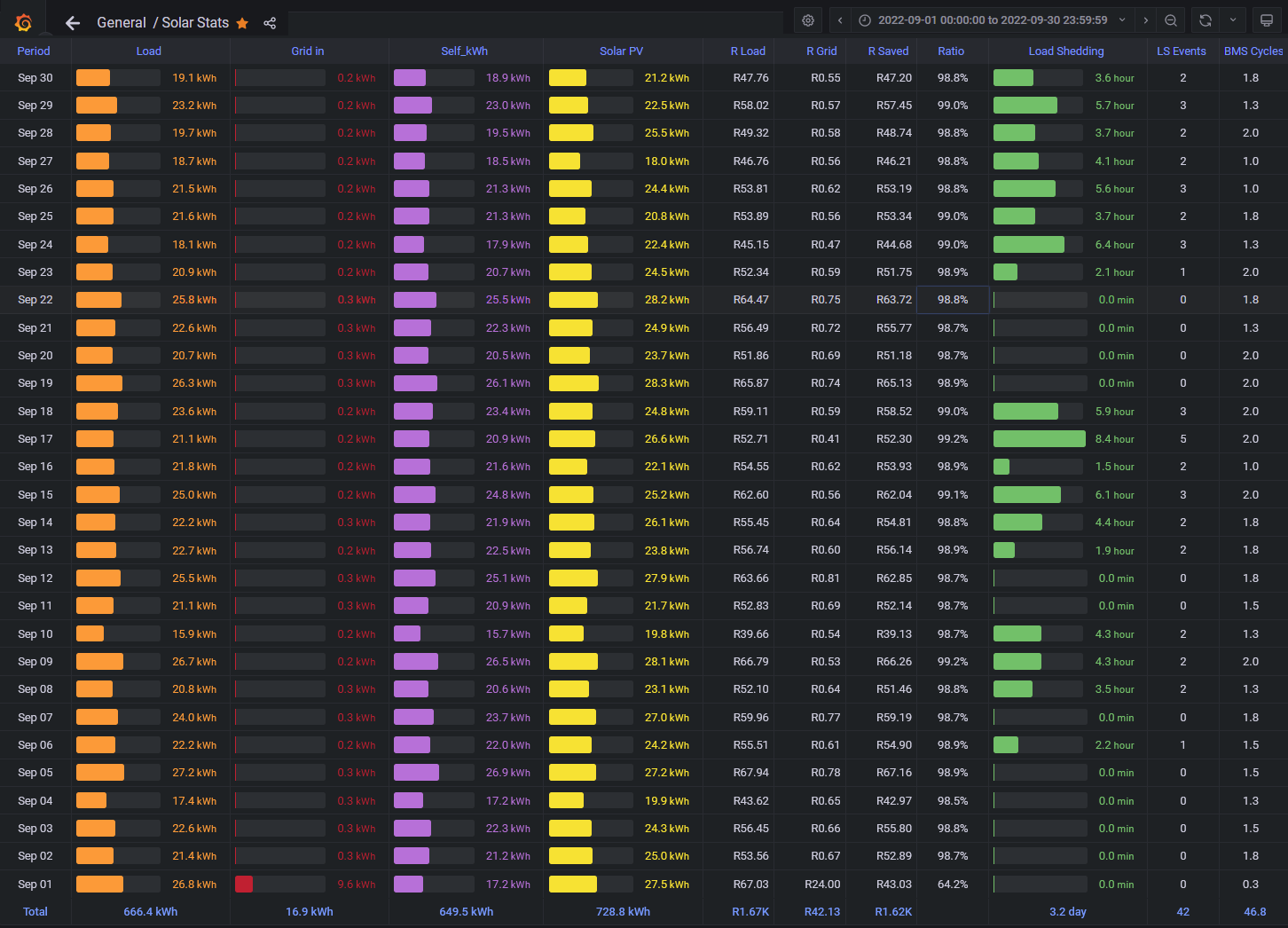
EDIT: Updated for the whole of September 2022. September 2022 been an excellent month for Solar yields (very few clouds) I'm running at 2.5% Grid_in_kWh, 97.5% Self_kWh The small 0.3kWh per day (~12w) grid_in is a trickle feed to prevent issues with prepaid meter. Not grid_out feeding yet. Self_kWh = Load_kWh - Grid_in_kWh Data from Solar-Assistant, Grafana dashboards Post your stats below EDIT: What made a difference for me was changing timers on my two geysers to use them to store energy during the day.


-
Check Neutral Earth Bonding. You may have a floating neutral when load shedding. Use a volt meter to measure Live-to-Neuteral Live-to-Earth Neuteral-to-Earth
-
SolarMan WiFi Dongle Hacking.... https://csirt.divd.nl/cases/DIVD-2022-00009/ To be fair, the issue was the publishing of super admin passwords for the backend on github.
-
@Mdf - thanks for the blue tooth tip. SA is quite robust as InfluxDB database is stored on disk and most of the /var/logs are stored in ram. You could mount the SA SD card in a Linux box (or boot the RPI with a fresh SD card and mount existing SA in SD/USB adapter) and run an fsck... Whilst there you might notice that sshd is on port 2222, and you could add your own account with useradd, and enable sudo... You could even add some additional python monitoring apps to track cell-voltages of hubble AM2, track a shunt... Just saying...
-
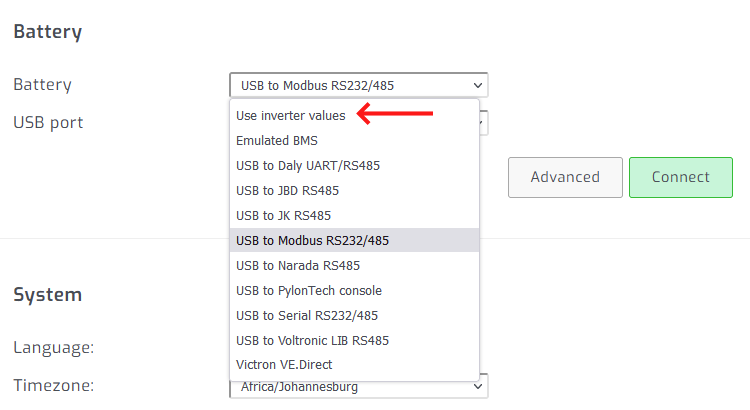
For the latest SunSynk firmware, check this thread: https://powerforum.co.za/topic/11687-sunsynk-5kw-8kw-and-12kw-latest-firmware-version/ Have you trued "Use Inverter Values" in SA?
-
The SunSynk inverter can use AGM/V (voltage) mode to estimate the SoC - it's not as good as using the BMS, but it works. The problem with using Volts is that Lithium batteries have a very flat discharge curve. SA can read the BMS SoC via RS485 or RS232, but SunSynk/SA/BMS can get SoC wrong after a power off of the batteries/inverter. The systems normally need a full cycle to re-calibrate the SoC. I suspect SunSynk in AGM/V mode uses both coulomb counting & Volts to calculate the SoC.
-
Solar Assistant is a bit finicky with changing Inverter Settings. It does work, but you need to be quick as SA keeps refreshing the values. Best to use the Inverter Touchscreen to do most of your settings. >My setup is completely off grid and running 10kW of LI batteries but they do not have compatible BMS. Ensure that you have the latest SunSynk firmware. Newer firmware supports more battery brands and battery models. A few months back, there were over 35 brands and over 80 models on the list. See Sunsynk_BatteryCompatibility_v9_English.pdf https://www.sunsynk.org/documents/158739eb-0f51-48cc-8079-186fc7387385 You may also be able to use a RIOT to translate the BMS to SunSynk. How is SA connected to the batteries? It SA reading the battery BMS via RS485? EDIT: You may find the "InDesign-Installing-Generator-Sunsynk-HI-V2-new-bat-list.pdf" helpful See https://www.sunsynk.org/documents
-
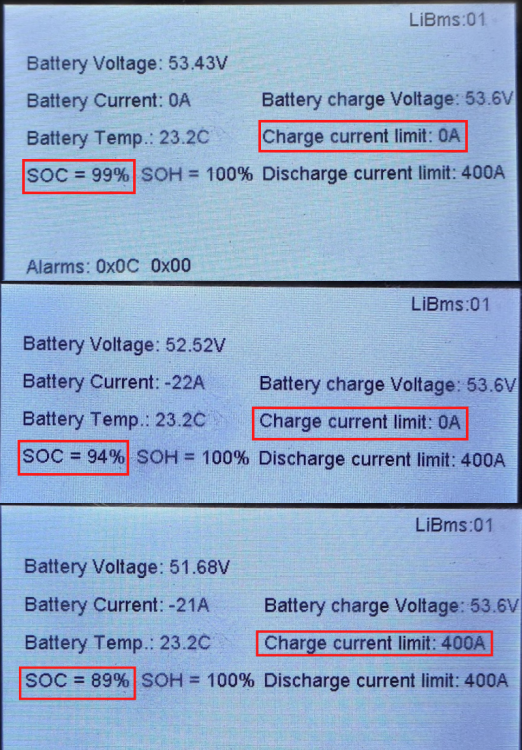
AFAIK, This is the battery BMS telling the Inverter it is full (0A charge allowed), but the battery is only at 70% SoC. Check the battery ID's and inter battery cabling. On my system (4 x AM2), "Charge Current Limit" SoC starts at 400A and goes to 0A as the SoC rises to 100%. I'll take some photos at different times to confirm. EDIT: The pictures below show the LiBms as the bank discharges. Discharge Between 100% - 95% the BMS does not allow re-charging to prevent continuous topping up. Charging When charging, the Charge Current Limit is reduced as the SoC approaches 100%. I'll see if I can take some images of the charge phase.

-
Please supply the details of your system: SunkSynk 8k or SunSynk 5k - seems like you have a 5k. How many batteries & model do you have? How many panels & rating do you have? Are the panels north facing, any shade? Are you grid feeding? What monitoring do you have - SolarMan/SunSynk/Solar-Assistant?
-
I would expect that these new batteries will address all know issues with AM-2. Also using LFP seems like a good choice for longevity. I'm quite happy with my 4xAM-2 subsequent to the firmware update. They have been performing as expected. Also appreciate having local support.
-
System installed 12 Nov 2021. I'm missing ~2 weeks data at the beginning Also experienced some glitches with data collection, so not 100% accurate - a bit under. In 9 months (Dec 2021 to Aug 2022): ~3.7MWh into 4xHubble AM-2 battery bank. ~3.6MWh out from 4xHubble AM-2 battery bank. ~6.7MWh from 16 x 400W PV ~1.5MWh from grid ~7.6MWh used

-
>apparently there's no warning when the update will happen This is true, it generally happens within a working day or two of being requested. It's a pity that SunSynk does not allow users to directly perform their own firmware updates. 😢 >experience problems after an update as there needs to be no load on the system during the update I've requested two updates to fix issues that I was experiencing. Had no problems due to inverter load. It's a pity that SunSynk does not publish change logs so we could avoid requesting updates in the hope of fixing unknowns. 😢 Historically, with IoT devices, you tended to minimise firmware updates as there are risks with updates. Today, due to security issues (Mira botnet, etc), it's necessary to upgrade firmware more often. TIP: Keep your IoT devices in a "DMZ" network.
-
-
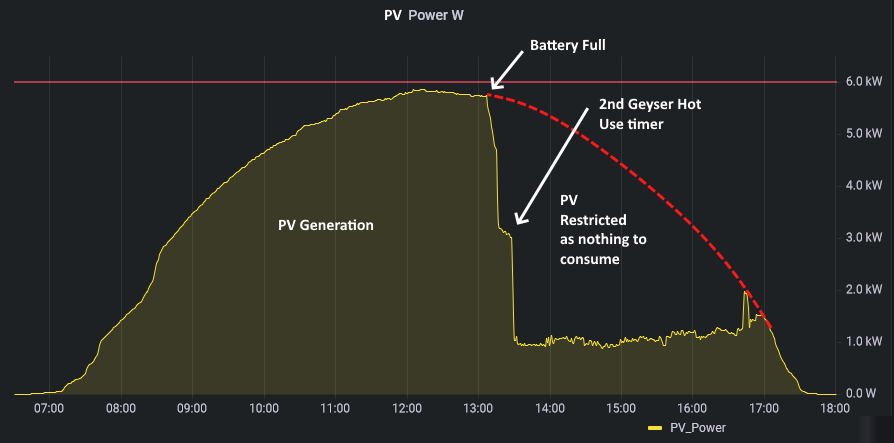
>The 12 panels produce average 8kh per day If you not grid feeding, then: 8kWh PV does seem low. I have 16x400W and generated 29.9kWh today, and there was some wastage in the afternoon. I would have generated more today, if I had a load / battery / grid feed - see the dotted line below. The Deye will only draw Solar PV to match your consumption. >In the morning the battery is still @100% Since your battery is at 100% in the morning, then no PV will be fed in to the battery during the day. Suggest: 1) Using some timers to control geysers, pool pumps, etc to only run 9am to 3pm (load shift) when there is Solar PV. 2) Set the Deye to discharge the battery at night to say 30% SoC/70% DoD, and charge battery only from PV in the day. At 30% SoC, the inverter will switch to Grid for the rest of the night. In the day, the inverter will charge the battery from PV. 70% of 5.1kWh = 3.5kWh you will save every night. You will still have ~1kWh to use for load shedding at night, and you can adjust the threshold if there is load shedding announced on Eskomsepush.
-
If you OK with a bit of tinkering, then the Sonoff may be of interest: https://www.sonoffafrica.co.za/ Sonoff Power Monitor Pow R2 - 15A - for lower power devices (not geysers) Sonoff Smart Geyser Switch - 25A - for geyser Sonoff Smart Stackable Power Meter - Main Unit Sonoff Smart Stackable Power Meter - 4Relay You can flash these with Tasmota can connected them to MQTT (no cloud) and HA. https://tasmota.github.io/docs/ There are other Smart Plugs that have power monitoring out there. Most run Tuya and store data in the cloud. I recommend plugs that can be flashed with Tasmota. Add a database (eg PostgreSQL/InfluxDB/MySQL via HA Recorder and create dashboards in Grafana. Works a charm. TIP: Use containers on your RPI


-
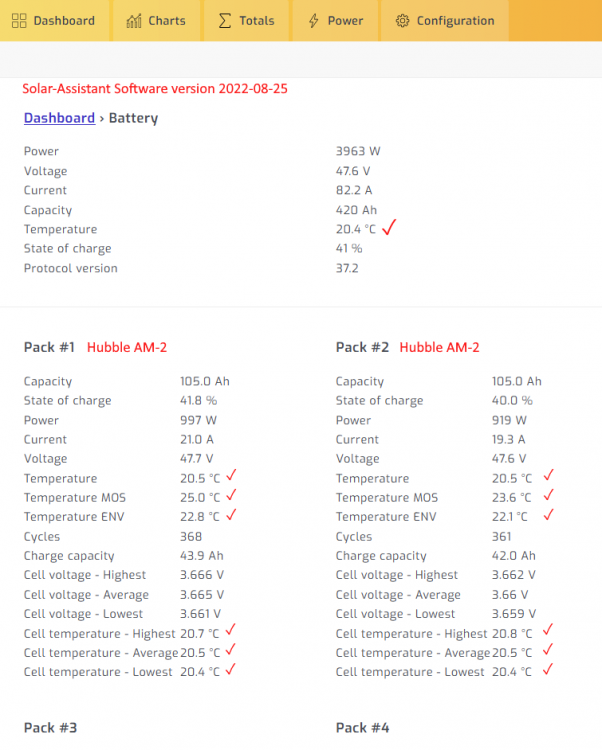
FYI: Good News, Solar-Assistant Software version 2022-08-25 is now reporting the correct temperature from Hubble-AM2 batteries: https://solar-assistant.io/help/updates/changelog 2022-08-25Beta New features: Add WiFi country code selection to network configuration. Upgrade of underlying frameworks and libraries. Basic support for EASUN SMG II and PowMr inverters that use with RS232 WiFi dongle and SmartESS app. Select inverter type "Sumry". Support for most important setting of Must and SRNE inverters. Support for adjusting more Deye and Voltronic settings via MQTT. Corrections: Correct temperature reading of USB serial protocol.

-
Good News, Solar-Assistant Software version 2022-08-25 has fixed the incorrect temperature reporting issue on Hubble AM-2 - connected via RS232/console port: https://solar-assistant.io/help/updates/changelog 2022-08-25Beta New features: Add WiFi country code selection to network configuration. Upgrade of underlying frameworks and libraries. Basic support for EASUN SMG II and PowMr inverters that use with RS232 WiFi dongle and SmartESS app. Select inverter type "Sumry". Support for most important setting of Must and SRNE inverters. Support for adjusting more Deye and Voltronic settings via MQTT. Corrections: Correct temperature reading of USB serial protocol.
-
Updated my dashboard with some of the ideas from your dashboard - thanks: Cycles = Number of Load Shedding Events 4th Aug 2022 Load Shedding Cycles 06:49 - 07:57 14:01 - 15:52 22:05 - 00:00 (actually 00:06) 5th Aug 2022 Load Shedding Cycles 00:00 - 00:06 12:06 - 14:01 20:02 - 21:51 CoJ seems to have a timekeeping problem

-
I'm trying to programmatically confirm if the inverter is "throttling back PV production". I was hoping to use the SunSynk MPPT registers. Adapted from https://github.com/kellerza/sunsynk/blob/main/sunsynk/definitions.py # SunSynk PV MPPT Sensor(186, "PV1 power", WATT, -1), Sensor(109, "PV1 voltage", VOLT, 0.1), Sensor(110, "PV1 current", AMPS, 0.1), Sensor(187, "PV2 power", WATT, -1), Sensor(111, "PV2 voltage", VOLT, 0.1), Sensor(112, "PV2 current", AMPS, 0.1), Any ideas?
-
Thanks for the feedback. Grafana is a fantastic visualisation & dashboarding tool - I often get ideas from other dashboards.
-
Perhaps it's "3 grand per month for 10 years"
-
I was thinking of getting a small PV or irradiance sensor / weather station to measure solar/cloud and use some heuristics (logic) to see if the PV generated is in an expected range for that time of day. Was hoping these was something simple I could get from the MPPT readings that would indicate "clipping"
-
Nice dashboard - I've updated one of my boring tables to include "Cell display mode" Q1. How to you record Average Cloud Cover - do you have a weather station or something? Q2. Where to do get the load shedding schedule? Thanks in advance.
-
Detecting SynSynk inverter "clipping" - is it possible? I've been using the fantastic @kellerzasunsynk python library - thanks @kellerzafor a great python library. On my system I don't grid feed excess (may change later). In the afternoon once the battery is full, the inverter stops drawing PV power - "clips" the PV. I would like to make use of this excess, but am not sure how I would detect that the inverter is "clipping" vs just a big cloud reducing PV. Q. Is there any way to detect/measure/monitor if a SynSynk inverter is "clipping"? Any ideas would be appreciated. Thanks in advance.