


___
Members
-
Joined
-
Last visited
Everything posted by ___
-
Here you go. I used some of these as under-counter lighting in my previous house. I had a small buck converter on them to drop the voltage, then adjusted it until the light level was comfortable. worked out around 9V. https://www.bidorbuy.co.za/item/481401488/Led_Rigid_Strip_Light_12V_1000mm_LOCAL_STOCK.html
-
In my experience MR16 is indeed becoming harder to buy. I can still find them at our local "Eagle lighting", but the hardware stores have stopped selling them, they only sell GU10 now. If you intend installing such a lighting system in your house, remember that DC cabling must be separate from the AC cabling. You cannot put your 12V cabling through the existing conduit, and any switches would have to be DC rated. If your intent is to keep it a separate system, then just remember to fuse the cabling for safety, and you can run with MR16 until they become impossible to find. One other possibility... GU10s have a built-in power supply that drops the voltage from 230V. They don't need a actual 230V to work. They will often work just fine with anything above 80V. Since they all have small switch mode power supplies in them, and the very first thing an SMPS does is to convert the input to DC... you could also just use a boost converter to turn your 12V into 90V (ish) and power your GU10s with that. I'd suggest experimenting a bit first. Something like this. Still seems like a waste, but it will be a lot more efficient compared to a full AC/DC round trip. But... honestly... I'd get me some strip lamps from this guy. I've dealt with him multiple times, and his 99.94% positive feedback rate is well deserved.
-
A calibration difference of 1% is usually acceptable, but this is a bit far out. The first thing to do is make sure you don't have voltage drops on the cable. It is normal to measure a slightly higher voltage at the MPPT while it is charging (during daylight in other words) because of the internal resistance of the cable. Again, this should be maximum 100mV or maybe 200mV. If the multimeter measures significantly differently at the battery and at the MPPT, you should first make sure your cabling is sufficient and that there are no poor connections. With that out of the way, I must say I'm unsure if there really is a problem. It seems the battery's internal measurement measures low, but the MPPT (because it measures higher) actually gives the battery a proper charge. In other words, you can probably just ignore the battery's own low reading.
-
Yeah different BMSes have different expectations of the hardware connected to them. Some BMSes get very upset and disconnect their DC protection relay/FET easily if you don't stop charging quickly after it has ordered you to do so. In my experience, if you keep your battery voltage BELOW the voltage where the BMS activates its protection features, and if you have a large enough battery so that constant charge current interventions is not necessary, then you don't need communications with the BMS. If anything bad happens, the BMS shuts off the power and the entire house goes dark. Oops... let's not do that again 🙂 There is however one very useful feature that comes from BMSes that can do comms, and that is that they track SOC. If you already have another way to track SOC (eg an inverter that has this built in, or a BMV), then you don't need to use the BMS for that. SOC is always an estimate, and even the BMS gets it wrong (I have examples of use cases where a BYD battery gets it spectacularly wrong), so using your BMV-7xx is really not a bad alternative. But ideally you want a BMS that allows you to regulate the voltage and not constantly mess with current limits. If you just aim for 3.45V per cell, it should run like a conventional lead acid bank...
-
I would be incredibly impressed with anything that can do that. The trouble with opening a circuit is extinguishing the arc. The arc of lightning.... which has already proven its capabilities just up the cable from here... I think the best thing I've seen is a type of air-gap arrester used in some security systems. Literally a small array of correctly spaced plates that will arc over at a few thousand volts. Still kills a bunch of stuff, but the stuff furthest away from the arrestor has a slim chance...
-
Nothing wrong with that. Not sure what you mean, but using copper busbars to as a distribution point is common and allowed. Now you just need an inverter or two... 😛
-
You can however configure the Peukert factor on the BMV to make it work with LFP batteries. Just set it to 1.05 (or even to 1.00 to disable it), instead of the usual 1.2 or 1.25 for lead acid.
-
Definitely ask Jaco for a quote. I'm not in sales 🙂
-
The ESS control loop adjusts PV-inverters every 5 seconds, but MPPTs generally react in the 100ms bracket? 🙂
-
Yeah that one looks odd. It looks as if the main feed (thick red and blue) feeds into the RCD. The RCD has no overcurrent protection (two green levers), and then there are two much thinner conductors looping around to what looks like a 60A main breaker (those wires look too thin for 60A). Usually the main switch comes first and the RCD second, so it seems you have them swapped. Also, it looks as if a red wire runs from the top of the 60A breaker to the middle group of breakers. I assume these are circuits that are not RCD protected (in older houses the lights were often not on the RCD), which further lends credence to the theory that the RCD and the main switch is the wrong way round. The way this is wired, there is no overcurrent protection for that middle group of breakers (the RCD is the only thing in its line, and it has two green handlers) and you have a theoretical 80A capability downstream, with a much too thin wire providing that power...
-
Something to check: It could be a poor connection or a hot wire that is smoking and not the inverter. As a rule, if electronic components start smoking, things stop working pretty soon after that. If things continue to work, then it's probably a conductor that is smoking. Check all your connections. I've had some cases where I accidentally clamped the tip of the insulation of the cable in the terminal instead of the copper, causing a poor connection, some oxidisation and some generated heat.
-
There is a way to look through the bottom vents and look for a bolt, whether it's the right one. If you see a round-headed bolt, you have one with a manufacturing defect. Ask your installer to have it RMA'd. In this piecure you can actually see the bolt glowing red. It's the wrong material bolt.
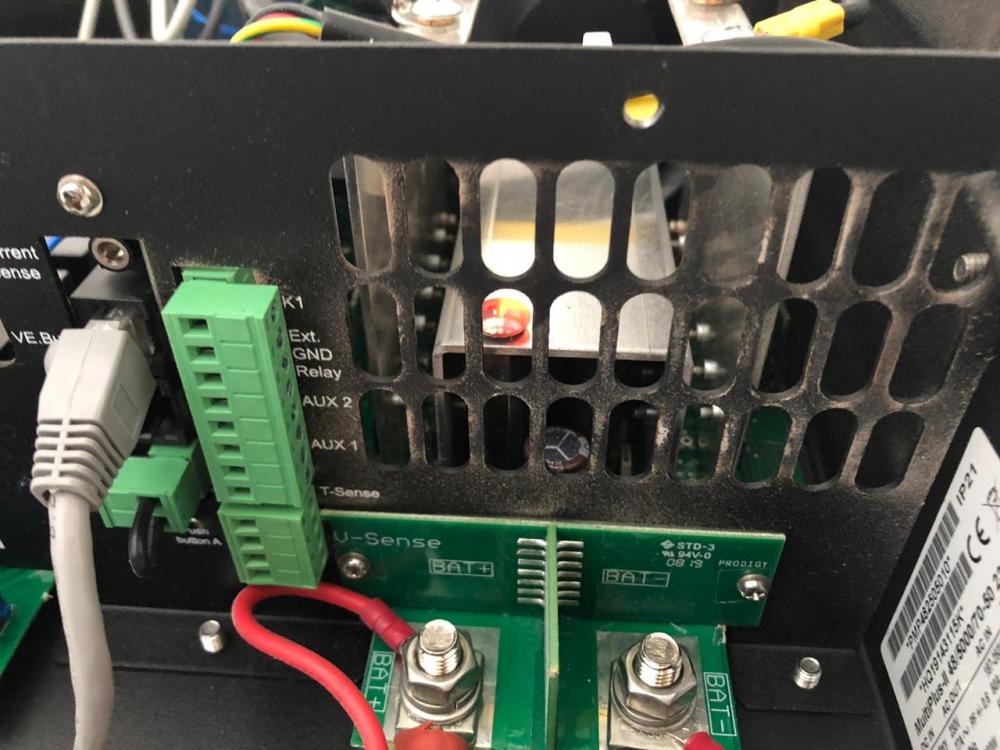
-
Of course. But SMA is considered even more upmarket (rightfully so) with a price that goes with it 🙂 An SMA system ties all the PV on the AC side, using SunnyBoy inverters. They then have a SunnyIsland that charges the battery, and that can create a microgrid for the SunnyBoys to tie with. It's brilliant for building microgrids, but I think it's a bit overkill if it's just for one house.
-
No, the mechanism is different. The MPPTs regulate on battery voltage and are a lot faster than the control loop that limits PV-inverters in an AC-coupled setup.
-
Put up a picture. Is this the big boxy Can-bus one, or the smaller form factor? I'm not in the market but people who are will want to know 🙂
-
Yes. In more detail, if it is running off-grid, then the Multi raises the frequency to throttle the PV-inverter, and it is regulated to the point where all the loads are powered and the battery is fully charged. If there isn't enough power, the frequency drops to 50Hz, the PV-inverter runs flat-out, and the remainder comes from the batteries. If it is running grid-tied, and you are allowed to feed into the grid, then by definition the PV-inverter's generation is used first (the remainder charges batteries, and when that is done, the rest goes into the grid). When not feeding into the grid, then it become a bit more complex. Then at times (while ramping up, adjusting) the PV-inverter might be limited while some power comes from the batteries. Which is why it is better (even if you don't get paid for it) to feed the excess into the grid...
-
Quality. The Victron unit has a 5 year warranty and generally last more than 10. It has excellent support from the manufacturer. Firmware updates are available and free. The VRM telemetry site is arguably the best available in the business today. Though the cost appears high, it's actually cheaper than many competitors. For the Voltronic unit, the warranty is 2 years, they generally last about 5, support from the manufacturer is non-existent (though admittedly the local agents are not too bad), 3rd party telemetry is your only option (aka ICC), and if there is a bug in the firmware... good luck. The only other competition in the same price class is even worse. Battery wise, I rank them like this, at the risk of angering some people 🙂 I leave out batteries that might not be available in this country, eg the excellent Discover AES battery. 1. BYD. They are available in the country but I don't often see them used. I assume it's the price. The new Premium battery is excellent. It's a 16s battery and has excellent maximum charge and discharge currents. 2. Pylontech. I put them this high up because of good support, good warranty, they did well in the Ausie battery benchmarks, and it's an honest battery. They tell you upfront that their EOL is at 60% and the discharge rate is C/2. Not as good in this regard as the BYD, but not bad either. Support-wise I would probably put them ahead of BYD even, but I think BYD has a small technical lead on them. 3. FreedomWON. Local maker, looks good, uses an excellent BMS (Orion BMS). Good charge and discharge current levels. Does good voltage control and doesn't need any workarounds in the software (the above two do in some cases). 4. SolarMD. Excellent battery, though somewhat pricey. Not many installers offer it as an option, I suspect because becoming a distributor is not as simple as with the others. I heard through the grapevine you need to register as reseller and it costs a small fee. Good charge and discharge currents (1C). 5. BlueNova. Uses Winston cells, which is excellent but adds some costs. Has their own BMS. Earlier batteries had some issues in that respect, later ones are much better. Battery capacity is determined based on a C/10 discharge rate, which in my opinion is cheating a little, but can be dismissed as "marketing boosting the numbers". It may be more realistic as to how people will really use them in a residential setting, but it also means that when comparing with other batteries (the least of which uses C/2) you are not doing apples for apples. So do keep in mind when you do comparisons. Edited to add: 6. Revov. Second-life batteries. A bit of a mixed bag, some people report success, and some don't. 7. LithiumBatteriesSA. A bit of a newcomer to the arena, but popular with DIYers. Watch this space, I suspect a new battery might be coming. Generally uses the Daly BMS. Lower end BMSes don't have comms. I'd probably take one of these over a Revov once it stabilises a bit.
-
Not at all. For the Quattro inverters (those with two AC inputs), there is a simple priority. If both AC inputs have AC present, then it prioritises input 1 over input 2. Usually you would install your generator on AC-1, so that merely starting the generator is sufficient to switch to the generator (even if the grid is up), and stopping the generator sends it back to the grid (on AC-in-2). If for whatever reason the inverter doesn't like the AC input (eg weak generator, not a good sine wave, etc), and there is AC on both inputs, then it may instead move on to AC-in-2. It cannot mix power between the two AC inputs, because... well that is not how it works... the generator would have to be synced with the grid for that to even work. It's just two interlocked transfer switches...
-
Have seen a few of these now. In many cases its actually a low battery issue. Some background required. The way the Multi knows it is overloading, is if it cannot produce 230V into the output for some amount of time. It uses a 20khz PWM signal to form the sine wave, and it cyclically adjusts the duty cycle of the PWM signal to form a 50Hz sine wave and to hit 315V (ish) at the peak of the sine wave. If at max duty cycle it cannot hit the peak, it knows it is overloading. Now the battery voltage itself also plays a role, that is to say, at lower battery voltages and higher loads it will overload faster (also because higher currents are involved on the primary side of the transformer). In these cases the overload often coincides with a low battery alarm. There are also still a few 5kVA models made in mid 2019 out there that has a manufacturing defect, causing it to overload and/or overheat at lower power values. If you have one of those, simply have your installer RMA it and swap with a new unit under warranty. I have one case which is neither of these, but I'm still waiting for the support guy to explain his thinking to me. And it involves large Quattros, not pedestrian multis... 🙂 So long story short, make sure your DC voltage on the terminal of the Multi isn't sagging excessively under load.
-
Yeah, I've said something like that too. Problems that you can throw money at are not big problems. I mean, sure, money is always a problem, you never have quite enough for all the things you want to do, but see it this way: The real problems are things you cannot solve with money, for example, a medical condition you'd gladly pay to be treated for... only there is no treatment. Apologies for that dark thought... but perspective and all that 🙂 Spend the money and make it safe.
-
If it was me, I'd probably make me some kind of switching solution. So DC breakers are insanely expensive, but... something I saw in a solar R & D workshop, they actually use a plug and socket method so that PV strings (a few on the roof) can be combined to get different voltages and or different power levels. Occasionally someone forgets to turn off the MPPT before pulling a plug and they pull a nice long flame... but other than that, it works quite well for using the same array for multiple purposes. Then... simply switch them PV modules over when you really need to. Or.... get a real inverter and put the Solis on the output. You can even use that nice Hager changeover we all use to only move it there for the duration of load-shedding, or if you really need to move it.
-
You won't be the first one. Same happened to @georgelza a few weeks ago.
-
Cool. Now build an sd-card installer for it, and then ship it 🙂
-
I sometimes use long nosed pliers to move things around. I know it's not a traditional sparky's tool, but it works 🙂 So in this case, the job I have to do is split my essential loads across two RCDs. The standing loss over just the one is 13mA (about one modern appliance away from nuisance tripping), and when the inverter does its relay test the additional DC testing current plus transients when it opens and closes the bonding relay throws the RCD. Old problem that comes back every time a new appliance is added or an old one is replaced. Drives me nuts. But I had no space in the DB (the age old problem), but there is this BIG RCD from back in the 80s/90s that takes up 4 spaces. So last night I replaced that with a more modern CBI QA17C (those things actually have exceptional specs), and then later I will get permission from the minister of internal affairs to take the other half of the DB down and split the other loads. 🙂
-
The Multi takes up to 20ms to throw the switch. That compares pretty well to most UPSes, but you do occasionally get an appliance that's not happy with that. Perhaps it also has to do with the age of the appliance itself. The power supply in a PC for example usually can ride through 20ms, but sometimes they can't anymore. In my house my Yamaha AV receiver clicks its speaker anti-pop relay out and back in, everything else stays up though.


