


Calvin
Members
-
Joined
-
Last visited
Everything posted by Calvin
-
@hoohloc please ignore last graph in my post - it was supposed to be deleted....
-
No problem - see below. Done for 34S, 18E panels face 45 at 35.

-
Odd - I am on 71.93 and watchpower 1.13 works. REALLY odd. In parallel use Bypass mode does not work at all.... From manual "*ECO mode disabled when in parallel mode." Are you sure about this? I had the same fright when measuring just current - turns out that power factor under these circumstances is about 0.1. If you do not have a direct way of checking this, you can confirm it by using your utility meter - turn off everything else and check how fast it moves. Your setup sounds similar to that of @Plaashaas, who seems to have hit some magic combination of setup that actually works. Perhaps he would be kind enough to share his setup in detail, including all the settings? BTW, I was surprised that @Plaashaas can run his paralleled inverters with only one connected to the grid. When I tried it (on firmware 71.86 at the time) it would not accept it unless it was present on all 3 my inverters.
-
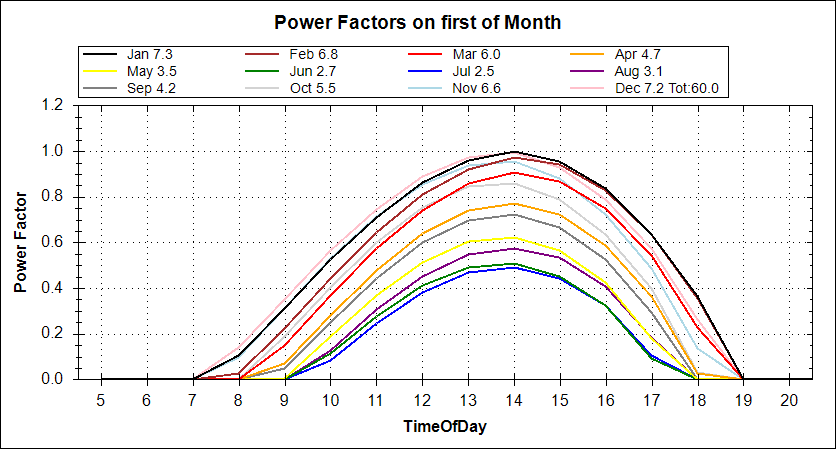
The graph below is for panels at 250 degrees. if you look at the line for September, you will see a maximum of about 72%, which is about 1150W. Your 980W is 85% of that. The graph below is for the panels at 75 degrees. In September you max out at about 88%, roughly 1400W. Your 1200W is also about 85% of that. Not sure what MPPT you are using, but generally I think that the numbers you are seeing are a bit low. How do you get your figures? Are all your panels on one MPPT?


-
I have a program with which I can calculate what you can expect, but I need to know the angle (from horizontal) of your roof/panels.
-
A lithium battery at 43V is fully discharged, and has probably been shut down by it's BMS. What type of battery is it? 15S, 16S? Are you measuring 43V at the inverter, or inside the battery? If you disconnect (and switch on) the battery, what voltage does it give?
-
Have you checked the voltage? Perhaps it is set a bit low...
-
The most difficult bit.🤣 "For everything else, use Mastercard"
-
Pylons have a well known "feature" that during charging the SOC stays on 89% until it is almost full, and the very quickly jumps to 100%. Not sure where the 88% comes from, but perhaps it is related.
-
So did I, for several months. That does not mean it was clever, or sustainable in the long term. I thought that @NoviceSolarshould be aware that the advice you gave him is not universally considered to be good practice. I am not trying to tell you what to do. If you read the comments by @Coulombin the thread that I linked and still want to do it, go for it.
-
Some backgound needed. Which Mecer inverter do you have? The King, MKS, MKSII? What max Util Charge current do you have set on each inverter? Have you got the inverters set to "Appliance Mode"? I use 5kVA generator for charging with my King. On startup I set the Utility charging current to 10A - once it is happy I increase that to 60A. Starting on 60A does not work with my setup. As @Coulombmentioned, these inverters are extremely finicky about frequency stability (slew rate), but a 25kVA generator should have no problem...
-
You need to be careful here. Most 310W panels are 72 cells. It is marginal but 72 cell panels in 3S is NOT a good idea with 145V inverters - I have had to re-wire mine to 2S after plenty of problems caused by over-voltage in the SCC. See this post for more detail.
-
Hi Willie, I do not use ICC myself - I have developed my own control system that run on an Arduino. Micro-controllers like the Arduinos are far more reliable. Having said that, I do use 3 Raspberry Pis in my home entertainment system and they have been in use since the early days of the first RaspPi - 2013 I think. My experience with them is that 90% of all issues are related to the SD card - either bad connection or corruption. I think that perhaps I have a problem once a year between the 3 of them. Also, if you read the forums there appears to be many people who are very happy with ICC. Have you tried running it on another PI/SD card?
-
The Kings certainly can - I run 3 of them. It is a double-conversion device, which means all incoming power (PV and grid) get converted to DC, and all loads are powered from that DC (and the battery) via the inverter. Some people get confused about the difference between grid-tied and hybrid - the King is hybrid but not grid tied.
-
Each inverter needs to control its own panels. You need to bring in 3 cable pairs, each with 8 panels. Your breakers will need to be 40A as you will have 2S4P on each inverter. All the wiring is explained in great detail (with nice diagrams) in the user manual https://www.mppsolar.com/manual/PIP-MK (PF1.0)/PIP-MK manual-20190717.pdf No - batteries are connected to all 3 inverters via busbar. That answers both questions (A) and (B)😀 One huge issue: current firmware (71.93 / 02.49) has many bugs. Kings in parallel in PYL mode simply do not work. (they are supposed to). You would need some external management software like ICC to make it work properly. Also, I assume 20A DC fuse is typo: 15kW @ 48V is over 300A.
-
I have Axperts that give information at 2 second intervals, but even that has problems. The basic issue is that the inverter will clip output to match demand: whatever the batteries will take + any actual loads. How to know if there is potential extra PV that could be harvested? One way is by increasing the loads slowly, (by sending more power to the geyser in this case) and monitoring the inverter - once it starts taking energy from the utility or battery, you are at maximum. The problem with this approach is on days with intermittent clouds - the system cannot react fast enough to the varying PV irradiation level. I ended up making a pyranometer (a 5W panel with a load resistor, calibrated to match my panels' output) to measure the actual PV power available at any time. On the AC overload side (which is the part that @JustinSchoemanwas interested in) even the 2 second update is a bit too slow for detecting potential overloads caused by motor starts etc. I have a current transformer on the AC outputs that give me a reading 100 times a second (at each zero-crossing). If that reading is too high the geyser triacs will reduce loads to compensate. in theory you could get around the Goodwe by: Measuring potential PV as described Measuring AC in and out (either directly with a microcontroller or using a power meter like this https://www.banggood.com/PEACEFAIR-Single-Phase-RS485-Port-Modbus-Smart-Digital-Electric-Energy-Meter-p-1331578.html) Reading battery power directly from your Pylons All of this could be done by the same Arduino that you might use for switching the triacs.
-
I would be happy to share , but most of what I did was based on the excellent work documented on this page: https://learn.openenergymonitor.org/pv-diversion. If you google "instructable arduino triac" (without the inverted commas) there are many well documented examples that will give you an idea of the work involved. If you read through these and are still interested I can give you the details of what I did - circuit diagram, board layout, components source, code etc. It is quite a simple build (I used a bit of veroboard), but anything involving 220V and high current needs to be soldered VERY carefully. I used BTA41-600 triacs and MOC3021 opto couplers. One could use the (much cheaper) BTA26-600 triac. One warning - If you are not familiar with the world of Arduinos and C++ it is quite a learning curve. Good luck - let me know if you want the details.
-
Have you considered going for proportional control? I have hooked up both my geysers through triacs so that I can adjust the power linearly using phase control (essentially a high current "dimmer"). Advantages: The main beauty of this is that you can now allocated any spare PV to the geysers, saving the battery from charge/discharge cycles as you kick in or out the 3kW geyser loads. You can run your geyser any time when system has some spare inverter capacity, but perhaps not enough for the full geyser load. Zero-delay switch off time in case of overloads. I control the triacs with the Arduino (Due) that I use as a controller for my whole system. Everything is powered by the Arduino: I run the triac of one pair in a CAT5 wire, and use two of the other pairs for a DS18B20 to accurately measure the geyser's temperature. This works fine for (in my case) 15m away. The most expensive part is the heat sink for the triac - total cost per geyser is about R200. By doing it this way you essentially incorporate the geyser into the system as an additional energy store - lots of fun to be had optimising the rules for power allocation.... One needs soldering and programming skills to do this, but I can see that you are doing all this already.😀
-
A really good alternative is Banggood.com. They have a shipping method called "South Africa Direct" which is cheap (R0-R100 depending on order size), fast (typically < 2 weeks) and reliable (I have used it maybe 30 times without a misfire). Best of all, it is couriered to your door. You can pay the duties (normally about R50) either on checkout or when it arrives in SA.
-
I have 3 Kings in parallel with 8 Pylons, and they simply do not work with current firmware when using the PYL setting. I have ended up using the USE setting. This works fine but you really need a management system (something like ICC) that can read the BMS and change the inverter settings based on the actual charge level. Note that even when these bugs are sorted out there are 2 reasons why the ICC type of solution is better: Voltronics have so far not even tried to implement the most obvious functionality: allowing back to Grid and back to battery to be based on SOC rather than voltage. They charge the batteries to 53.2V, which is condierably too high.
-
I believe that you are right - the display unit seems to deal with all external communications. Is yours on 2.49?
-
I am not an expert on this, but from reading these forums it appears that the combination of the BMV702 and ICC is what most people with lead-acid batteries go for to make Axperts really work.
-
I am afraid that I am no expert on this - perhaps you should start a new topic and ask for input. My impression is that the open source options also run on RasPi or other flavours of Linux. There is apparently some political issues around ICC, now sold by 2 warring parties (centurion solar and iccsoftware). The latter appears to be the good guys but their web site is dismal - not confidence inspiring. I read that ICC had a windows version - not sure if that still exists. A very knowledgeable person to ask might be @Jaco de Jongh Good luck
-
Just go to https://centurionsolar.co.za. It is a management package that runs on a Raspberry Pi - the complete thing incl hardware is about R2600. Essentially it will modify the inverter's settings on the fly, based on rules that you can define. Also provides very nice graphs and information. There are also some open source software I believe.
-
sorry, that should have been 11 & 16. One solution is to use something like ICC to control your inverter. Probable cheaper than the alternative, and I believe that it works around most of the issues, and give you a nice management interface. I don't use it myself, but that is because I have built something that essentially does the same.


