


Calvin
Members
-
Joined
-
Last visited
Everything posted by Calvin
-
You can safely connect 12 panels. If your inverter is a low voltage model (145V max VOC eg. King, MKS), they need to be connected as 6 strings in parallel of 2 panels in series.
-
Totally agree with @gbyleveldt. DIY is fun but needs to be cost effective. You will probably find Pylon 3.5kWh on November specials for under R20k - same sort of cost per kWh, 10 year warranty, integrates with all sort of inverters, no hassles.
-
If you are using a King try upgrading the main firmware to 71.94 and display unit to 02.49. (Files are in the downloads section) If that does nor solve it you really need to set the battery type to USR, bulk charge to 52.5V and float charge to 50.5V. The downside of that is that you no longer have SOC information, unless you use external software to manage / monitor your system. See this post: https://powerforum.co.za/topic/4933-axpert-vmiii-error-69/page/2/?tab=comments#comment-85981
-
I am unaware of any such regulations in SANS - possibly may be in some municipalities but I would be surprised. (Non-sealed lead acid batteries would certainly need ventilation) One thing to beware of: putting your inverter in a small unventilated space could lead to very high ambient temperatures. That would be bad for the life expectancy of the inverter and especially the Pylons.
-
There is no such things as AC or DC cable. Many cables are of course designed with a particular purpose in mind, and are then labelled/sold as such. Copper cable has 2 important basic properties: The cross-sectional area determines the current carrying capacity. You choose it (at the economic level) by the voltage drop (power loss) you are prepared to tolerate and (at the safety/legal level) by the cable's ability to shed the excess heat generated due to that power loss. Note that this heat-shedding is dependant on the cable's installation: a cable in free air can disperse far more heat than one running in a conduit, especially if surrounded by other heat-producing cables. The voltage rating of the insulation. A key difference between AC and DC is that 230V AC actually has a peak voltage of 325V There are other properties that are relevant for PV cables: they need insulation that is more resistant to UV than cables designed for indoor use. PV cables also need very high insulation resistance (>1000V) if used in high voltage strings. The important things is: if your peak voltage is below the cable's rated insulation voltage, and your (RMS) current meets the criteria above, it does not matter if you use push AC or DC through it.
-
@Marius Fourie I have to agree with @Gnome - your statement is correct for all the Axperts except the King, which is double conversion. It can and does blend PV and grid if necessary. In a parallel setup like mine you cannot even use bypass - the only source of AC output is the inverter, which does not know or care where the DC that feeds it comes from. Not quite correct - it uses the information from the BMS for target charge voltages and to reduce the rate of charge as it approaches 100%. It does however still use voltages and not SOC for thresholds for switching to grid or back to battery mode (unbelievably - how difficult could that be to program?). I can understand why @pierre. might think that you are not entirely objective.🙂 Please do not misunderstand me - I think the Axpert King is OK hardware for a very good price, but the potential is limited by terrible firmware and non-existent support. If and when my setup needs replacing I will look elsewhere, and in the meantime I would not recommend it. Companies like Voltronics should, in my opinion, not be supported. Darwin will surely smile...
-
They are sailing VERY close to the wind: "Even though suppliers may be tempted to a adopt a marketing strategy aimed at luring potential customers by means of displaying the lower VAT exclusive price; vendors are reminded, as discussed above, that it is a criminal offence not to reflect the VAT inclusive amount when advertising or quoting prices in respect of its supplies." source: https://www.golegal.co.za/prices-advertised-vat/ "ASA Directorate found that the mere inclusion of a statement to the effect that “prices exclude VAT” is not compliant with the provisions of the VAT Act, which in turn means that such advertising contravenes clause 19.4 of section II of the Code." source: https://businesstech.co.za/news/finance/331579/new-cases-deal-with-whether-south-african-adverts-have-to-include-prices-with-vat/
-
@Richard Mackay, The answer depends on your usage and assumptions. For daily cycle (off-grid) use LiFePo4 batteries are much cheaper per kWh over the life of the battery. Example: US3000: 6000 cycles x 80% DOD x 3.5kWh = 16800kWh in life. At R20k per battery, this works out to about R1.20 per kWh. Any reasonable lead acid battery will cost at least R2000 for 100Ah@12V. Assuming you get 1000 cycles at 50% DOD total production is 1000 cycles x 50% DOD * 1.2kWh = 600kWh. At R2000 per battery, this works out to R3.30/kWh Of course it ALL depends on you assumptions. Can you really get 6000 cycles from your Pylon? On the other hand, can you really get 1000 cycles at 50% DOD from lead-acid? Perhaps you can half Li-ion cost by getting local "second-life" batteries? Other factors: Li-ion takes up less space, need less maintenance, has BMS and balancers built in, has higher round-trip efficiency and hence generates less heat, is cooler😎 On the other hand, for UPS/standby (anti-load shedding) use lead-acid is a good option. Certainly you will never get near using 6000 cycles in that scenario, so Li-ion's biggest advantage is negated. I bought Pylons - if I was doing it again I would look very hard at the "second-life" option. My batteries only go through about 120 full cycle equivalents per year, so I will never get near using 6000 cycles. It may be a bit of overkill.
-
😭😭😭😭😭
-
I think he is the person behind LithiumBatteriesSA...
-
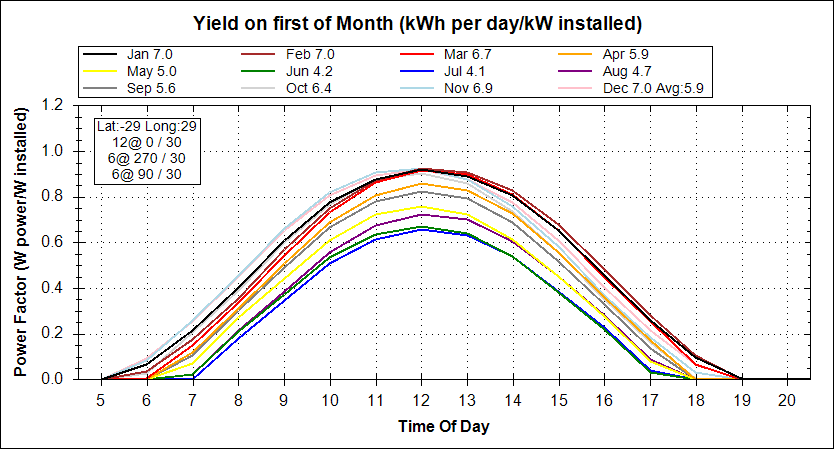
These graphs are the sum of the solar insolation (the total PV energy hitting the panels) for the panels and orientations listed in each. So, they would approximate what you would get with a separate MPPT controller for each bank. Although, from the link @Louisvdw posted above, the losses from combining different sets on one controller is less than one might expect.
-
Clearly ANY panels will aid in overall production (unless you put them upside down 😁). However, saying "it is always worth it" to but in extra panels "even if they produce only 40% of rated" misses the fact that for most people the installation of PV systems is marginal even when using optimal panel positions. Fair enough - bad choice of word. We all have different ideas of what constitutes a disaster. I guess that what I am trying to say is: if you can place your panels facing North, absolutely do so. If you don't have the option by all means place them East/West, but be aware of the reduced yields, especially in winter.
-
Be VERY careful about East-West panels. See this post Bottom line: East/West panels add a little bit in summer early morning and late afternoon. In winter they are a disaster.
-
Correct. I have now been using my Pylons for about 10 months and capacity loss so far is less than 1% so I am happy with them Like all Lithium batteries they treat you well if you treat them well. Don't overcharge, don't keep fully charged at high temperatures too much. In summer I normally only charge them to 70% (discharging to about 40% overnight) and they (and the inverters) have their own air conditioner to keep them below 25C. Once every 2 weeks I take them to 100% @ 52.6V for half an hour to reset the SOC counters. There is also the option of "second-life" batteries - https://lithiumbatteriessa.co.za. Some good reports although they always seem to be out of stock.
-
Good idea - sadly this will not work with the Axpert King. The King seems to ramp up the fans pro-actively the instant load or SCC power increases, perhaps because they use many components very close to their voltage/thermal limits.
-
Not only could, you really should.🙂 And when you add the next 2, keep them 2-in-series. These inverters are very sensitive to total voltage - using 72 cell panels 3-in-series is a very bad idea the will almost certainly result in your SCC tripping and may well damage it. (search this forum for @Coulomb's posts to see the details). Your panels will produce over the 145V allowed limit at 15°C. As for connecting them in parallel, one should use a combiner box that has a separate fuse for each string, as well as surge protector and DC breaker. I know that some people just use a Y-connector (much cheaper) - not sure if that is a sensible place to save money.
-
Actually, it goes up to 80A PV charging plus 60A AC charging.
-
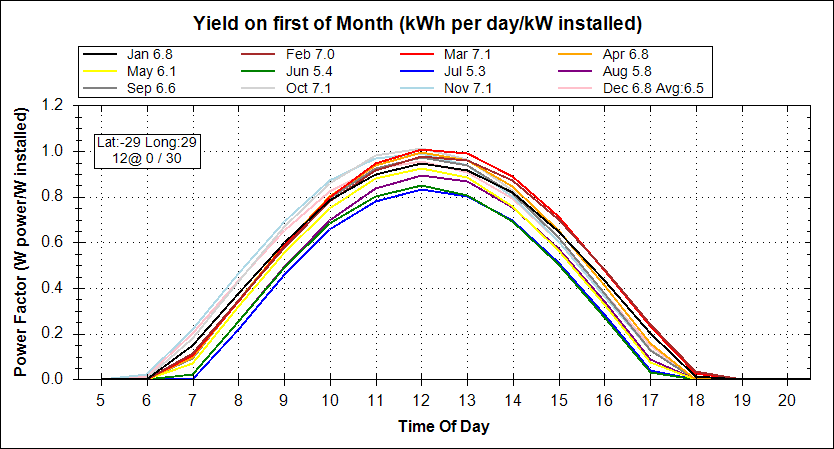
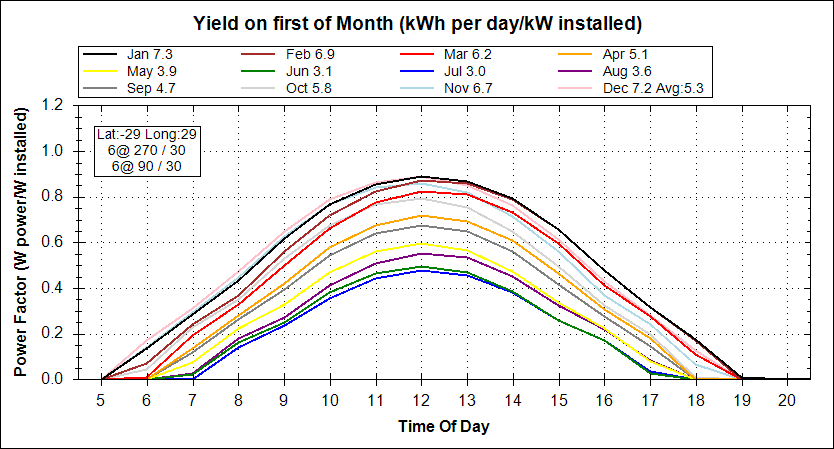
Below your maximum yield for the 12 panels facing North. And for the 12 Panels facing East and West Note that this is the maximum that could be achieved, assuming perfect conversion. It does not make allowance for thermal coefficient or MPPT losses, which could reduce peak yield by 10-13% on a hot day. The output from the East-West panels would be further reduced if the are on a single MPPT. You can see that the biggest drawback of the East-West combination is the terrible performance in mid-winter. Annual average is 5.3 vs 6.5, a 18% reduction. Below is the graph for your combined system
-
Hi @Coulomb, I can confirm that that the fix for unwanted AC charging is still present in 71.94 🙂 The behaviour is somewhat inconsistent (not new to 71.94): If the inverter is powered up whilst setting 16 is UdC, it takes no grid power at all. Display shows Grid and Battery symbols, no lines. Makes sense. If powered up in UCb and then changed to UdC it stops charging but uses grid power for self consumption. (and the display stays in "Charging by utility" mode...) The important thing is that it (still) does actually stop AC charging when set to UdC. (test setup: no PV, output(inverter) switched off)
-
The manufacturer claims 6000 cycles at 80% DOD, which would take almost 20 years to achieve assuming a full 80% discharge every day. We don't really know how these batteries will age, but I would be (pleasantly) surprised if they will last anything close to 20 years.
-
That all looks as expected - once the battery is full the SCC limits the PV input to supply only the actual loads, as the battery can no longer absorb the additional energy. Not sure if your 60% switch over to SUB is chosen to leave some in reserve in case of load shedding - remember that Pylons are happy to go down to 20% SOC.
-
Not sure if you have actually bought the Sirius, but if you have not be aware that the consensus opinion (of people who know what they are talking about) is that it is a scam. See this post:
-
Sounds almost too good to be true! Will be interested if this stays like this consistently - please keep us updated. BTW, what is the software that you are running on your Raspberry Pi?
-
It sounds like the normal problem with the King and the Pylon: the battery voltage requested by the pylon is 53.2V which causes the King to overshoot, pushing the battery voltage too high which then causes the battery to tell the King to stop charging, which is warning 69. Things to try: Upgrade to 71.94 main firmware if you are not there already. Try putting setting 5 into USE mode, Bulk charge to 52.5V and Float charge to 50.5V. Downside - no SOC information, and the premature float bug will occasionally bite you. Use some external software to manage the inverter and battery. There are several free options as well as ICC. The reason they all exist is that you really cannot operate a King with a Pylon battery without something.
-
@Coulomb I think you may be double counting the currents - each 6mm² cable pair will carry 4 panels (2S2P), around 80V x 20A. So cable sizing should be fine. (Unless I am having a senior moment...)

