superdiy
Members
-
Joined
-
Last visited
Everything posted by superdiy
-
Chris, you are spot-on. The most important thing here is to never exceed the inverter PV input voltage. If the inverter specs says that it accepts 600W from PV, that simply means that the inverter can utilize up to 600W from PV, even if you have 3000W worth of panels connected, the inverter will only use up to 600W of the available 3000W. Current and power is not an issue - just do not exceed the max PV input voltage.
-
If and when you ever connect more batteries, use the same type and gauge cable and try to have the same total length of cable for each parallel string in order to have the same resistance and thus the same voltage drop across the cabling in each string - it will help to keep the batteries balanced.
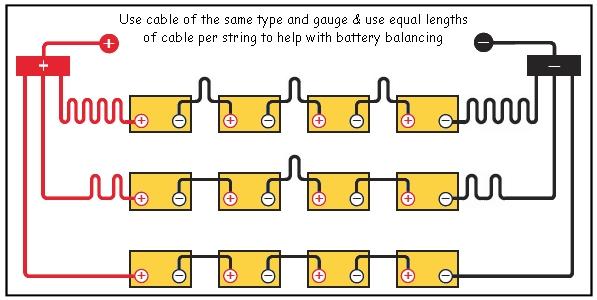
-
Thanks Chris.
-
Just to confirm - is it the BMV-700 or BMV-702?
-
Thanks Chris Thanks for the dealer info. I fully agree with you. Compared to the price of batteries, the BM is a small investment. As I've mentioned, my batteries aren't cycled daily, like in your case, and during loadshedding they don't really work hard, but the BM will just give me all those additional information. I can even mount remotely, far away from the inverter and battery bank - since with the infini you don't have the option to add a remote display like with the Axpert, I think the BM will come in handy here.
-
No, you would not need a HV model. The battery monitor only monitors the battery bank and you connect it directly to the 48V battery bank. The PV voltage is not in any way related to the battery voltage.
-
Max solar charge current of 60A is 60A to the batteries @ approximately 50V - that is not the current from the PV panels. An inverter / charge controller will draw whatever current it can or requires to supply the load, charge the batteries etc. etc. That is why no max PV input current is specified in the Axpert manual. Let's forget about losses for a moment and use rounded figures: to be able to charge the batteries @ 60A you need 60A x 50V => 3000W from the PV panels. Now, say you have a 3000W array of panels and under ideal circumstances you are getting 3000W from them. At that specific moment in time the MPPT maybe determines that the MPP voltage is 105V (per string of 3 panels) and at that moment in time the MPP current will thus be 3000W / 105V => 28.5 A. Two of the main reasons why some inverters and charge controllers want higher PV input voltages, are: 1) At a higher total PV system voltage, the total current from the panels is much lower and you can use thinner cabling and have less losses: compare 4 strings of 3 x 250W panels connected in series per string to one string of 12 x 250W panels connected in series. On 1 string you have 8A @ 375V, on 4 parallel strings you have 32A @ 94V - lower voltage, but higher current. 2) Usually the hybrid inverters and grid tie inverters are designed to make use of higher PV input voltages, because they can more effectively convert a higher DC voltage to AC than a lower DC voltage to AC.
-
OK, as per jhay's suggestion, the earth-neutral link is moved closer to the inverter and in bypass (utility) mode it would be out of the circuit. I've also moved the optional "Inv. Out" breaker to also be out of the circuit when the changeover switch is in bypass (utility) position and I've added a separate isolator feeding the inverter input.
-
Hi Chris If I may ask, from whom did you buy your bmv-702 and what did you pay for it. I've been going through the manual and it looks very feature rich. I don't really need it for my set-up since my batteries aren't cycled daily or worked hard (yet), but the monitor looks like a "nice to have".
-
The bulk and float settings are battery specific - what do you have installed?
-
Hi Thys To me your diagram looks good. You neutral - earth bonding is spot-on. I would suggest you run 10mm2 live and neutral conductors with a 6mm2 earth between the 2 DBs.
-
Agreed. If the inverter then has built-in E/L protection, you don't have to do all of this. If input and output neutrals are connected inside the inverter you can either connect earth and neutral or leave it un-connected.
-
Yes, I understand your reasoning. The idea of my diagram is for a sub DB and inverter some distance from the main DB and in that case you have to have a "main switch" on the sub DB (typical SP+N). If you want to supply power to your (inverter) load via the changeover switch in "utility" position, but also isolate the inverter, I would suggest to add another dedicated isolator for the inverter or use a changeover switch with more contacts as per Carl's suggestion/diagram. Agreed.
-
Yes, that doesn't help at all. 10mm2 is extremely thin for battery cables unless you have a 500W inverter on a 48V bank.
-
What you'll have to do is to connect the inverter input before the existing ELR and then you have to link the inverter output neutral to earth before the new / second ELR. Any fault currents in the circuits connected to the inverter will trip the new / second ELR and any fault currents in the existing circuits will trip the original ELR. You'll have to connect the input to the inverter before the original ELR, because if you link the inverter output neutral to earth and utility power is available, the original ELR will trip.

-
No, not professionally.
-
The panels cannot push more current than required, the inverter will pull what it needs. Compare it to a battery: your 100Ah 12V battery can supply maybe a 1000 amps or more for a very short period of time, but if you connect a 12V 12W bulb to the battery, the bulb will only draw 1A from the battery - not 1000A.
-
The thicker, the better. You'll have to give more detail though: 1) Inverter make & model or max input current (from battery) 2) System voltage (if you have not supplied inverter make & model) 2) Distance between battery bank and inverter
-
The cells in a PV panel are connected in series and therefor the Voc and Vmpp of a 200W, 250W, 300W etc. PV panel will all differ and it is not a good idea to connect different types of panels in parallel. I would suggest to rather connect 3 x 300W panels in parallel - the charge controller will only use as much current as it requires at any given time and if your panels are mounted at a fixed angle you will in any case not get max current all the time.
-
No, the Voc may not exceed the charge controller's max Vin. I'm not sure what you mean by "system will be in parallel"? If you parallel the panels the Voc will still be 45V, and the total current will be 3 x 8.18A; if you connect the panels in series the Voc will be 45 x 3 and the current will be 8.18A. What is the charge controller's max VIN and max IIN?
-
I'm not aware of any special requirements, but if you come across anything, please share. Yes, I've made up my own battery cables. I don't have a crimping tool for those 35mm2 lugs so I've made a punch and die set for the 25mm2 and 35mm2 lugs. I don't solder them, I only punch them and then add some heat-shrink.

-
Yes, those spec sheets were doing the rounds since last year, but nobody could confirm if and when they will become available.
-
No, you cannot parallel the infinis. I think the software is similar to WatchPower - it is called SolarPower Pro. I've only seen WatchPower screenshots, but it has the same look and feel. You cannot download it from the voltronicpower.com website though, but it is available on the net - here is a link to the latest version: http://www.ostrovni-elektrarny.cz/support/Voltronic/SolarPower_1.08_Windows.zip
-
A few...
-
I can vouch for the infini - the single phase unit is currently only available in 3KW though, but it can be overloaded quite a bit without any issues. It is a dream machine - I love my infini! A 10KW 3 phase model is also available.