WannabeSolarSparky
Members
-
Joined
-
Last visited
Everything posted by WannabeSolarSparky
-
Interesting discussion about the "Rules"
-
Stick with reputable known good suppliers. https://powerforum-store.co.za https://www.diygeek.co.za My 2x Narada batteries and and 1st growatt spf5000es and Sunsynk 5k inverter came from DIYGEEK running more than 5 years now with zero issues https://segensolar.co.za Need an installer account to buy, some bargains but mostly a bit pricey https://www.solarwaysuppliers.co.za I buy my panels and mounting systems from them, best prices online open to public https://acdc.co.za Expensive, but can go there in emergency if desperate for something. https://www.liteglo.co.za Electrical supplies online - nationwide delivery quick and their prices are really good, they based in JHB and I am in Cpt often get supplies from them cheaper than suppliers in cape town even after adding their courier fees.
-
Yes, that is to mitigate the back-feed when high loads switch off (mostly the geyser) and to have the benefit of the extra amps if I ever need to startup big loads. I tried zero and 20watts before but ended up over-running by 100 to 200 watts back to the grid for split second. The sweet spot for my setup seems to be 50watts. Goal is to give Eskom as little of my power as possible. This will all only change when I am ready to try fully off-grid again or when I am "forced" by Eskom to go that route. No, All my loads are on the grid side with only my home-lab server on the Essentials side. When/if the grid goes down then all the loads are automatically switched to the essentials side.
-
I hope and trust that you will all have a great prosperous and sunny 2026 😀 After quite a few years running solar, my system is finally getting to the point where everything is running optimally. Eskom only got R115 from me in December and in my books that is almost a big win :) This year I have planned and budgeted to add another 10 solar panels to get ready for winter and to add my 4th JK powered battery to the system. Winter 2025 showed me that I am way short of charging power and ended up where I had to give Eskom R400+ for 2 months (June/July) to top up my batteries. I have north facing roof space to add the 8 new panels, so this should hopefully be enough to keep the batteries topped up nicely through June/July. The added bonus of the new additions will be when Eskom start implementing fixed fees, I should then be able to disconnect and go fully off-grid. For all the HA users here as some really nice animated sensor cards and switches. https://github.com/Anashost/HA-Animated-cards


-
Usually with lithium batteries you would check the individual cells voltages, you will quickly notice/see a cell or cells that have problems as the will usually be a few milli-volts away from the average. Good healthy cells in a battery pack should never be more than 0.005 volts away from the average. if they are then it could indicate a bad cell or improperly balanced cell. You say 3 - 4 years, by that time I think other chemistries may or may not be available that may work differently.
-
That is quite normal, the voltages of each battery will never be the same due to various factors (age, cell resistances, connections, cables etc etc). However if there is a very big difference then interrogate the batteries more closely to ensure all the cells are in good health and that your balancing is working correctly.
-
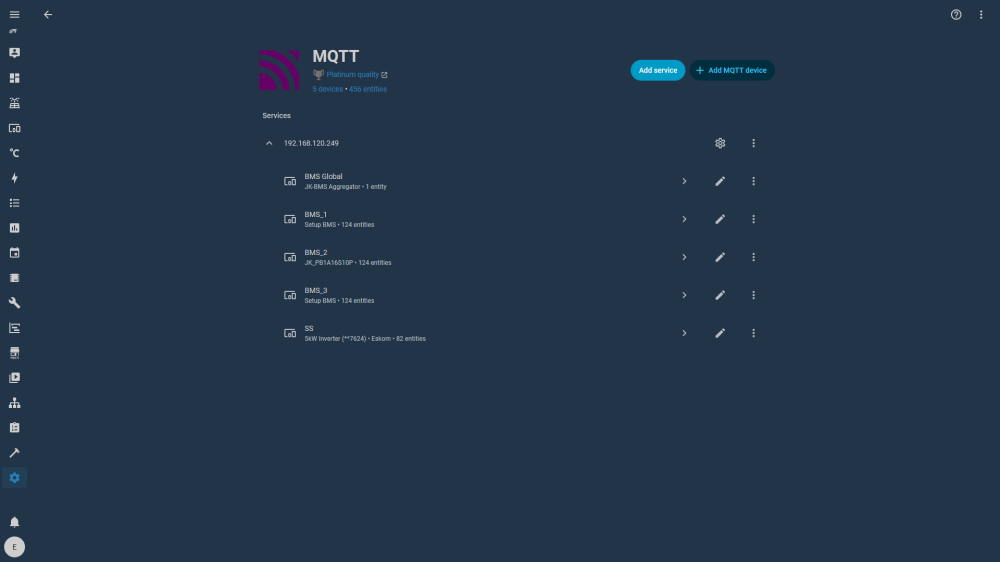
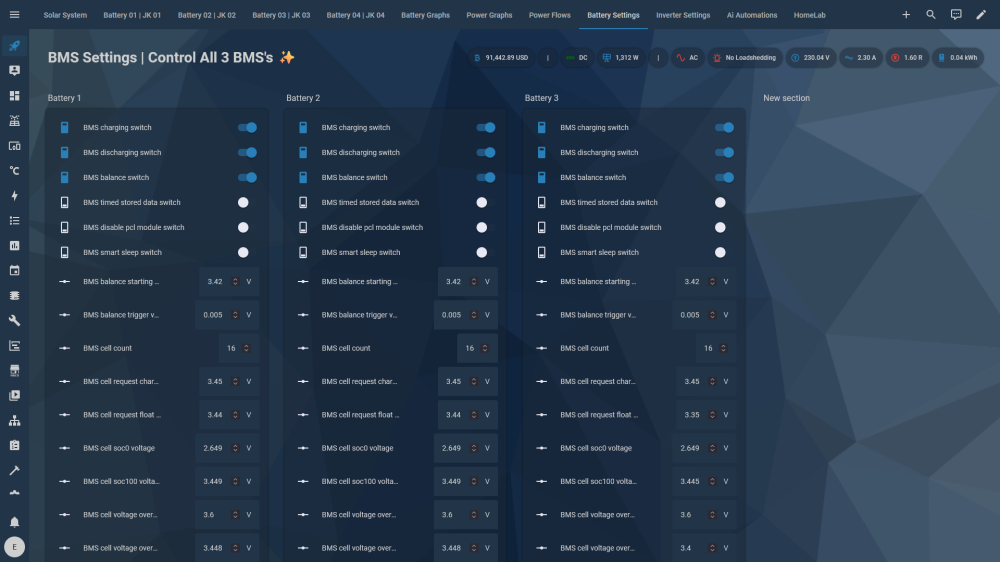
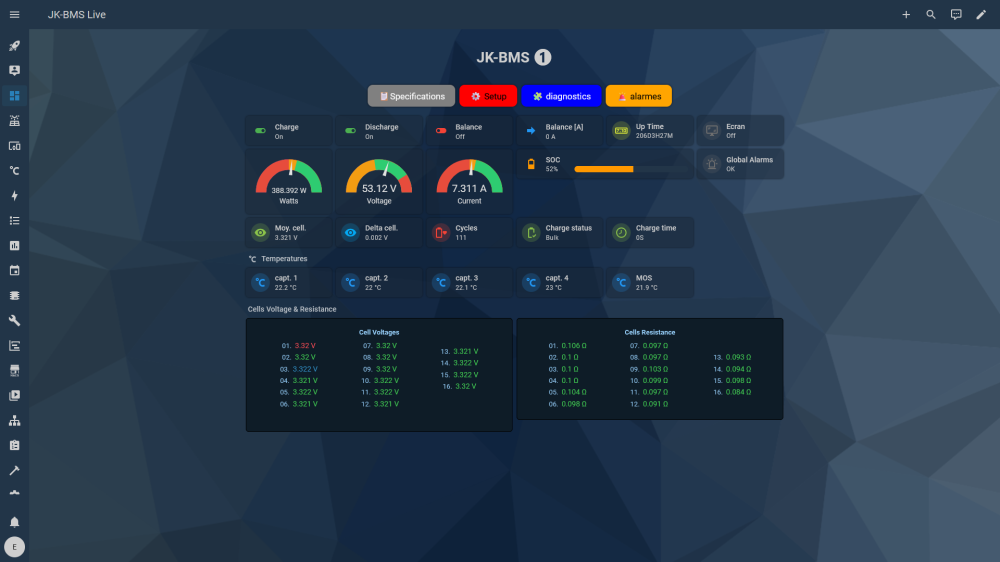
A many of you know already I love data, but sometimes it can be a pain to get data streaming in reliably. There are so many different ways to do it. ESP32 with rs485 ttl, Bluetooth, arduino ttl/rs485, rs232 etc etc the list goes on. Many are very technical and need an understanding of how to program esp devices. I have now found what I think is the simplest way to connect your JKBMS batteries to home assistant. The data flows in very reliably at a decent rate (Almost realtime) and all you need is a simple rs485-usb adapter and the ability to follow some simple step. Data flows nicely into mqtt and exposes a crapton of data entities for you to use all over your HA where ever you like. You can make adjustments to the bms settings right from inside HA And if you too lazy or time constrained then you can get a ready done for you templates to get you going You can view this project on github (Yes it's open-sourced) https://github.com/jean-luc1203/jkbms-rs485-addon
-
I upgraded my 2 naradas from 15 cell to 16 cell and replaced the narada bms with these https://lithium-cells.co.za/detail/429365 I also upgraded 2 Sunpays 15 cell to 16 cell and replaced the pacebms with these https://lithium-cells.co.za/detail/429365
-
2022-JK-BMS.pdf
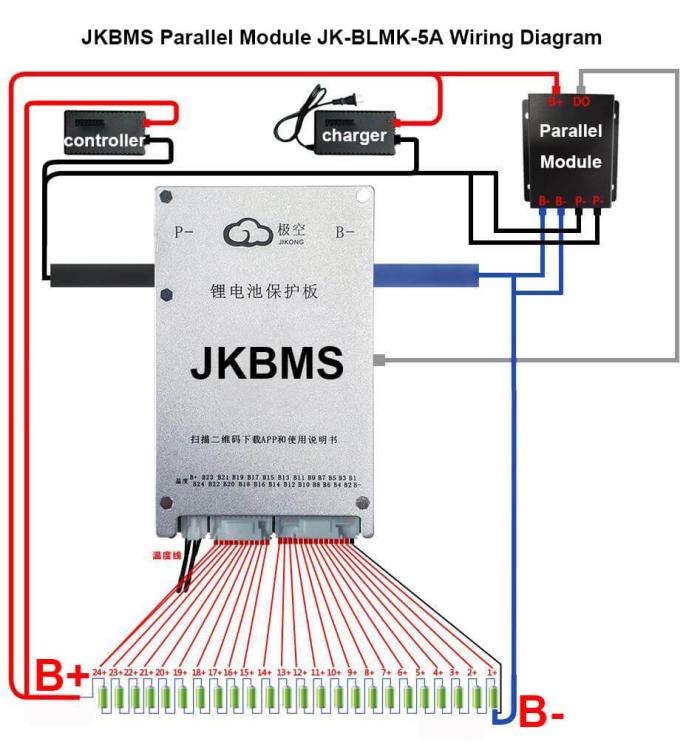 those images you shared show the batteries at midpoint in the flat area of the charge cycles, you will not easily see bad cells that way, you should rather check at the top end of a charge cycle to try pinpoint bad cells. and check each cells voltage to see/find runaway cells.sounds like some of the cells may be out of balance. those batteries mostly use pace bmses so try getting the pacebms software and check the settings, they may need adjusting to help you bring all the cells back in to a balanced state.giving unlimited cycles, and assuming normal usage, what would the remaining usable capacity be at the end of year 10?JKbms's in my opinion are the best and will communicate nicely with each other and your inverter. And they have a great app to manage them and set all the correct settings. They also integrate very well with homeassistant and as @Scorp007 already mentioned, definitely go look at Andy's youtube channel. and definitely as @Sidewinder mentions, try making them into 16s batteries, worth the effort, i did that to all my batteries and they work way better now :)@DieLem and they come with the required screws so no need to get those extra :) And those hooks are top quality, not like the knock-offs you see being sold everywhere at higher prices.https://www.solarwaysuppliers.co.za/index.php/product-category/panel-mountings I use these for most of my installs.@TaliaB and a very difficult one for them to close as they would need to "re-write" quite a few laws and regulations to close it.@Moffat I would agree that if your system is in any way whatsoever physically connected to the grid then they (eskom/muni) can and probably should make rules to a degree especially on the safety and technical side to protect network integrity. But they should not be overstepping their boundaries. I also think this is where a lot of confusion comes in... The definition of grid-tie and partially off-Grid and full off-grid systems. There are several types of solar connections/systems 1 - No solar - only an eskom connection on it's own DB - Needs COC 2 - Pure grid tie system (e.g. solis grid-tie inverters and or microinverters with no batteries e.g. Solis S6-GR1P ) - Needs COC 3 - Grid tie hybrid systems (e.g. sunsynk, deye, solis S6 etc) those that can grid-tie and have batteries and can run with grid outages) - Needs COC 4 - Semi off-grid systems e.g. (growatt es5000spf) connected to the main DB that's connected to eskom/muni with bypass and feeding power to the inverter from the eskom/muni circuits. - Needs COC 5 - Full off-grid systems (can be any inverter types) that is Physically NOT CONNECTED AT ALL to grid/eskom/muni and has its own COC and Earthing system. There is a difference between choosing to Export or NOT EXPORT or choosing to be Semi off-grid or Full off-grid physically from eskom/muni. For the least hassle I personally would choose a combination of (Option1 AND Option 4 physically separated from each other) if you do not want any of the eskom/muni hassles and still be within the safety regulations and laws.@DesRamsay this in my opinion is actually quite simple... And as @Bobster. mentions (Caveat: We are just laypersons having a chat here, not lawyers or engineers. As I read the reports around the registration process it seems that you might get away with this, but the onus would be on you to demonstrate that there is no connection between the inverter and the grid. ) Here is my opinion, understanding and methodology: My Opinion from a bit of research A) - eskom cannot dictate/INTERFERE with what happens after their meter, unless you have a grid tied system then they have LIMITED say over the installation extending as far as it is SAFE for your system to feed back and have the required safety mechanisms in place as they/eskom/municipality require (keeping within the gazetted regulations and laws). B) - Most everything after their meter falls under other regulations and laws related to safety (sans, health and safety laws) and of course your insurance requirements and common sense. My understanding for off-grid Currently all you need to comply with are COC, sans etc... As long as my system is physically isolated from eskom/municipality then they have NO SAY over how I setup and use my system other than sans, coc, safety, insurance and common sense. There are no gazetted regulations or legal requirements to register such a self-use off-grid system with eskom or your municipality. My Methodology from my understanding above 1 ) I have an eskom prepaid feed coming into my house to a regular eskom pre-paid meter, then goes into a regular DB with the normal standard earthing, incoming breaker, earth leakage device and 20amp circuit breaker for a single wall plug outlet, wired down to a normal sabs plug outlet socket below the DB. This can all have a coc and 100% fully complies are all applicable laws, regulations eskom requirements, insurance etc. I now have a fully compliant eskom connection and they have no further say as to what happens in my house and how I use that single wall outlet. Note: As long as I use legally permitted appliances on that outlet. 2) I also have a full solar system (panels, inverter, batteries and DB with its own earthing system and circuits leading out to all sockets lights etc in my house) This system has its own COC, and full complies with all safety regulations, sans, insurance, common sense etc. 3) THIS is the big one where all or some of the confusion comes in. How to use eskom/muni for your off-grid system when you have a run of no sunshine to keep your batteries going. Actually very simple, you buy a 48/52 volt charger that has the correct safety specifications to be safely used as an appliance, and simply plugin it in to your wall outlet socket. This is now simply a normal legal appliance which eskom/muni has ZERO say over as you are by law allowed to use any legal appliance in your home and no law or regulation can prevent you from doing that and using it for it's intended purpose. Conclusion: In my opinion, I now have a fully legal eskom/muni connection as well as a fully legal off-grid system. Discuss...Hey if the diy works then that's great :) Usually you can cascade all the batteries together. usually there are 2 rj45 ports used for rs485 to link all the batteries and then there are usually also rj45 can port to link to inverter. but sometimes the diy way is more satisfying anyway if it works :)If the array is high voltage in series (250v+) then 6mm2 should be ok, that is quite a long run so ideally 8mm2 would be safer with less voltage drop. As for the type of cable, and using 4 core, some of the more clever guys here on the forum can answer that :)@Verrayne I love my sunsynk, reliable and has not missed i beat in over 5 years now. As a long time sunsynk user I can categorically state in my opinion, the sunsynk app/portal/system/support is atrocious. What started of as a re-branded deye inverter with a good reputation, unfortunately that has gone down the drain... especially in SA. Maybe they just follow with good support where the demand is highest. They saturated SA in the days of constant loadshedding and now don't give a hoot about SA. That's my rant of the year :) Best solution is to get home assistant or solar assistant or something similar where you are in control of the data and never need to rely on some third party system.@Gambit the rs232 on most bms's is usually for configuration software like pbms etc that connects to your pc/laptop rs485 is usually for the monitoring software and inter battery comms etc If your battery has a pacebms/jkbms/seplosbms etc then definitely the rs485 port will work for most monitoring systemsHere you go https://github.com/syssi/esphome-pace-bms I tested this with my pacebms and esp32 works perfectly.It should be ok. Mine is inside an enclosure in my garage with ambient temp in summer of 29 and never had any issues with my pi.