P1000
Members
-
Joined
-
Last visited
Everything posted by P1000
-
Some of those higher capacity batteries have non-standard discharge curves. From those that I have looked at, all the extra capacity was below the voltage cutoff for the BMSs I could get, so it would have been a complete waste of money to opt for them.
-
The primary problem is not the quality of the cells, it's that those batteries don't have balancers in them. I have considered buying ingco batteries to harvest the cells - they are currently the cheapest source locally.
-
Do you mean the GW5048D-ES? Yes it is NRS-097 certified. Just search for "NRS 097 Approved inverter list" and the CT list will pop up with a table of approved inverters with their report number and certificate number.
-
The Staubli connectors that come with the panels are about as premium as they get, they stuff that is usually mated to it is usually far from it. The connectors have a completely different structure than what you get in a typical wall plug - look inside the female and you will see they have a number of spiral or straight contacts made from plated spring material. This arrangement ensures much better contact than the (usually 2) contacts in an AC socket. I'm pretty sure that's not true, and also the source of many of the problems.
-
Most likely because the mating connectors weren't compatible, or badly crimped. This is the biggest risk with poor installations. Ideally all mating connectors should be of the same manufacturer and same series. Rule of thumb is that if it has a red oring, it's not genuine Staubli (most likely what the Canadian solar panels came with) - if it has a black oring it might be. It's worth paying the exorbitant prices for Staubli connectors and proper crimping tools if it means your house won't burn down.
-
Yeah, please don't install any switch-gear that is not certified to the standards required in your country (or at the very least the equivalent ISO standard if you are willing to do the research and take on the risk.) Even if it is a completely off-grid installation. Something like this can quickly turn into a fire. It's also a good idea to check all your terminals annually and tighten them, thermal cycling can cause them to work loose, leading to a situation like this. On a side note - there are no affordable certified ATS (that I could find) - those that were certified cost about as much as an 8kW NRS097 hybrid inverter. So my suggestion is to rather design your system so that it does not require an ATS. You can use contactors, but not in the same way as you would an ATS. IOW, you cannot use a NC and NO contactor to function as an ATS, since they cannot guarantee interlocking/break before make.
-
I would guess that the battery is disconnecting due to a cell over-voltage event.
-
There is someone on another forum that claims he can generate an unlock code for a fee (and also many that doubt this claim). Also another that claims he got a code directly from DEYE: https://diysolarforum.com/threads/china-kills-all-non-sol-ark-branded-deye-unit-in-the-usa-this-morning.94349/page-100
-
The fact that he can discharge the batteries makes me think it's more likely to be the BMSs. The BMS can stop current in one direction, the bidirectional inverter cannot really fail that way - all the components are used for both directions (unless perhaps the software is detecting a problem and disallowing charging).
-
Technically, you are not allowed to increase the supply - if your eskom supply is 150A, then that is the maximum breaker you may install anywhere in the system. The solar is not allowed to supplement above that limit. (But nobody pays attention to that, so do whatever you want.)
-
That's the nice thing about open source software. If you want a feature that is missing - you can add it yourself.
-
You can check here and filter for the parameters you need, there is one that meets the requirements but is 45mm tall: https://za.rs-online.com/web/c/passive-components/capacitors/aluminium-capacitors/?pn=1&rpp=20&selectedNavigation=attributes.Capacitance=15000µF^attributes.Diameter=25mm They are all snap-in, which i
-
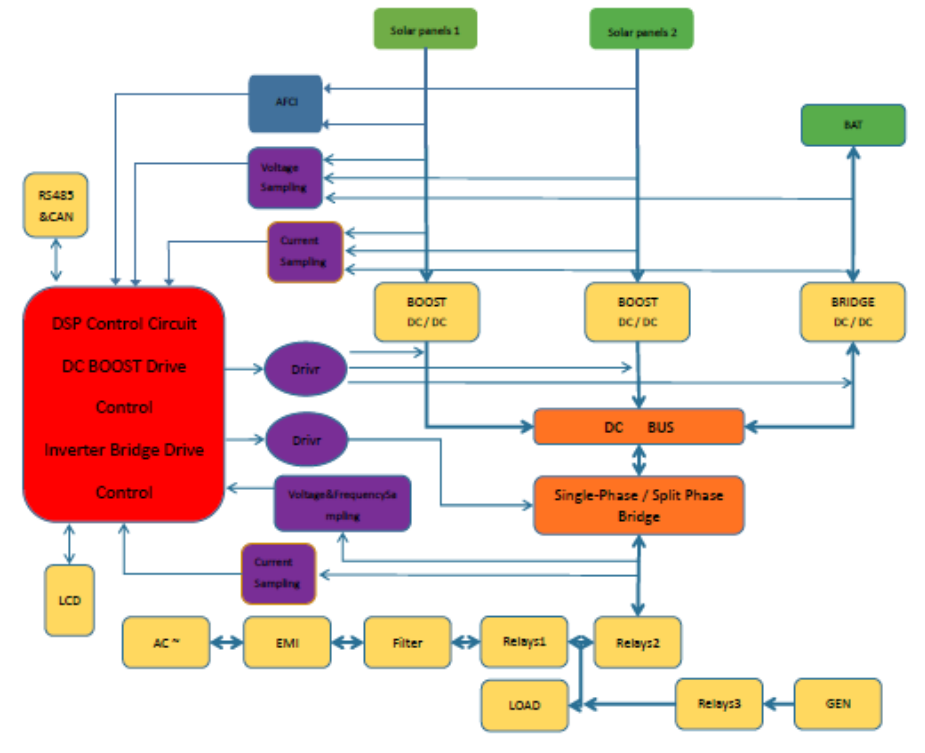
Me too. The MPPT in the Sunsynk/deye goes to the HV DC Bus. There is another isolated DC/DC bridge (bidirectional) that couples the battery to the HV DC bus. It's not the same as with the low frequency Victron solution (although the new RS is probably a similar topology).

-
Not quite - it's output is the DC bus voltage, which should be around 330V (the exact voltage depends on your AC voltage and some other factors). Apart from that, it's under software control, meaning that the response time is limited. So there exists the possibility that the current might overshoot the capability of the hardware - possibly saturating the inductor and killing the IGBT before the software even knows about it - that is why there is a Isc limit.
-
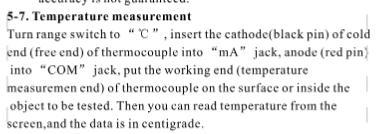
And the picture you attached (which is also what is usually used with multimeters) is a thermocouple, which is not a thermistor. It does not change resistance with temperature, or at least that's not how it is used to measure temperature - it generates a voltage by the thermocouple effect when two dissimilar metals are joined. Most multimeters use k-type thermocouples. So in this case, it might just be necessary to swap the positive and negative leads of the probe. Looking at the Toptronic T48, it seems that it uses a proprietary connection for the probe: https://www.hellermanntyton.co.za/products/digital-multimeters/tbmtempprobe/911-01867 Though, I'm not sure if the website is correct, because I don't see where it plugs into the multimeter: https://www.hellermanntyton.co.za/products/digital-multimeters/t48/911-00004 According to the manual, it mentions two connections, so I guess the linked probe is not correct. http://mail.hellermanntyton.co.za/download/manuals/t48-digital-multimeter.pdf
-
No. Your inverter can only invert 5000W. In other words, it can only convert 5000W into AC (ignoring the 10s overload capacity).
-
Your inverter can only invert 5000W. The MPPTs can do 6500W, but then your batteries have to be taking at least 1500W of charge (the rest going to the grid/backup).
-
That's because most of the efficiency gains for fridges/freezers come in the form of better insulation. (And the door seals also contribute significant losses as they age).
-
Cell surface make no difference when you pack the cells closely like that and into a box with the same surface area. The box surface becomes the limiting factor. Packing those cells close is the same as a big cell - unless you have water cooling or similar running between them (like tesla). Don't get me wrong - Greenrich is a perfectly adequate battery, and I can recommend them, but the claim that the smaller cells have any advantage in this case is nonsensical. The only reason that they use them is because they are cheaper.
-
From my experiments it looks like pylontech just has better cells. (and for 4 times more losses, you only need double the internal resistance)
-
I have measured these and they will increase in temperature 4x faster than Pylontech's 0.5C batteries at the same C-rate of discharge (the greenrich has 4x the internal losses of an equivalent pylontech). I would not use them at a higher rate than 0.8C, preferably 0.5C. The claim about the cell surface area is useless when it's re-packaged in the same form factor.
-
That is the default values. I've seen batteries that reached those alarms a couple of times at the start of commissioning and they are still in daily use after many years. It seems like the cells they use are quite robust (if you exclude the 125Ah). (Go look at the logs, there is a good chance that you also had OVP events when your battery was new.)
-
Like this? https://www.takealot.com/electric-quartz-heater-800w/PLID72496228
-
Those aren't max limits, those are operating limits. You can put as many panels as you like to, as long as you remain below the voltage limit of the MPPT, and below the Isc rating (I think 34A per MPPT for this inverter).
-
Check the fuse.