superdiy
Members
-
Joined
-
Last visited
Everything posted by superdiy
-
I've been using a MEDE8ER MED500X since 2010 - ripped all the kid's DVDs onto the internal HDD and also use it for movies and series. It is still used daily by the kids - they have a choice of more than 300 of their DVDs and when they go to bed we usually watch an episode or two of one of our favorite series. I actually bought a newer model (MED800X3D) last year on special, copied everything from the MED500X's HDD to the MED800X3D's HDD, but never started to use the new M8R - the old one just keeps on working...
-
OK, the Dixons want a 59.2V bulk charging voltage, although the Axpert can only go up to 58.4V. The float charge setting of 52.8V is correct. Everything else looks fine. Setting 11 is set to 2A, which means that the batteries will be charged at 2A if PV is insufficient e.g. on cloudy / rainy days or during nighttime, if needed. If you are OK with that, you can leave all the rest as-is.
-
Maybe you should check all your settings, not only the charging current. The Axpert has a maximum charging current setting (setting 02), which in your case should be set to 40A for the current bank and then it also has a maximum utility (grid) charging current (setting 11) which you have to configure depending on if you want to charge your bank from the grid and at what rate, say in case the batteries are discharged below a certain level at night or during a cloudy/rainy day - that setting is entirely up to you, but again should be set to a maximum of 40A. You should also check all of the following settings: 01, 05, 12, 13, 16, 23, 26, 27, 29 & 31 - a lot of these are determined by the battery type and specific -properties.
-
What, who gave you that advise? The Axpert already has a built-in charge controller, why would you need a separate one. You might score a little in efficiency if you add a very good external charge controller, but the price and effort will certainly not justify it. As mentioned above, you should charge the batteries at about 10% of the Ah rating, that is 10% of (3 x 10⁵) => 31.5A, but as @plonkster mentioned, you can charge at a bit more than that, up to about 14-15% of the Ah, so I would not recommend that you set the Axpert to a charging current of 40A. And add fuses to the individual battery strings as well.
-
Moisture might cause the Earth Leakage Relay to trip, depending on how severe and exactly where the leakage occured, but should not be able to trip a circuit breaker. Please give more info on exactly what tripped on the input and output.
-
If you are unsure, post pictures.
-
Hi ebrsa I have both T105REs and HA-02 balancers, the balancers are just not connected yet. Up until recently I've used zener balancers as per the detail and link @Chris Hobson has posted about a year ago. The voltages of my batteries were up to 0.4V apart initially and since I've added the zener balancers it became more balanced until the voltages between the batteries were within about 5 - 10mV of each other. So even the cheap zener balancers worked fairly well to keep the batteries balanced. You should still not confuse the two terms namely balancing and equalizing - however by balancing the batteries continuously by means of battery balancers you will probably not have to equalize them that often, if at all - keep in mind that balancers are permanently connected to the batteries. On the other hand an equalization charge is an occasional controlled charge at a higher than normal voltage for a short period of time (say about 1 - 2 hours) to mix the electrolyte in each cell and to reverse possible sulphasion. You can google a bit and read up about battery balancing and all the associated advantages; in my opinion you will only benefit from installing balancers.
-
Hi Chris As @SilverNodashi already said, buy the thickest you can afford. OK, not really, but I would probably use at least 50mm2 (or the next value up) for 200A on that length of cable. The thing about cable lengths is often misunderstood. The positive and negative cables running to the inverter does not have to be the same length, just as short as possible to have as little as possible resistance and losses. The exact cable length thing is very important in parallel battery strings in order to utilize (charge and discharge) each string equally. So in your case you are going to use copper bars (obviously needs to be of the same length and cross-section) to link the batteries, which is perfectly fine. Equally important are the cables connecting the battery strings to the busbars. Here you should again use cable of the same type and thickness (which should then have the same resistance and other properties) - ensure that the total length of cable used per string is equal for each string - say you have 200mm of cable between the negative busbar and the battery pole in string 1 and 300mm of cable between the positive busbar and the battery pole in string 1, you will have a total length of 200 + 300 => 500mm of cable in string 1. In string 2 you must therefor also use exactly 500mm of cable in total, does not matter if you use pieces of 100mm & 400mm or 250mm & 250mm etc. etc. as long as the total length of cable used per string is equal in each string. Refer to the images below. If you are however going to add a battery monitor with midpoint monitoring, you'll have to keep the cable length on each side of the midpoint exactly the same per string and on each side of the midpoint. Since you are going to make use of copper bars to link the batteries, you must ensure that you have equal lengths of cable between all the batteries and busbars. The best way to achieve that is to measure the longest piece of cable you'll need and to then cut all your cables to that length.
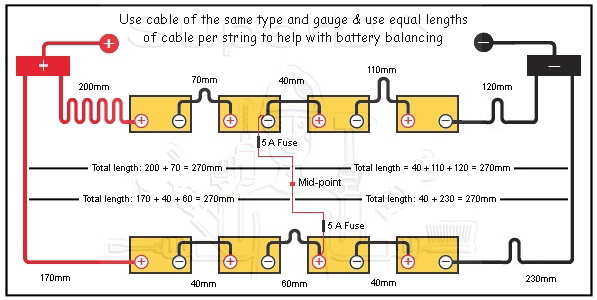

-
Hi ebrsa I think the terms got a bit mixed up somewhere in the chinglish. The HA02 is not technically an equalizer, but rather a balancer and by keeping the batteries balanced you might need to perform equalization less frequently. The purpose of cell (battery) balancers are to keep the voltages of the cells (batteries), it is connected to, as close as possible to each other - that is exactly what the HA02 also does. By keeping the voltages of the cells (batteries) close, you effectively keep the SOC of the cells (batteries) very close to each other and if checked with a hydrometer the SG should also be very close to each other. By keeping the values of the SOC's of the cells (batteries) close, you might not need to do equalization charges that often, unless there is another reason to do so. From the Trojan website: Equalizing is an overcharge performed on flooded lead acid batteries after they have been fully charged. It reverses the build-up of negative chemical effects like stratification, a condition where acid concentration is greater at the bottom of the battery than at the top. Equalizing also helps to remove sulphate crystals that might have built up on the plates. If left unchecked, this condition, called sulphation, will reduce the overall capacity of the battery. Many experts recommend that batteries be equalized periodically, ranging anywhere from once a month to once or twice per year. However, Trojan only recommends equalizing when low or wide ranging specific gravity (+/- .015) are detected after fully charging a battery. So, by making use of balancers like the HA02 or similar, your batteries should be in a much better state than without using a balancer of some sort. You might still have to do equalization charges though, just less frequently.
-
The crystals all suffer from the frequency variations caused by temperature fluctuation, whether it is the higher frequency crystals used for the microprocessor's timing or lower frequency crystals, e.g. the clock crystals running at 32 768 Hz. Looking at a deviation of about 3.5 ppm for 10°C above or below 25°C, I think the difference between measurements and calculations on hot and cold days will be negligible on a day-to-day basis. I'm not that into maths, but maybe @plonkster can throw in a few calcs...
-
Drifting off topic again... Digital clocks, watches etc., not connected to mains power, makes use of a quartz crystal oscillator as time base. A typical digital wrist watch and battery operated alarm clocks etc. makes use of a quartz crystal oscillating at 32 768 Hz. By making use of multiple divide by 2 stages (15 of them), you end up with a frequency of 1 Hz (or pulse every 1 second) and that is used to drive the "seconds" counter in the clock or watch, or to pulse the coil in a wall clock to move the "seconds" hand and clock mechanism. The major cause of frequency variation in the quartz crystal is because of temperature changes and I quote: "The crystal planes and tuning of a consumer grade clock crystal are designed for minimal temperature sensitivity in terms of their effect on frequency and operate best at about 25 to 28 °C (77 to 82 °F). At that temperature the crystal oscillates at its fastest. A higher or lower temperature will result in a -0.035 parts per million/°C2 (slower) oscillation rate. So a ±1 °C temperature deviation will account for a (1)2 x -0.035 = -0.035 parts per million (ppm) rate, which is equivalent to -1.1 seconds per year. If, instead, the crystal experiences a ±10 °C temperature deviation, then the rate change will be (10)2 x -0.035 ppm = 100 x -0.035 ppm = -3.5 ppm, which is equivalent to -110 seconds per year." In newer microprocessor-based applications, quartz crystals are also used as the clock signal for the microprocessors, the frequencies are typically just higher, e.g. 20 MHz etc. etc. Unfortunately the quartz crystals still suffer from frequency deviations caused by temperature changes. Furthermore some clocks like clock radios, oven clocks, certain microwave ovens etc. makes use of the 50 Hz (or 60 Hz) mains frequency and divides that to get the 1 second (or 1 minute in clocks without seconds) pulses. Those clocks might drift much more if the mains frequency frequently drifts. We used to see this a few years ago when eskom was under a lot of strain and the mains frequency frequently ran low - some clocks lost a couple of minutes a month. Most digital pool timers with battery back-up would make use of 32 768 Hz quartz crystals - it is inexpensive and fairly accurate and will keep time when the mains connection is lost. I've repaired 2 different models and both used 32 768 Hz quartz crystals. Stand alone sprinkler timers would probably also make use of 32 768 Hz quartz crystals - again it is inexpensive and fairly accurate. The geyser wise unit probably makes use of a microprocessor and higher frequency quartz crystal.
-
Split the DB to run the stove, geyser (if not solar) and other heavy users directly from the grid. Then get a 3KW infini or rebranded infini for between about 12K and 17K IIRC. It is a true hybrid which can normally supply 3KW and can combine the grid to supply loads of more than 6KW for extended periods, like when the vacuum cleaner, hair dryer and a few other items are used simultaneously. Add up to 4500W of PV panels and a decent battery bank, e.g. 8 x Trojan T105-REs and you have a reasonably cheap set-up which should work seamlessly once configured correctly.
-
@SilverNodashi
-
Are you sure that is accurate?
-
Lightning will probably jump almost any fuse, so I doubt that any fuse will prevent a lightning strike from causing harm down the line. Your best bet is to divert the lightning with the shortest possible path with the least resistance directly to ground, but even if you do that it is not guaranteed not to char few things down the line.
-
Some strings will still work harder than others connected that way. You need busbars and equal lengths of cable between each sting and each busbar.
-
Are those 6 parallel strings?
-
Thanks Chris, I've just received mine.
-
So is it for sale or why is this posted in the classifieds section. How much do you want for it?
-
I have not received mine yet and need to perform a few tests before confirming the above, but according to the Chinglish on the web it seems that the 4 sets of cables can be connected any way you like - none of them seems to be connected internally, unlike the HA01's connections. The equalizer is not affected with battery connection way, no matter in series or in parallel, both can work.
-
A battery monitor, e.g. BMV? It will measure volts and current and can be logged...
-
Yes, I also noticed that - I think it is just another re-branded infini with some minor changes to the look-and-feel.
-
If they heat up, it is either a bad connection or the current flowing through them is quite high, but still lower than the current rating of the fuse.
-
It totally depends what problem(s) occurs where in the bank, even if those fuses are used to link 12V batteries in different strings, a blown serial fuse in one string and a failed cell in another string might result in a voltage equal to the battery bank voltage which might need to be isolated. Rather safe than sorry - you are working with DC.
-
Those are used for automotive blade fuses rated at 32V only, so unless you are using them in a 12V or 24V system, don't use them. http://za.rs-online.com/web/p/automotive-fuses/7874126/