Gerrie
Members
-
Joined
-
Last visited
Everything posted by Gerrie
-
Very interesting stuff, just out of interest was there any favorite between the four?
-
I also had the transformers making a noise and have changed all of them to the GU10 230V Led’s. Definitely those old 12volt lights draw quite a bit of current and is not energy efficient, The LED’s are the better option as you can even get them as low as 3W. Earthing is always the better option, some will say if they are out of arms reach they need not be earthed, but when you need a COC you might find the earthing is non-compliant, the bright light fitting looks correct and should pass a COC if installed correct. My old dimmers does not dim although the lights do switch on but I did not get the dimmable GU10’s because they are very expensive and I have just too many to replace, so for now they are good enough. I think eventually I will just replace the dimmers with normal switches.
-
I also inspected my inverter from top to bottom when I received it. At the bottom something looks like a fan but their are no visible moving parts. But one thing to keep in mind these units are IP 65 rated. Designed to work on ship decks and take a water spray without a problem. So if it sits on a garage wall under a roof it might look a bit strange.
-
I don’t agree with this statement even the CPA have terms for when you can get a replacement, if there were any fault on the part of the consumer these terms will determine the course of the claim.
-
I also agree, so far that is the only shortcoming I could find with the Sunsync and I don’t like to keep changing settings everyday from ‘limit to load only’ I have one Pylontech battery only and have found sometimes it ran down to fast not leaving me with enough backup for night time, I have also done as Tariq mentioned by changing the SOC setting so that the battery can keep its charge a bit longer but I would like a easier tick box option. Hopefully Sunsynk will be the first to jump on this opportunity and be the solution.
-
I don’t know what I would of done if I was in a similar situation. I think normally if their was a problem with the inverter from the commissioning that the installer picked up they should definitely replace the unit, but the fact that it did work for a certain period of time and only than became faulty is the grey area where the terms and conditions become the choice of the supplier. Just my understanding of things. I do think that it’s great that they fixed the unit in a reasonable time and gives me a bit of re-assurance with my own Sunsynk should something go wrong with the unit. Maybe you should twist their arm for a free Sunsynk logger or extended warrantee to make up for lost production😉
-
I got this message on the Solarman app, Is anyone else also getting this message?

-
I was thinking if adding a separate voltage regulator between the inverter and generator would make a difference for those of us who have the cheaper type generators that can’t do a good job regulating voltage? Few years back with some serious load shedding I had to get a office running with a small 5KVA adendorf generator. The problem was lights and computer screens were flickering and showed signs of bad voltage, we decided to get a additional regulated power supply from AC/DC. This seemed to resolve the problem and we did not have to buy another generator. Has anyone actually tried something like this with inverters that is a bit finicky with voltage?
-
I would also like to change limit to load remotely or is their perhaps any newer software version that allow the Limit to load only to be set on a timer setting on the touch screen? Also Is the new Sunsynk dongles available yet?
-
I have not worked with the thee phase Sunsynk, but if I had the option to do three phase I would start by fitting a three phase changeover and splitting each phase at the DB board to Non-essential and Essential loads and wire only the absolute important things for each phase like lights, alarm system, cctv, gate/garage motors, plugs for fridge, TV and computers to essential. The one battery should give some backup at night during load shedding as long as you stay within the battery limits. During day time the excess PV can still feed those non-essentials and let you save a bit on power. As your system gro you just swing more loads to essential side.
-
I use the same version and it works, you might have another problem connecting to the battery. Do you get the green Battery Module icon once you push connect?

-
https://powerforum.co.za/topic/2408-pylontech-us2000b-how-to-read-data-from-them/ This link might lead you towards that direction. There were quite a bit of interesting info on how to get into the pylontech program.
-
On my own geysers I prefer to switch both live and neutral through a double pole relay rated 25A, this relay is controlled by a Sonoff, the 25A relay takes the geyser load of about 9A while the Sonoff load is only the relay coil of about 20mA. In this case the Sonoff should last many years because it’s just for control and not power loads. Using a double pole contact to also switch neutral will make fault finding easier should their be a earth to neutral fault on the geyser element. If you don’t have a double pole switch you might have difficulty resetting the earth leakage on a neutral geyser faults. Just my thought on geyser control.
-
It looks like the meter from this attached manual will allow back-feed up to 50Wh as long as it’s not continuous otherwise it will flag a reverse condition. The 50Wh is quite a lot of room when it comes to spikes that will probably only last a few seconds. It does not say it will trip but mention the reverse flag condition and the credits will continue to decrease even in reverse. Page 23.
-
It was never my intention to run it in parallel like the but when I installed the solar geyser I did not want to remove the old geyser but rather keep it as a spare, as I thought removing a perfectly good geyser would be a waste.
-
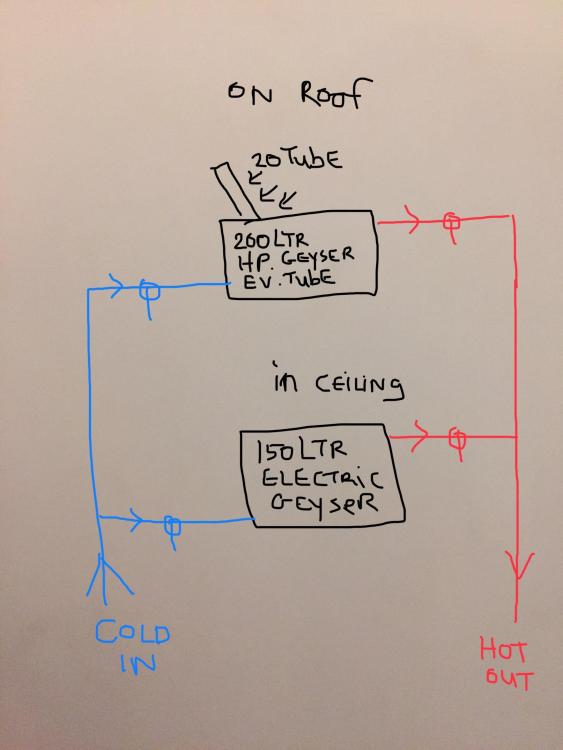
It does mix and send hot water from the electric geyser in the ceiling to the evacuated geyser on top of the roof especially during the night, it took me a while to realize this because after everyone showered at night my EV geyser on roof would be say 44degrees and without giving it any power during the night it would sometimes be higher the next morning like 50degrees thats when I realized the hot circulation is happening. Unfortunately I cannot see the temperature of the geyser in the ceiling but would expect it to be slightly colder when it has not been powered for a couple of hours. Your first geyser in line seem to make the difference and is key for longer periods of hot water, I might change my system to series but for now I’m still experimenting with the parallel setup and am just wondering where to fit the circulation pump.
-
I’m curious of how this worked out for you, did you test the system with any results? I did something similar but have put my two geysers in parallel, I have my old normal electric 150ltr geyser in the ceiling that I kept just as a spare and installed a HP evacuated tube 200ltr geyser on the roof about 2years ago. For the two years I have been using only the EV solar geyser and have switched off and drained the spare old geyser, but about May this year I had a small problem on the EV geyser controller that prevented me from using the element so I decided to re-instate the spare geyser in ceiling I opened it’s valves and switched on the element I also just left the EV tube geyser to carry on as normal, so-that I could see how it will work. Well it changed my mind on thinking geysers need to be in series only, as I have not had a day with anybody complaining about cold water since May. I have fixed my EV solar controller in the meantime but hardly used it. I now power the old geyser in the ceiling mostly with excess solar PV and because the two geysers both feed my taps at the same time the geysers seem to maintain higher temperatures at all times and need less heating. I think I will add a circulation pump now for the summer to circulate hot water through the two geysers it should assist in keeping the EV tube geyser more under control due to their extreme efficiency in summer when they tend to blow out hot water when temperatures can go over 89degrees.
-
I’m still new with Sunsynk but the second change-over might be worth it due to me only having one Pylontech US3000 battery, if I had more batteries I could possibly go completely off grid and would not need that second switch, but with one battery I need to keep my loads according to battery capacity.
-
Hi Joey this is timer based with the Sonoff switch fitted inside my DB. When weather is nice I just leave it to switch with timer settings on my phone, but when the the weather is cloudy I just disable the timer on my phone. The screenshot below is the two change-over controls.

-
I have three sections in my DB. Two of the sections have auto-changeover switches. It can switch between inverter and Eskom. The third section in non essential straight from Eskom like dishwasher, tumble drier, underfloor heating, geysers, microwave and my kettle plug. 1st automatic changeover switch is for essentials like CCTV, lights, Alarm, gate motor, tv plug. These run 24/7 on inverter backup. 2nd auto changeover switch feed the rest of plugs for Fridges, TV’s, computers etc. Normally switches on at 7h30 till 15h00 when daylight and with PV availability. This is how my Axpert worked for more than two years , now I replaced the Axpert with a Sunsynk but C/O switches still in place and the Sunsynk with all it's features don’t really need the second changeover switch as it can feed back to non-essentials as well, but if Eskom is down it cannot, for that reason I think it’s worth keeping the second changeover as I can still switch the second lot of loads over to inverter if needed in long power outages. I have one other separate change over installed that also work with a sonoff to switch my one geyser between eskom or solar PV during daytime peaks to try get max out of the system. What would recommendations be about this setup unnecessary or does it have some merit?
-
Hi YellowTapemeasure I also have the Landis Gyr pre-paid meter with Sunsynk set to draw the 20W, it has not yet tripped but I did notice on the inverter screen today that while the washing machine drum ramps up and down (non essential load) there is a slight back feed to grid of +-10 to 40Watt. This happens for about 3seconds and than changes to draw again the 20Watt. Happens about 5 times a minute but I could not see any effect on meter or credits changing. Do you know what is meant by pre-paid meters tripping? does it actually stop working or what state does it go to, and how does it come right again. I also want to set the draw to zero but don’t know what to expect.
-
I don’t know the Deye CT but have just done the Sunsync CT. There is a arrow on the CT and the arrow needs to point in the direction of current flow from grid to the load-side.
-
Thanks Tariq, yes I did install the earth bond relay.
-
WiFi dongle installed on weekend and works with Solarman smart. One question if someone could please assist, do I need to tick the Sunsync “signal island mode” if I’m not feeding to council ? the inverter is set on the 20W continuous feed from grid to prevent the reverse meter flow to the council.
-
Both systems has a place in the market and in my opinion there’s no right or a wrong between the two. If you are planning on installing a inverter it might be worth fitting a big enough system that could also be used to dump excess PV power into, but this normally require a reasonably big size inverter especially if you have more than one geyser. In my own situation I have one evacuated tube geyser and one normal electrical geyser that I dump some excess PV into, but I think I choose the evacuated tube geyser because it can manage without electricity and timers and always have hot enough water for showers.