


NigelL
Members
-
Joined
-
Last visited
Everything posted by NigelL
-
As far as I remember, the Efergy monitor has a setting where you enter the Mains voltage. If this is set above/below the actual mains voltage, the calculated energy will be correspondingly above/below the metered value. Also check whether the clip-on current sensor is properly attached. The two sensor surfaces must be lightly pressed together (i.e. no gap) and have no cracks, chips or dirt between them. A third possibility is that the Effergy monitor may not accurately record very low-current loads (standby current of TVs, PSUs etc). This can easily add up over a couple of months.
-
This results in a somewhat unexpected consequence - your solar panels will run slightly cooler as one draws more electrical power from them. See https://www.sciencedirect.com/science/article/pii/S2211379716301280
-
Hi Bobster While your solar panels are capable of generating 3kW - they only deliver the amount of power that is required by your system. Practically, this is done by your solar charger limiting the amount of current drawn from the solar panels. Sunlight energy on solar panels is normally converted into a small amount of electrical energy (e.g. 17%) and the remaining power (83%) is dissipated as heat. When you stop drawing electrical energy from the solar panel, 100% of the sunlight energy will dissipated as heat. So you are correct - the solar panels are one very large heatsink 😉
-
A 4kWh Lithium Battery is undersized for a 5kW Inverter. Take a look at the Pylontech battery recommendations for example. You should also typically set your minimum SOC to around 30% - although this depends on how much battery reserve you need to keep for loadshedding. I have a 12kWh BlueNova battery with a 3kW inverter so I generally only discharge to about 65% SOC overnight. My battery appears to have a larger capacity than advertised - cell voltages still looked okay when I once discharged it close to the full rated capacity (as measured by BMV712).
-
I am not familiar with the HXE310-P meter, but unless it's a bi-directional meter, it is highly likely you will be charged for pushing power back to the grid - as though you had used the same amount of power from the grid.
-
The good news is that you are unlikely to have any problems with a grid-tied setup (this can sometimes result in low-power/short-duration feedback to the grid - causing some prepaid meters to trip). The bad news is that you are likely to be charged (i.e. units deducted) for any power that you feed back to the grid!
-
South African Standard SANS 60364-7-712:2018 (which is based on the international standard IEC 60364-7-712:2017) - titled "Low voltage electrical installations - Part 7-712: Requirements for special installations or locations — Solar photovoltaic(PV) power supply systems" does not have any requirement for metal conduit. Section 712.522.101 states that "All non-metallic cable management systems exposed to sunlight shall be of a UV resistant type" I think that SANS 60364-7-712:2018 is likely to be the "applicable regulation" on this issue, but I am not 100% certain.
-
For some useful info on solar panel performance, based on installation angle, orientation and your location, see https://www.pveducation.org/pvcdrom/properties-of-sunlight/solar-radiation-on-a-tilted-surface Edit: This page is probably more useful - https://www.pveducation.org/pvcdrom/properties-of-sunlight/calculation-of-solar-insolation
-
The City of Cape Town introduced a second Feed-In tariff that is a bit more user-friendly - see the "Residential Small Scale Embedded Generation 2" in the attached document. This works out at R85.00 more than the standard monthly "Network Access" fee, so you need to feedback 108kWh/month or roughly 3.6kWh/day to offset this increased fixed cost. The only way this will work to your financial advantage is to maximise your feedback during summer months to try and offset your increased usage during winter months. Remember that you cannot be a net-exporter over any 12-month window. However, it is worth taking note of section 10.3 of their Supplemental Contract: Electricity Consumptive Tariffs 2019-2020.pdf
-
Honestly, I think they forgot about my application until I followed up with them in September. They quoted me a 2 week turn-around for a decision on the permission to install, in May. I was not in a hurry for the paperwork since the installation was already "completed" prior to the application 😉. The City of Cape Town require you to sign a "Supplemental Contract" that basically lays out the rules and options available. Max inverter power Power Export or Non-export options Bi-directional energy meter (if exporting) Costs and Tariff structure (depends on whether one chooses to export power) If you choose the export option, then you may not feed back more power than you use over any rolling 12 month period.
-
Another point to keep in mind is that PV Panels generate optimal power in sunny and cold conditions, whereas solar water panels work best when it is sunny and hot.
-
The summary version: May 2019. Submitted my application September 2019. Inspection of premises October 2019. Sign and hand-deliver the required "Supplemental contract" October 2019. Permission to Install letter received. Feb 2020. Commissioning approval letter received (dated Jan 2020). I think that this would have gone a lot slower had I not followed up/queried the progress.
-
Victron definitely support BlueNova batteries - see https://www.victronenergy.com/live/battery_compatibility:start . BlueNova batteries, with newer BMS firmware, also support the DVCC feature - it works well on my system 😉
-
Reminds me of the following XKCD webcomic 🙂
-
It looks like sustainable.co.za also do higher-power versions which have higher-capacity batteries - e.g. https://www.sustainable.co.za/sustainable-1000wh-power-box.html
-
If one has extra space in the DB, one can install an extra changeover switch so that the non-essential loads can be switched over to the Inverter Output. You must then carefully manage the loads so that you don't trip the inverter, but this could be really helpful in the case of an extended power outage.
-
Indeed! 😀
-
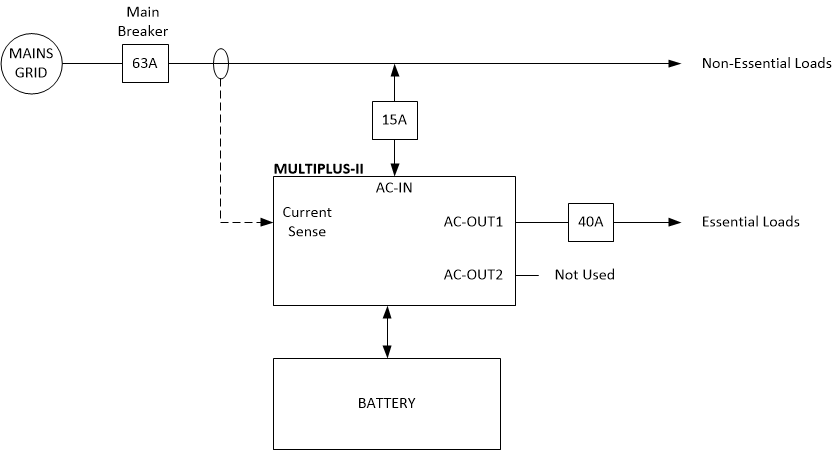
This is true if one uses the transfer switch in the Multiplus-II, however one does not need to do this. You can always use the alternative method shown below 😉 In this case the Non-Essential loads are not limited by the 15A breaker and you can still make use of the full 5kW to Essential loads if needed.
-
Hi OCD75 The BAT terminal on the Shunt should be the only thing connected to the Battery Negative. All other "negative" connections (loads, chargers etc.) must be connected to the "Load" side of the Shunt. If you don't do this, the BMV712 shunt cannot properly measure current into/out-of the battery - and will then give an erroneous reading for the State of Charge.
-
This reminds me - do check that your probes are not plugged into the mA/A/current-measuring input on the Multimeter! This will do a bit more damage than leaving a black mark...! 🤯
-
This may be useful... https://lamphq.com/led-lights-glow/
-
Hi Stoic There is typically 230Vac between each phase and Neutral, but about 400Vac between any two phases. Normal household appliances connect between one phase and Neutral (i.e. never between phase 1 and phase 2) - so will not be exposed to 400Vac. The simplest way to visualise this is by considering the following diagram. This shows the 3 phases plotted relative to Neutral - Neutral is the "0V" line. Each phase is at most +1.0 or -1.0 relative to the 0V reference. The difference between phase 1 and phase 2 can be much higher - i.e. 1.5 or -1.5. If one does the maths for sine waves that are 120 Degrees out of phase, it turns out that the voltage between phases is 230Vrms x 1.732 = 398Vrms.
-
Note that your change-over switch will switch the supply to your houses from L1 (L3 for second house) to the Inverter which is synchronised to L2. There is typically 400Vac between L1, L2 and L3 so one should not rapidly switch over - otherwise you may damage some equipment (e.g. motors) and burn the changeover switch contacts. You will need to switch to the OFF position for a few seconds before connecting to the opposite position.
-
Hi Gerlach, I bought some of the glands and the sleeving from Rubicon, but they are quite expensive. AC-DC sometimes have stock of the 25mm and 20mm glands.
-
See my bus-bar solution, with BMV shunt and Fuses. Uses a Gewiss box (GW44208) and a base-plate split into two sections.


