Achmat
Members
-
Joined
-
Last visited
Everything posted by Achmat
-
The second option. This was from feedback from other users. I've asked sunsynk directly for an answer to this but they have not responded officially. I have the 8kw sunsynk and only ever pushed it to 9kw and it used from pv and batteries to 8kw and the balance was taken from the grid.
-
1. Yes. Pass through is 35A combined and not in addition. 2. It will blend. It will take whatever pv and battery can provide for the essential loads then only topup the difference from the grid. 3. Correct again. You could even put your geyser on the second aux output of the inverter so you could power it during load shedding if you want. 4. See 3. Yes you can. @Tariqis using the smart load on his 2kw geyser and it works a charm. It was created for this. Excess pv to go to hot water. Geyserwise and connecting it to the aux would give you the best of both in that if its a very sunny day and there is load shedding, you could still send excess pv to the geyser element.
-
In the battery settings you need to untick grid charge. Not sure if comms is working with the freedom batteries. On the system mode page you need to enable user timer. Then you can set the minimum SOC percentage and set to the start and end times. I would change the percentages to 40% and then specify the times.
-
I have all four of their apps working, solarman, Solarman Smart, Solarman Business and Solarman Pro. I think when I setup my account I selected installer. On the Solarman Pro app you select devise then select the inverter. Swipe to the right to get the history tab and then you can swipe the right to get to the parameter you looking. I don't use the the Pro app as you can only select one parameter at a time to display whereas the smart and business apps allow for multiple parameter selection.


-
Mine is in an open plan kitchen. It can be loud but the fans only come on with a continuous load of more than 2kw. During the day the fans are on most times from 10am to 4pm in summer. It's getting cooler now so the fans are not running continuously. We have become use to it and hearing the fans go on gives an assurance that its working. Today's temperature graph. Fans turns on at 50° and runs for about to minutes then switched off at 45°.

-
I use NMOT figures STC is under ideaal test conditions. As an example, my 305w panels is rated at 36.8V Voc NMOT. I have 11 panels and it should get to 404V. I have never seen my string go higher than 370V. You should be fine with 9 panels. I would however start with eight and monitor the voltage before adding the month one. I started with 7 panels per string before increasing it to 11 panels.
-
Yes. Not even from pv. The grid connection is closed during grid failure to prevent feed back to the street or shocking anyone working on the line. It's one of the safety requirements.
-
How load is this genny and what's the fuel consumption like?
-
During load shedding, none of of the grid side loads will get any power.
-
@Tariq is using the smart load for his geyser and it works.
-
I don't think any inverter offers something like that. Only thing I've seen is where a very small panel is connected and then extrapolating the data for the size of the main solar array. You looking for something that can measure current solar irradiation to compare if your pv array has any spare capacity that's going to waste.
-
If CT value is negative it is the wrong way around. You could swap the CT wires in the inverter or turn the CT around.
-
If you set the inverter to "zero to home", any excess pv not going to the essential load should then be going to the non essential loads. You can then decide if you can move more of your loads to the essential side.
-
I think both the Deye and sunsynk only logs consumption going through the inverter and not the data from the CT coil. The CT coil is only used to make sure there is no feedback to grid. Consumption would loads on the inverter + aux output + any current going back to the non essential loads to zero the meter. I have my whole house on the inverter so don't have this issue.
-
You should also install a transfer switch before the inverter. Basically the transfer switch has 3 positions. Grid, off and inverter. When the inverter needs to be bypassed for whatever reason, you switch it from inverter to the off position and then to the grid position. Grid -> transfer switch -> light circut -> off -> inverter -> light circut
-
CoCT added the flat connection charge to post paid last year year. Not sure if prepaid customers are paying this yet. For CoCT it's ±R170. I really don't have an issue with this fixed grid availability network charge. I might have an issue if I was paying the R700 plus that CoJ customers are paying.
-
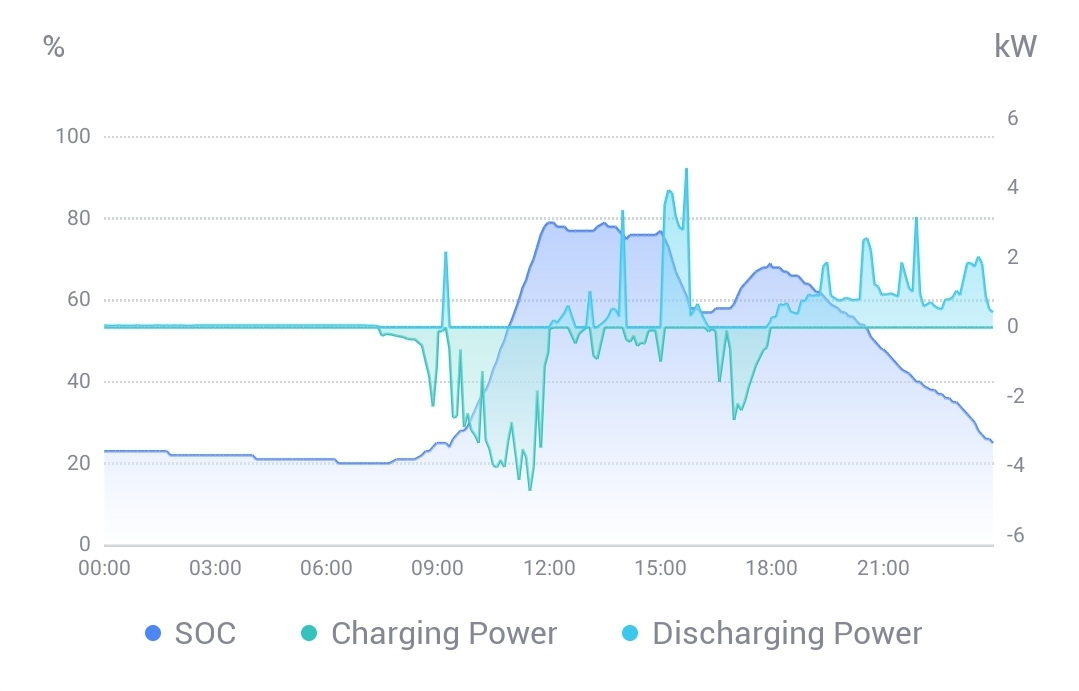
I don't think lithium is prone to any damage from discharge/charge cycling during the day. I leave the batteries to supplement the power needs on cloudy days. The grid is my backup only. My SOC and battery power from yesterday.

-
I don't think that's the case any longer. 5 000 cycles from a 3.5kWh pylontech battery equates to 17 500kWh. At R19k for the battery it works out to under R1.10/kWh. Last two days have not been very good for pv generation with batteries only charging to 70% SOC today and 50% SOC yesterday. I just increase the minimum SOC when Eskom announces load shedding.
-
You take a feed from the DB to the input of the inverter. Then you take the existing light circut and connect it the output of the inverter. Light circut will now receive power via the inverter using the existing wiring and DB circut. When there is no load shedding the electricity will flow from the grid through the inverter to the circut. During load shedding, the inverter will automatically provide power to the light circut from the batteries or solar panels. This is a very basic explanation of how it works and I hope that you have an electrician to do this as this is how most on grid backup inverters are connected.
-
Another reason why I use a card for purchases where possible and institute a charge back with your bank. It does however take time. Did a charge back for flights with lastminute.com. They disputed the request by my bank and then I asked my bank to appeal which was successful and received the full charge back refund after 4 months from submitting the charge back request. Not sure if you paid using a card and if you could pursue the charge back option with your bank.
-
That does help somewhat. Is this fully of grid with no grid connection available? Or is the grid still there in case of bad solar days? The sunsynk 5kw can work for this application. I'm sure the axpert can as well but the sunsynk has really taken the SA market by storm over the last year and for good reason. Its an excellent product. If its fully off grid with no grid connection available I would go with the 8kw sunsynk inverter. 3 x hubble Am2 5.5kw batteries. Two will be sufficient but what if there are a few days of very little solar available to charge them fully for night time use. I used an efergy energy monitor to get a better idea of what my usage was. Its not 100% accurate but its a good indication of my daily usage patterns and what my peak power requirements were.
-
What is you load you going to run from this. Your daily usage is not an indication of what size inverter you need. You could run 3 x 4kw geysers an hour per day only to give you usage of 12kwh for the day. I have the sunsynk 8kw inverter but the 5kw might be fine for you depending on your load. I l can't comment on Narada but the hubble Am2 5.5kw batteries seems to be good value for money. I have pylontechs though. Panels I would suggest the biggest you can go for and mono panels are better than poly which I think those Canadian panels are.
-
I don't think you can do it on the website. You will need to use one of the Solarman apps on android or iOS.
-
NMOT. I have 11 x 305w panels and only get a max of 360v in the morning then drops to 330v as the panels heat up.
-
PV voltage is 100v to 500v. MPPT voltage range is 125v to 425v. 10 panels would be too much and exceed the MPPT range so it will shut down above 425v and could blow up at 500v.